
Content Level: Overview / Implementation considerations
Principles and Suitability
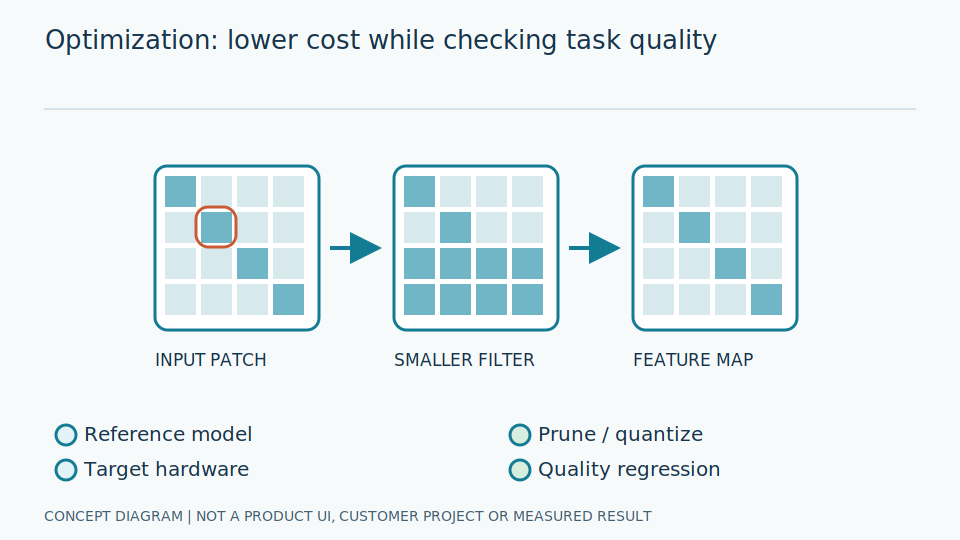
Quantization reduces numerical precision in weights or activations, while pruning removes computation considered less important. Either can change accuracy, and neither necessarily speeds up a runtime without hardware support for the resulting form. A smaller artifact or fewer apparent operations therefore needs task and device verification before it can be described as a useful improvement.
Making a model smaller or reducing computation is a trade-off, not a cost-free benefit. Quantization represents numbers less finely; activations are intermediate layer values. Pruning removes selected parts under a chosen rule, but a smaller file does not always make the operational path faster. Check whether the processor actually uses that form and how the answers relevant to the task change.
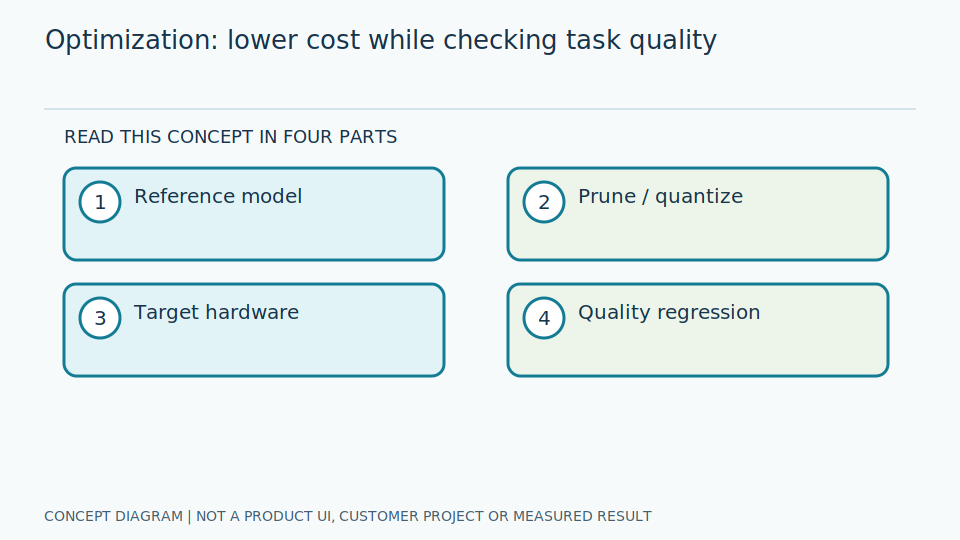
Engineers define a baseline with the same inputs, runtime, and hardware. In quantization, calibration data estimates numerical ranges; it does not calibrate the gauge. Select representative training data within scope, not test data. Inspect out-of-range weights and activations as well as downstream coordinate transformations, so measured differences reflect optimization rather than simultaneous unrelated changes across several parts of the system.
Scroll the diagram horizontally to inspect all details.
Illustrative Industrial Example
Design example: try INT8 for a gauge detector using calibration data covering real illumination, then inspect whether small gauges or thin needles disappear after changing precision. This is an experiment, not a statement that the product uses that representation or has achieved a verified improvement in memory, speed, or reading accuracy.
INT8 represents integers using eight bits under a defined conversion. Suppose large dials remain detectable but small gauges are missed after conversion. Aggregate scores may change little because large gauges dominate. Examine groups the user genuinely needs and whether failures have a review path. A reduced file size alone is not an adequate reason to accept the revised model.
Engineers run identical images through original and optimized versions, comparing raw output, filtered boxes, and downstream values. If small score changes cross a threshold, review thresholds on validation data rather than selecting them on test data. Verify whether the runtime uses the intended numerical form or falls back for some operations, then measure the full preparation path on target hardware.
Study and Trial Workflow
- 1 Establish a baseline with fixed weights and runtime.
- 2 Change one factor at a time, using training data rather than test data for calibration.
- 3 Compare optimized artifacts on a holdout and the target equipment.
Evaluation and Metric Definitions
Record before-and-after task metrics, p95 latency, peak memory, and power under identical inputs, including group-level results. Do not offer numerical improvement claims before conducting experiments. File size and technique names describe artifacts and methods, not measured operational outcomes, so reported changes need evidence from the actual evaluated configuration.
Task metrics must reflect the model's role and downstream result, such as boxes suitable for reading or angle error. Predefine acceptable degradation and report image and group counts. Power comparisons require a stated equipment boundary and workload. Neither file size nor operation counts substitute for measured energy, and untested savings must not be presented as established results of the optimization.
Engineers measure sustained work with identical data and input-output steps, inspecting lighting and target-size groups, including unreadable cases. Test methods separately before combining them to identify effects. Preserve original and optimized ready-to-use artifacts with hashes and settings for repetition and rollback. An experimental version's result must not stand in for a different file or version installed on the target device.
Limitations and Failure Cases
Unstructured sparsity may not reduce time in common runtimes, and quantization error can affect certain output ranges much more than the average. Evaluation must therefore inspect the device's execution behavior and task-specific failures, rather than assume that more zero values or a lower-precision representation automatically produces a faster and adequately accurate reader.
Unstructured sparsity means scattered empty or zero values, which may not reduce computations in the structure used by the device. Structured removal can also affect task-specific capability. Check compatibility and real outcomes rather than assuming zeros accelerate execution. Numerical-representation errors may have substantial effects when scores are near thresholds or targets contain very little detail, even if overall changes look modest.
Resource optimization requires a retained original and verification after export. If groups deteriorate, limit scope or choose another method rather than dismissing differences without examining consequences. Runtime documentation guides experiments, not universal hardware support or claims that a product already uses INT8 or pruning. Acceptance must rely on actual files and traceable tests, not the technique's name as an assurance.
Practical Checklist
- Does the device support the selected precision?
- Is an acceptable accuracy-drop criterion defined?
- Is the original model retained for rollback?