
Content Level: Overview / Implementation considerations
Principles and Suitability
OT security must preserve people's safety and process continuity alongside confidentiality, integrity, and availability. Adding AI cameras or gateways creates new access boundaries, requiring responsibilities to be divided among plant owners, integrators, and providers.
Confidentiality limits disclosure, integrity preserves correct data and settings, and availability means readiness according to defined requirements. Industrial systems also need physical safety and operational continuity. Cameras and gateways add accounts, software, and data paths requiring maintenance. Read-only collection is not risk-free: incorrect settings or stale data can affect interpretation and downstream decisions.
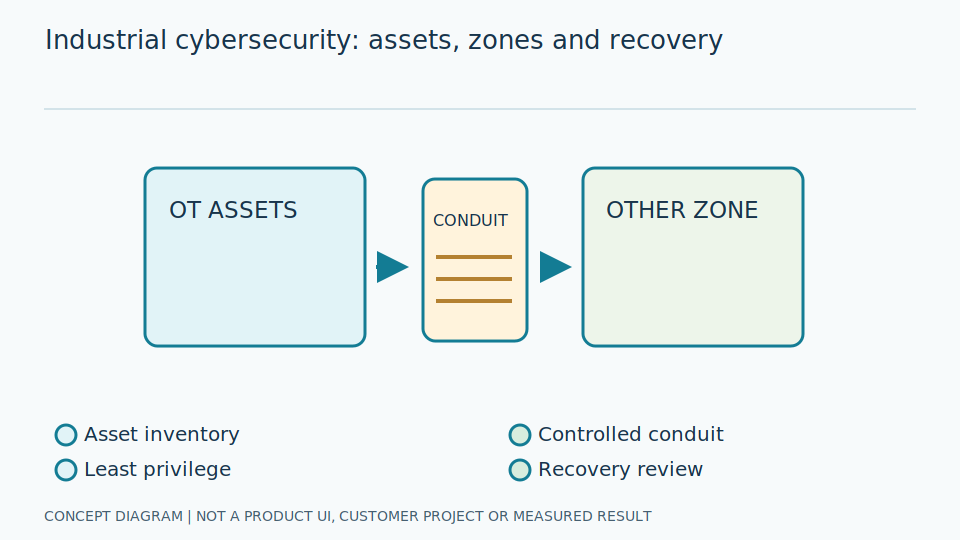
Engineers maintain an asset inventory of equipment and software, with data flows and owners for each boundary. Segmentation divides networks according to need; least privilege gives only permissions required for the task. Plan credential management, updates, and backups for approved windows. General guidance is not an instruction to reconfigure operating OT without first assessing effects and recovery with the responsible personnel.
Scroll the diagram horizontally to inspect all details.
Illustrative Industrial Example
Design example: a gateway reads within a segmented network, sends only to approved destinations, and checks model-artifact integrity. Permanent remote access must not be left without an accountable owner.
Suppose a reader needs a model update. Establish file provenance, approval, and compatible settings rather than treating a plausible filename as evidence. Remote access needs a defined owner, duration, and permissions under the plan; convenience in troubleshooting is not a reason for permanent access. When readings are wrong, check source quality and component integrity. Network encryption alone does not make the numbers trustworthy.
Engineers check configurations and permissions in approved environments and back up matching models, configurations, and calibration. Test restoration through paths that do not affect physical machinery before planned release windows. Incident response must identify who receives reports and decides actions. Do not conduct intrusive scanning or experiments on operating systems without authorization and risk controls.
Scroll the diagram horizontally to inspect all details.
Study and Trial Workflow
- 1 Inventory assets and data flows, including cameras, models, and update systems.
- 2 Define segmentation, least privilege, and credential management.
- 3 Plan patches, backups, and incident response around approved shutdown windows.
Evaluation and Metric Definitions
Inspect configurations and permissions, test restoration in approved environments, and review logs for the use cases. Avoid intrusive testing of operating OT without a risk-controlled plan.
Checks must connect scope with evidence, such as accounts in use, necessary permissions, and change history. The number of protective tools is not a security score. Confirm that recovery restores compatible components and that data retains appropriate units and timestamps. Logs aid review but must not collect secrets or unnecessary personal information. Assign monitoring responsibility: enabling logging alone does not demonstrate complete incident handling.
Engineers review plans jointly with OT owners and integrators, identifying checks possible in simulation and those requiring approved windows. Preserve configuration and recovery findings with their limitations instead of extending one environment's results to every factory. NIST SP 800-82 and AI RMF guide risk design and responsibilities. They are not certificates or evidence of unverified product testing or security services.
Limitations and Failure Cases
Transport encryption does not prevent incorrect model or sensor readings. Citing NIST does not establish testing services or certification.
Transport correctness and measurement correctness need separate checks. Protected transmissions can still carry values derived from blurred images or wrong unit mappings. Legacy systems may have update and resource constraints, requiring safeguards compatible with operation. Do not immediately apply generic IT advice by changing settings or disabling machinery-related services without responsible impact assessment and recovery planning.
Segmentation and access controls limit some paths but add maintenance work. Keep inventories and responsibilities current when equipment changes; no single measure guarantees protection against every risk. This example offers design considerations for OT and AI, not vulnerability-assessment services or product certification. It does not propose attacks or experiments that might stop a process. Always follow the scope and authorization of responsible personnel.
Practical Checklist
- Is remote access approved by a responsible owner?
- Are model provenance and hashes checked?
- Are configurations and calibration backed up, with recovery rehearsed?