
Content Level: Overview / Implementation considerations
Principles and Suitability
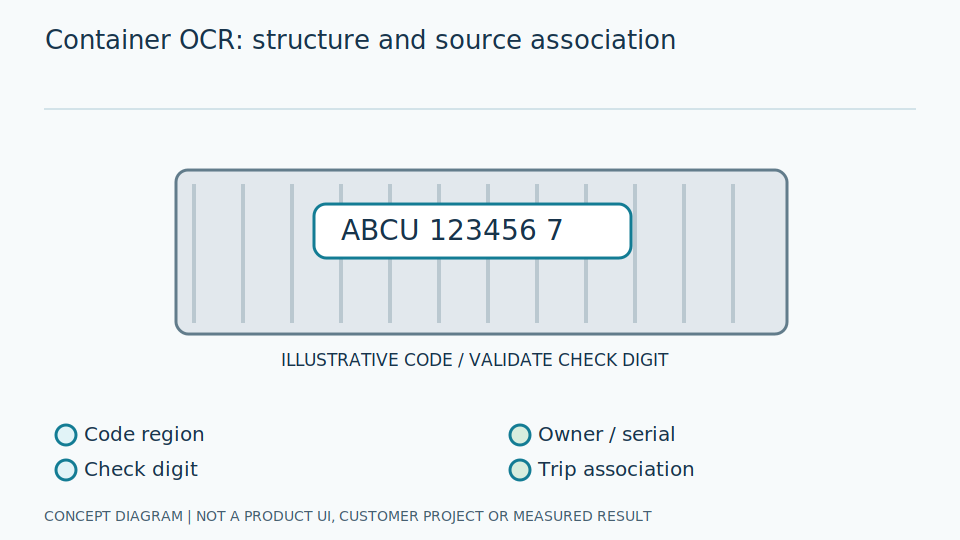
An ISO 6346 container code contains a three-letter owner code, an equipment category identifier, a six-digit serial number, and a final check digit. The check digit tests string consistency; it does not establish that the camera read the intended container or that the code actually exists.
The components of a container code serve different purposes. The owner code identifies the ownership component within the code system, while the equipment category letter differs from the serial digits. The check digit is calculated from preceding characters to detect some kinds of error, not to confirm container identity. Reading must preserve order in vertical or multiline text and must not mix nearby size or type markings into the identification code.
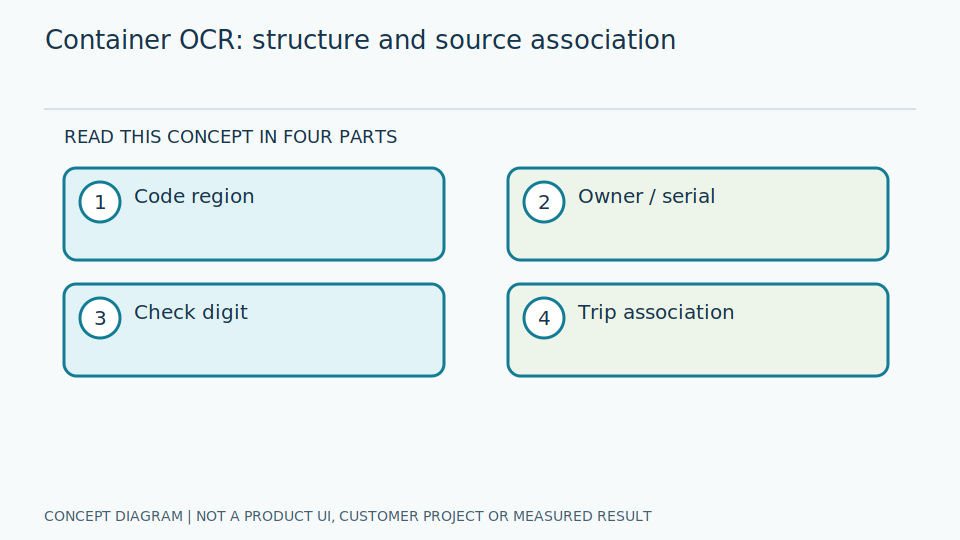
Engineers separate text localization, ordering, and structural validation, retaining raw OCR before formatting. When using ISO 6346 guidance, check definitions against available references and describe its role as code-validation design, not product certification. Distinguish correct reading against the image, passing the check digit, and matching an event to the physical container. The last of these needs additional timing and contextual evidence.
Scroll the diagram horizontally to inspect all details.
Illustrative Industrial Example
Design example: read a code on a container side, order its lines, and check the final digit. If validation fails, review the image rather than changing characters until the digit passes and treating the result as automatically correct.
Suppose faded old markings remain beside a freshly painted code. Recognition might combine characters from different sets into a plausible string. Inspect the text regions and continuity rather than choosing whichever characters pass validation. A valid check digit does not establish that the container in a work list is the one in view. Reviewers should see the image, gate event, and provenance of the proposed association.
Engineers test labeled multiline and vertical text, including size and type markings that are not identification. Inspect ordering and look-alike characters without altering the original evidence. When validation fails, send review status, raw text, and the reason rather than silently replacing it with a similar code from a work list. Gate-event association needs unambiguous identifiers and reference times so adjacent containers or old queued images cannot be confused.
Study and Trial Workflow
- 1 Locate text and define horizontal or vertical reading order.
- 2 Check the structure for the code type and distinguish size or type codes from identification.
- 3 Associate readings with gate events using timestamps and evidence images.
Evaluation and Metric Definitions
Report exact code match per event, no-read, and the proportion of check-digit failures. Separate OCR mistakes from incorrect associations between containers and work records.
Exact code match compares the complete code with confirmed ground truth. The number of correctly read characters is not a substitute: one wrong character can identify another container. Count defined events, including cases with no located text, rather than only strings passing validation. Report both failed checks and codes that pass but remain wrong against the image. This reveals the consistency check's limits instead of allowing format scores to conceal actual errors.
Engineers evaluate localization, reading, ordering, and event association separately using reference images with timestamps. Include several codes in one scene and unreadable images within scope. Do not invent an actual container code and present it as a successful result without checking it. BIC documentation explains structure and check digits; it is not evidence of authenticity or product support. Important decisions need an additional confirmation route suited to the task.
Limitations and Failure Cases
Rust, repairs, obstructions, and repeated old markings can confuse recognition. A check digit does not prevent forged codes and may miss some reading errors.
The digit catches certain mistakes but does not prove the text appears on the intended container. Multiple character changes may still pass, and code rules cannot restore information missing from the image. Preserve incomplete status rather than manufacturing an answer. Matching text against expected records can help reviewers find candidates, but candidates must be identified as suggestions, not camera-confirmed readings, and must not conceal conflicting raw OCR.
Combining images helps some conditions but risks mixing different sides or different containers, while increasing latency and evidence-management work. Set access and retention according to the task; container images are not necessarily free of confidential information. This example describes evaluating code reading, not product accuracy, capacity, or current container-registration services. Using a standard as a design rule does not certify the system against that standard.
Practical Checklist
- Are all required positions read in the correct order?
- Are size and type markings excluded from identification?
- Are raw OCR and review reasons retained before corrections?