
Content Level: Overview / Implementation considerations
Principles and Suitability
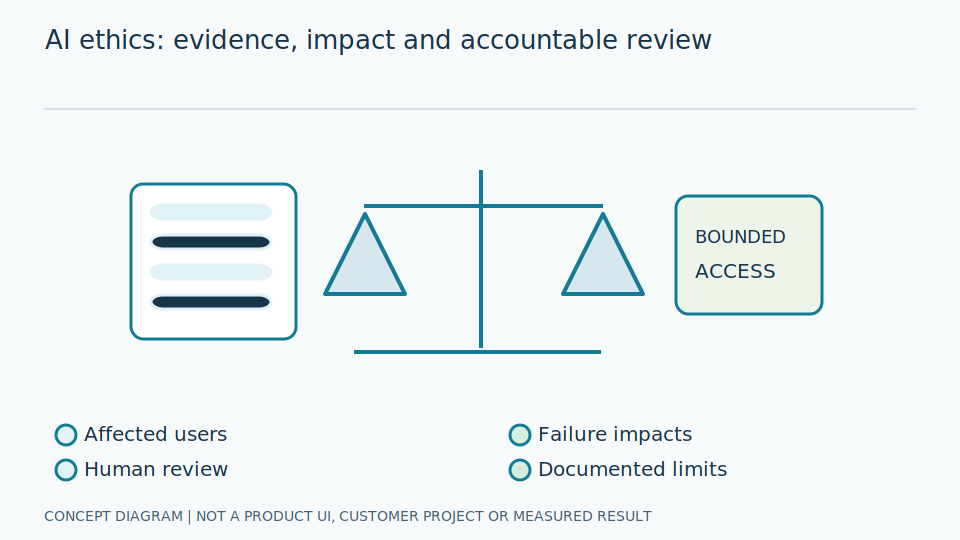
AI ethics considers harm, fairness, transparency, and accountability beyond average accuracy. Production-measurement systems can affect people when data is reused to assess work outside its original purpose. Ethical assessment therefore asks both what a system can do and whether a proposed use is appropriate, with attention to the people who bear consequences when observations, interpretations, or subsequent decisions are wrong.
Transparency should make boundaries and review routes understandable; accountability needs someone able to decide and correct actual errors. If camera data becomes evidence about workers, lighting or equipment faults can become inappropriate accusations. Define prohibited uses from the outset. A process-reading result should not acquire a different person-evaluation meaning simply because it is available in a database or appears numerically precise to a downstream user.
Engineers define relevant operating-condition groups and monitor errors without unnecessary sensitive-data collection. Meaningful human oversight requires evidence, time, and authority to correct outcomes, not merely acceptance of automated suggestions. Record objections and corrections and assign risk ownership. Risk-management frameworks help establish questions and roles but cannot automatically make person-affecting decisions fair; their application requires contextual judgment about purposes, rights, and the possible harm of errors.
Scroll the diagram horizontally to inspect all details.
Illustrative Industrial Example
Design example: gauge-camera readings should not become employee-performance measurements without agreement and impact assessment. Different lighting between shifts may expose some groups to more errors. The instrument-reading task and the proposed evaluation of people are distinct uses, and the latter must not be inferred merely from the availability of timestamps, unreadable-image counts, or automated results associated with a working period.
Suppose one shift has more no-read images because of illumination. Interpreting that count as poorer work performance skips the actual cause. Inspect imaging and equipment first. Affected people need evidence and a review channel, rather than having model scores turned into unsupported personal conclusions. Changing collection purposes from process observation to worker monitoring requires renewed assessment, not silent reuse under the original equipment-reading justification.
Engineers inspect results by lighting condition and camera source, with role-based data access. If someone disputes timing, trace images and timestamps rather than insist that a stored record is automatically correct. Record corrections and suitable notification. Use nonidentifying test data to exercise objections and confirm that the route works and the accountable person can genuinely change an erroneous outcome, not merely acknowledge that a complaint was received.
Study and Trial Workflow
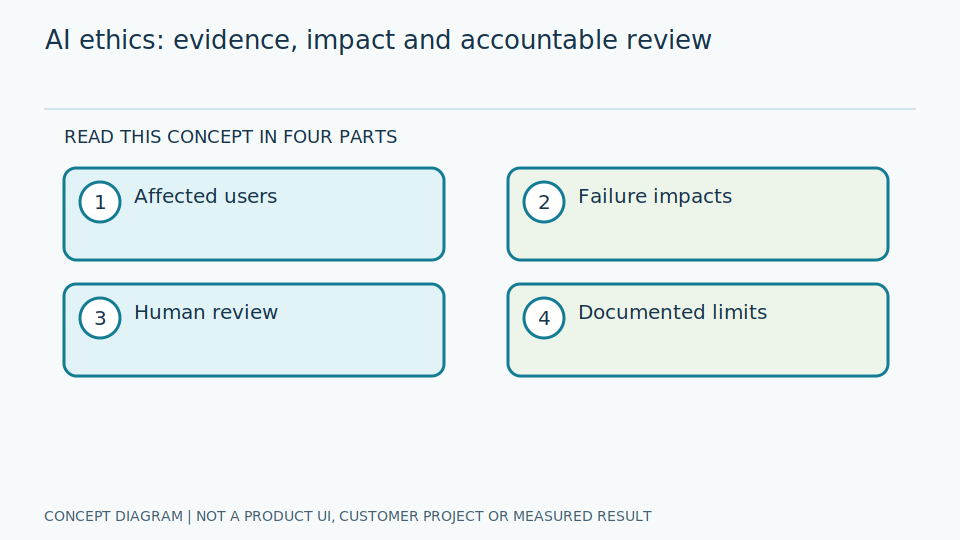
- 1 Identify affected people and misuse outside the intended purpose.
- 2 Assess errors by operating condition and provide result-dispute routes.
- 3 Assign risk owners, approvers, and conditions for stopping use.
Evaluation and Metric Definitions
Monitor differences in errors and review burden across appropriate groups without collecting additional sensitive information without justification. Verify that complaints can actually change decisions. Evaluation should address the functioning of oversight and the consequences of decisions, not simply whether a complaint form exists or whether aggregate accuracy appears acceptable across an entire population of images and operating conditions.
Interpret differences alongside data conditions and sample counts, avoiding causal conclusions about groups from one error proportion. Examine reinspection burden, correction time, and downstream consequences. Equal group scores do not establish fairness across every dimension: purposes, rights, and task-specific harms still require assessment. A numerical comparison is one source of evidence, not a replacement for understanding whether the proposed use and remedy are appropriate.
Engineers test reviewer handoff and appeals for understandable evidence and real authority to stop consequential outcomes. Check out-of-purpose access through roles and access histories, with incident ownership. NIST and personal-data documents inform governance design rather than certify ethics. Context experts and affected people should participate in defining suitable rules, so technical convenience does not become the sole basis for deciding what uses and impacts are acceptable.
Limitations and Failure Cases
No single metric certifies fairness in every context. Asking a person to confirm without evidence is not meaningful oversight. A reviewer can reproduce an automated mistake when the interface offers insufficient information, time, or authority, so the existence of a human confirmation step does not establish that a decision has received an independent, informed, and effective assessment of its consequences.
People may trust wrong automatic results because machines appear neutral. Show uncertainty and limitations rather than using confident wording or colors to pressure acceptance. Extra data collected to measure differences can create new risks, requiring clear necessity and permissions. The desire for fairness metrics does not justify gathering every category of sensitive information or sending it externally without an appropriate purpose and assessment of the associated privacy implications.
Governance adds time and workload but matters when impacts are substantial. Resource reviewers and define stopping boundaries; manuals or complaint routes do not end the problem by themselves. This guide describes what requires assessment, not existing product dispute mechanisms or completed ethics review. Image readings must not decide personal performance or responsibility without suitable evidence and process, and correction routes need ongoing ownership rather than merely an initial policy statement.
Practical Checklist
- Is the intended purpose of using the data clearly communicated?
- Can people affected by the results request a review?
- Are prohibited uses and accountable owners defined?