
Content Level: Overview / Integration concept
Principles and Suitability
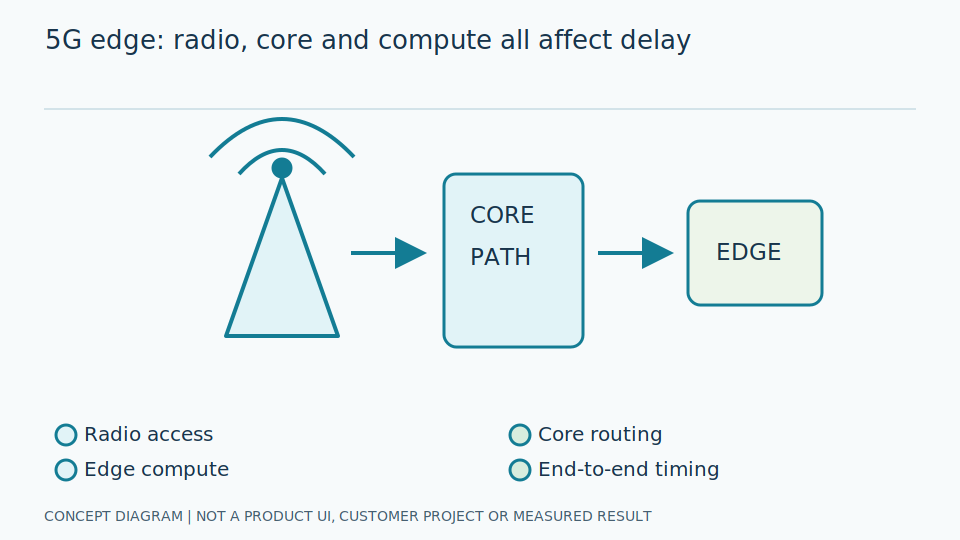
5G is a connectivity option, whereas edge describes the processing location. They need not be paired. Total latency depends on radio access, backhaul, core networks, queues, and applications, not just a radio timing figure in documentation.
General readers should separate the network transporting data from the computer processing it. A 5G connection does not mean computation is nearby, and edge equipment can use wired connections. Backhaul connects the access segment to other network portions; the core network is the associated central system. Examine where images travel and when results return. Do not select connectivity solely by network generation or peak transfer figures measured under different conditions.
Engineers derive latency and bandwidth budgets from image size, frequency, device count, and mobility requirements. Public and private 5G have different management and access boundaries requiring assessment against actual services. Handover changes connections between service points and can affect timing. Survey routes and expected load. General coverage maps do not establish identical performance at every installation point.
Scroll the diagram horizontally to inspect all details.
Illustrative Industrial Example
Conceptual example: a camera on a moving vehicle may need wireless connectivity, while a fixed gauge may be adequately served by simpler Ethernet or Wi-Fi. Compare actual conditions before selecting a network.
Suppose fixed cameras operate where cabling is feasible. A new network may add no necessary value while adding accounts, equipment, and maintenance. Moving cameras require route checks for metal and wall obstructions; the name 5G does not guarantee signal everywhere. Missing images require insufficient-data status and approved behavior, not stale readings or guessed images that merely keep a screen looking continuous.
Engineers compare Ethernet, Wi-Fi, and 5G under the same loads in tests that do not disrupt operations. Check end-to-end data age and retries after signal recovery with network owners. For mobility, use safe data-based or simulated routes rather than risky driving to induce signal loss. Separate network selection from control loops requiring their own safety and timing specifications.
Study and Trial Workflow
- 1 Prepare latency and bandwidth budgets and survey route coverage.
- 2 Compare Ethernet, Wi-Fi, and public or private 5G, including costs and maintenance.
- 3 Test handover, high loads, and operation during signal loss.
Evaluation and Metric Definitions
Measure end-to-end p95 latency, jitter, packet loss, and availability at the actual location, alongside costs per device. Peak data rates are not guaranteed throughput.
Jitter is variation in delivery time; packet loss means some transmitted information is missing. Examine effects on images and readings, not just network tests. Define availability in terms of receiving usable data, with test counts and periods. A maximum transfer rate under one condition is not simultaneous throughput for every camera. The p95 figure is neither a maximum nor assurance that every event meets its deadline.
Engineers measure installed routes within approved scope under planned normal and high loads. Check that queues after outages do not make old frames look fresh, and account for clock errors when timing across computers. Include equipment, connectivity, and maintenance costs without inventing unmeasured savings. 3GPP documentation explains system design, not on-site service assurance or current product 5G support.
Scroll the diagram horizontally to inspect all details.
Limitations and Failure Cases
Metal and enclosed areas alter signals. Edge processing does not fix radio outages, and 5G does not automatically provide deterministic control or safety.
An outage is a period when the communication path is unavailable. Local reading may continue while central transmission cannot; users need this distinction. Deterministic control needs verifiable timing requirements across the whole path. A radio latency figure cannot guarantee control commands. Moving equipment or changing surroundings can alter coverage, requiring review rather than reliance on one initial survey throughout service life.
Wireless connectivity adds flexibility in some tasks but also variability and access-management work. Wiring may better suit fixed points. Choose from requirements and comparative results rather than assuming newer networks are always faster or safer. This article describes edge connectivity concepts, not current product networks or service quality. Communication standards are not certification or safety assurance for a control system.
Practical Checklist
- Does the task actually require mobility?
- Is coverage supported by a site survey rather than a general map?
- Are fallback behavior and network ownership defined?