
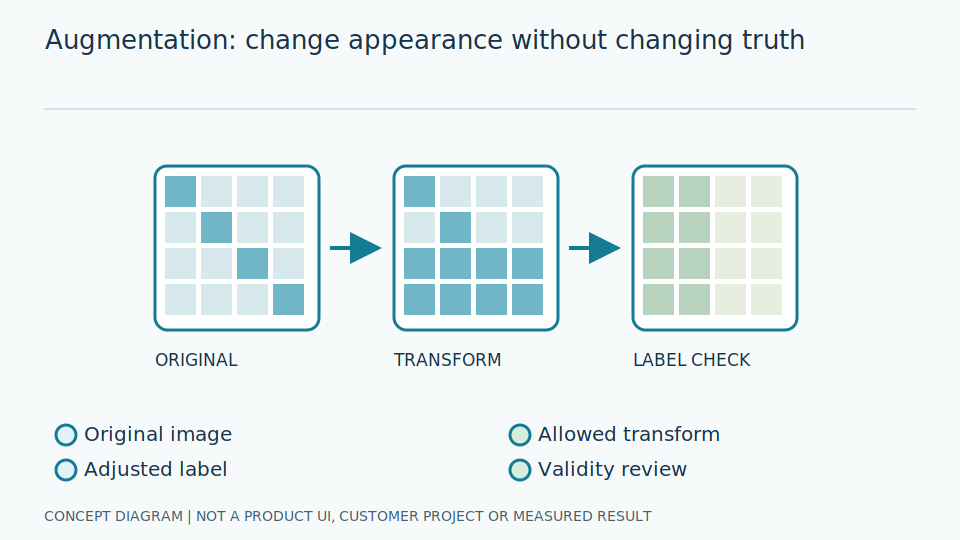
Content Level: Overview / Implementation considerations
Principles and Suitability
Augmentation creates variation that should preserve answers, such as lighting changes or noise within realistic ranges. Geometric transformations must update boxes, masks, and keypoints consistently, and may also change measured values. Preserving a class name is not sufficient evidence that every kind of answer remains valid after an image has been altered.
Variation can stop a system relying on one image appearance, for example by including darker or noisier images. But ask whether the original answer remains visible afterward. Noise is disturbance in image values; a transformation changes an image according to a rule. If alteration removes the needle tip, an annotation saying the gauge is readable may no longer be correct even though its object class is unchanged.
Engineers distinguish changes preserving object type, changes requiring coordinate conversion, and changes affecting the physical reading. Rotating the entire dial and needle differs from rotating only the needle. Cropping alters visibility and can remove the unit. Inspect transformed images together with boxes, masks, and landmarks, rather than training with a correctly transformed image and answers stranded in the original coordinate system.
Scroll the diagram horizontally to inspect all details.
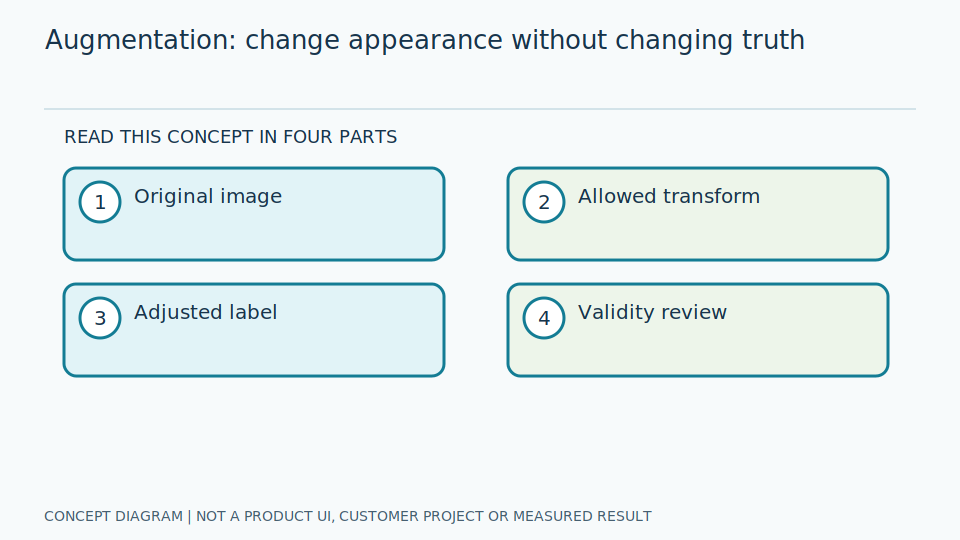
Illustrative Industrial Example
Design example: adjusting dial-image brightness may help train a detector, but rotating only the needle changes pressure. Mirroring text creates unnatural numerals. Existing labels therefore need consideration rather than automatic reuse. A transformation suitable for locating a dial is not necessarily suitable for reading its scale, digits, and unit correctly.
Suppose darker images are added to help detect a dial boundary under low light. That may preserve box annotations, but the reader still needs visible scale marks and units. If darkness removes those details, mark the image unreadable for the reading task. Choose lighting ranges from appropriately collected images rather than creating extreme effects unrelated to conditions the system could realistically encounter in operation.
Engineers use a small verification collection with known landmarks to check rotation, resizing, and cropping, confirming that points still refer to the same features. For blur, inspect thin needles and decimal points particularly carefully. Ablation means adding or removing one component to examine its effect. Compare each augmentation on the same real set, so simultaneous adjustments do not hide which change helps or harms.
Study and Trial Workflow
- 1 Separate transformations preserving class from those changing measured values.
- 2 Derive lighting, blur, and perspective ranges from site images.
- 3 Augment training data only, and compare individual transformation types through ablation.
Evaluation and Metric Definitions
Compare results on unaltered real images, separating low-light and small-digit groups. Check whether increased robustness sacrifices needle detail or decimal points. Detection results alone cannot demonstrate that a transformation improves measurement: the downstream reading and unreadable-image status must also be evaluated against the original task and its required visual information.
Test data should represent real images within the declared scope, not be altered to resemble training transformations and inflate results. Inspect both targeted groups and ordinary images: improved blur tolerance may worsen separation of neighboring lines. Report unreadable-image counts and downstream error, not just box correctness. This keeps conclusions about measurement tied to the visibility and interpretation of the information actually being read.
Engineers lock splits and decision criteria before comparisons, recording training rules, parameter ranges, and randomization. Periodically inspect transformed annotations as image overlays and measure error by target type. If improvement appears only on altered images and not real ones, reconsider whether simulated variation matches the task. Do not keep adding transformed images without investigating, or mix their effects with simultaneous changes to real data.
Limitations and Failure Cases
Extreme alterations can create conditions that never occur. Augmentation does not replace missing examples from new cameras or gauge designs. Its usefulness depends on whether the simulated variation corresponds to plausible operation and preserves the information required for the answer, rather than simply increasing the number of training images.
Rules useful for classification may be unsuitable for reading digits: mirroring distorts characters, while stretching changes needle angles. Choose transformations for the downstream question and state assumptions. Alteration does not necessarily supply knowledge of materials or scale patterns absent from the source collection. Collect missing real conditions appropriately instead of expecting image-changing rules to fill every gap in the available data.
Combining transformations expands possible variation but increases verification and reproducibility work. If answers do not change with images, models learn contradictions without their causes. Check coordinate reversals and identify invalid cases. Augmentation is development guidance, not a guarantee of accuracy or a statement of a product's currently supported data. Do not arrange hazardous physical experiments merely to produce abnormal images resembling an augmentation rule.
Practical Checklist
- Are labels transformed along with images?
- Does image cropping retain the unit required for reading?
- Does the test set retain real-image conditions?