
Principles and Suitable Contexts
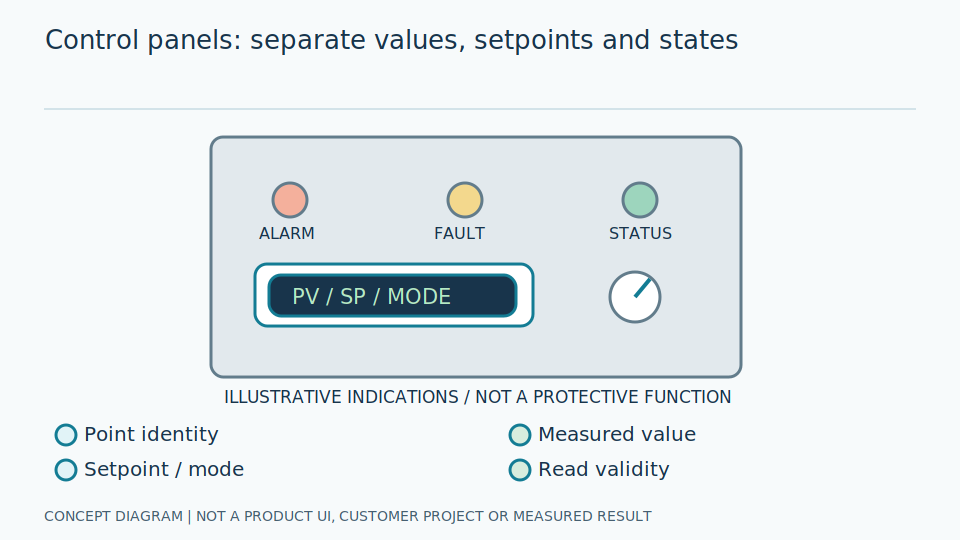
A panel may show a process value (PV), setpoint (SV) and mode indicators together. Reading a number without identifying its role can reverse its meaning. Image reading suits a fixed layout or a clearly identifiable current page. Observing the panel does not confer authority to control the machine.
The process value is the measurement received by the controller; the setpoint is its intended target. Their difference provides operating context, not immediate proof of failure: starting up or changing targets may involve a settling period. Interpret automatic or manual mode using the particular model's documentation. The same numerical difference may require a different explanation depending on which mode is active.
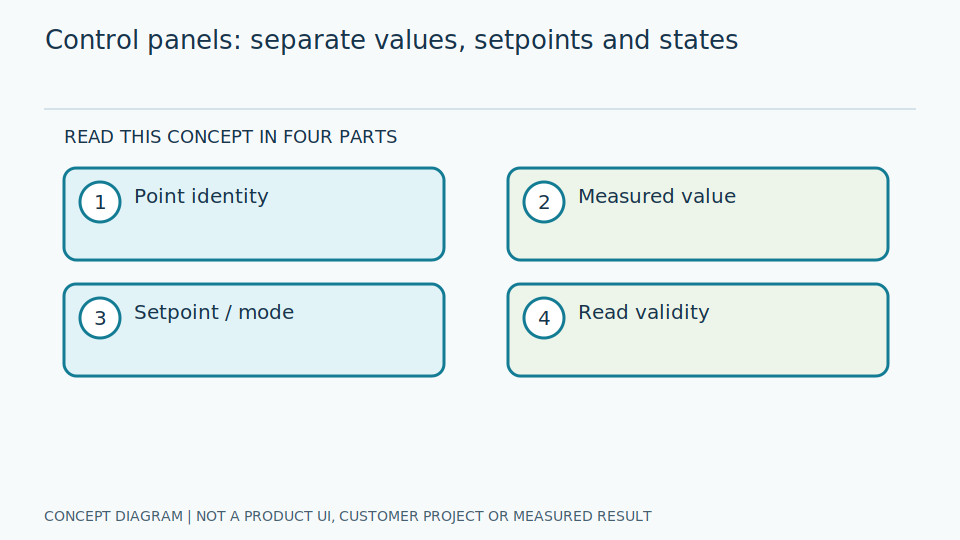
Each record should preserve value, value type, unit and displayed page. A region of interest, or ROI, limits the image area to read, but its meaning can change inside a menu. Confirm the page through labels or symbols, not digit colour alone. Correctly reading a setpoint does not prove that the command reached an actuator or that the process achieved the target.
Scroll the diagram horizontally to inspect all details.
Data and Preparation
Map display regions to their labels. Record operating, stopped and configuration modes. Collect examples of permitted menu pages without changing actual settings. Align capture times and equipment identifiers with operator records, and identify how a reading will be associated with the page visible at that time.
Build a page table specifying which values are readable and which pages should be rejected. Use normal-operation images or authorised reviews; do not step through menus on running equipment just to collect examples. Include enough of the equipment identity, units and mode lamps for interpretation, placing the camera where it cannot obstruct buttons or the operator's inspection of the panel.
Record capture and reading times because a display can lag its source signal. Retain page or layout changes when several models are involved. Decide whether to send only complete value sets or individual channels with separate quality flags. This choice must support users calculating PV-to-SV differences without unknowingly combining values from different moments or incompatible display states.
Failure Cases and Limitations
Menu changes or blinking during editing can cause a fixed image region to read the wrong kind of value. An illuminated mode indicator does not establish that an output is physically active. A frozen display may reflect a failed signal; use an unknown state when the current mode cannot be verified.
A plausible number may be a parameter identifier rather than a process measurement. Range checks alone cannot detect this contextual error. When the page is absent from the registry, suspend conversion and send evidence for human inspection. If retaining the previous value, label it as old; do not make a graph appear to contain continuous current measurements while the operator is viewing a menu.
PV-to-SV differences may arise from units, timing or signal-reception status. They should not automatically trigger setpoint changes through image processing. Keep observations for responsible personnel separate from control channels. The original controller must not depend on image results when camera or network failures occur, and panel images must not substitute for safety-system signals or emergency-stop circuits.
Evaluation Methods
Assess value-and-mode pairs rather than isolated numbers. Test page changes, blank displays and PV/SV swaps. Compare timestamps against authorised control records and report performance by page type. Correct digit recognition on the wrong page should count as a contextual error, not as a successful process reading.
Reference answers should identify process measurements, targets and menu text. Have a reviewer familiar with the panel map inspect images before seeing output. Check exchanged channel names even when both numbers are recognised correctly: swapping roles can reverse the user's interpretation of control behaviour. Include unfamiliar page sequences to demonstrate that the system genuinely reports unknown rather than forcing them into registered page types.
Acceptance must cover both record correctness and its time basis. Report human corrections separately from original output, counting rejection when essential parts are missing. Recheck the registry and test set after layout or model changes. Reading results demonstrate data capture only; they do not assess controller performance or authorise process changes simply because a complete numerical record was produced.
Ask users to identify the target and measured value from sample records after they pass through the system. If they remain confused despite correct digits, improve the information's meaning before accepting the work. Numerical accuracy is no reason to skip checking channel names and operating mode; the delivered record must support the same distinctions as the physical panel.
Review Checklist
- Map PV/SV locations and units.
- Include menus and abnormal states in the dataset.
- Separate observation from control commands.
- Verify the mode before using a value for decisions.
References and Further Reading
References explain principles, not product certification. Requirements from another jurisdiction do not automatically replace local requirements or the actual equipment manual.