
Principles, Scenarios and Suitability
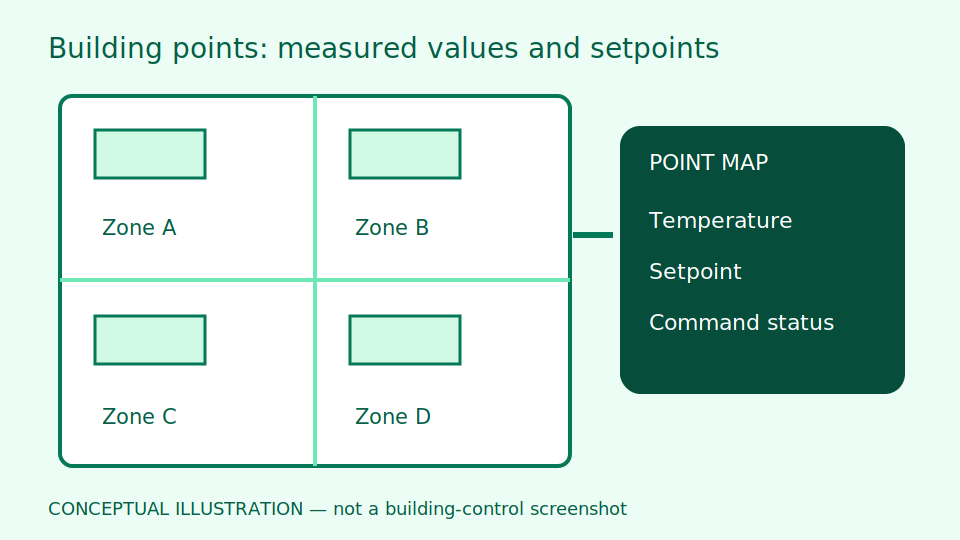
BMS integration must preserve point meanings: measured temperature, setpoint and on/off commands are not the same data type. Read-only integration is a suitable starting point for building context before assessing writes that may conflict with existing schedules and interlocks.
A BMS manages building equipment such as air conditioning. A point is one named data item; a setpoint is a target, not actual temperature. An on command does not prove a fan is running. To investigate out-of-hours use, read the schedule, command and feedback together and ask how the room was used that day.
Some protocols use write priorities to determine which command takes effect. An interlock is a designed condition preventing operation. New integration must not override existing controls or operator commands. Read-only access still requires network-load assessment. Future writing is separate work requiring traceable cancellation and relinquishment of control, not an automatic consequence of successful reading.
Scroll the diagram horizontally to inspect all details.
Illustrative Design Scenario
Illustrative design scenario: combine room temperatures and AHU status to review operation outside the schedule. Display an on command separately from feedback confirming actual operation. Do not change setpoints until the building operator has approved the change.
An AHU is an air-handling unit. Suppose a meeting ends but its fan continues running. Operators might check a special schedule, cleaning work or post-event ventilation. Earlier shutdown reduces running time but may affect remaining occupants and air quality. Confirm that context before proposing a schedule change.
If the command says on and feedback says stopped, check controller status and maintenance before blaming a user. Simulate controller loss and recovery in a test system and ask building staff to verify the distinction between command and actual state. Do not include fire systems in HVAC experiments.
Inputs and Prerequisites
Provide a point list, protocols, units, write priorities, scheduling rules and network topology. Verify building-system access permissions and segment networks according to the assessed risks.
Each point needs a device identifier and physical area because room names may recur on different floors. An enumeration is a coded state translated according to its manual. Zero does not necessarily mean stopped on every device, and undocumented mappings require investigation.
Output should include data type, units, latest timestamp and quality, distinguishing measured temperature from its target. An untranslated code should remain unknown. Generic conversion of a number to true or false must not produce a reassuring green status that its source never defined.
Trial and Integration Workflow
- 1Map points with device IDs, units and quality flags.
- 2Test read-only access, enumeration conversions and abnormal states.
- 3If writing is proposed, test priority, relinquishment and command cancellation in a test system.
Evaluation and Acceptance Criteria
Compare points against the existing BMS display. Check stale data after controller disconnection and cases where command and feedback disagree. Acceptance should cover reconnection without replaying old commands, not just successful reads while every controller is online.
Sample numeric values, states and schedules crossing day boundaries. Check holidays against the time actually used by controllers. Comparing one temperature point does not validate command conversion or multi-valued state mappings, even if that measurement matches perfectly.
Building staff should review simulated events and permission paths. Any proposed writing must demonstrate cancellation and relinquishment in a test system, including partial failure. A successful protocol response is not proof that physical equipment followed the command; feedback remains a separate piece of evidence.
Scroll the diagram horizontally to inspect all details.
Failure Cases and Limitations
Devices using the same protocol may define objects differently. Additional traffic can affect old controllers. Ordinary HVAC integration is not fire-system work, and connecting data does not automatically make a system compliant with a building standard.
Room-use information may reveal occupants' behaviour. Use only the necessary area-level detail, without linking individuals to productivity rankings. Historical storage needs a defined purpose and permission boundary, not indefinite collection simply because points can be read.
Shorter air-conditioning schedules trade energy use against comfort and air quality. Proposals must follow site requirements and responsible staff review. BMS connectivity does not establish that a deployed integration can control every building, nor that a proposed schedule is appropriate everywhere.
Practical Checklist
- Does every point identify its unit and command type?
- Is write access disabled by default?
- Is an offline controller clearly identified on the display?