
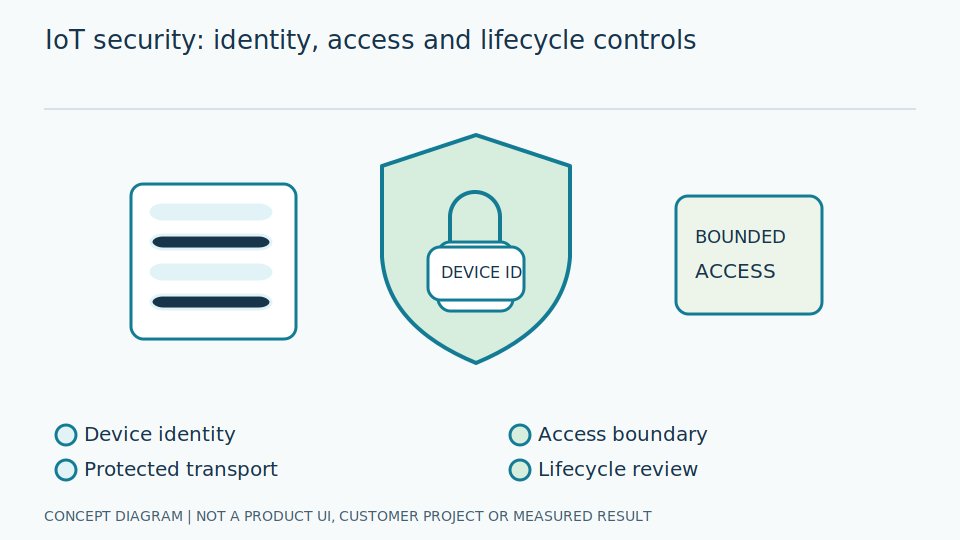
Principles and Suitable Contexts
A threat model identifies important data, connection points and authorised actors within each boundary. It helps select risk reductions according to actual consequences. OT also requires attention to continuity and physical safety; IT practices should not be applied without assessing the constraints of existing equipment.
A trust boundary is where access decisions determine which person or system may reach which resource. Encryption can protect data in transit under its configuration, but cannot fix excessive account privileges or a device transmitting wrong values. Start with confidentiality, integrity and availability needs and their consequences for users and processes. These goals overlap but require different evidence and controls rather than one blanket security label.
Unlike office systems, OT shutdowns or configuration changes can have physical effects. Select measures with process owners and approved change procedures. NIST guidance provides an asset-and-responsibility framework, not a product security certificate. Protecting IoT must not make safety instrumented systems, interlocks or emergency shutdown depend on general monitoring channels. The monitoring architecture should remain within its supplementary role while physical protections retain their established duties.
Scroll the diagram horizontally to inspect all details.
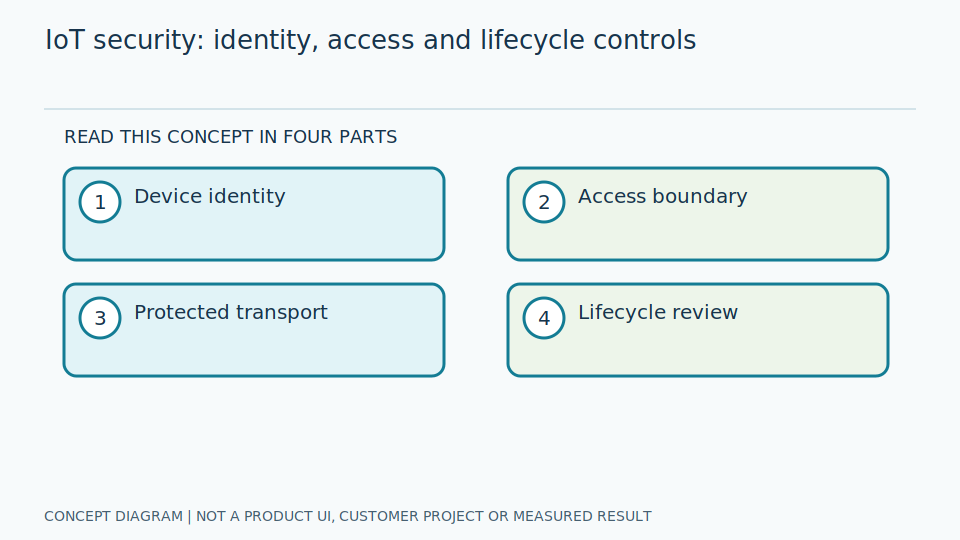
Design and Data Preparation
Inventory assets and data flows. Segment networks, restrict permissions and use individual identities where feasible. Plan key and certificate management, updates and backups. Identify incident recipients and a disconnection procedure that does not put the process at risk, rather than assuming isolation is always harmless.
Identify hardware, account and connection owners and necessary data before granting access. Separate reading from administration and command-writing, granting only justified role-specific permissions. Document legacy-device constraints and agreed compensating measures. Do not assume every model supports encryption or key rotation in the same way. An inventory should reveal capability gaps explicitly rather than concealing them behind a generic statement that all devices are secured.
Assign certificate renewal, updates, backups and recovery responsibilities, aligning event times across systems. Checks and connectivity changes must stay within approved scope with a return-to-previous-state method. Use nonsensitive test records for permission checks. Incident handling must not depend on abruptly disconnecting a physical process without assessment; containment should respect the owner's operating constraints and existing safety procedures rather than applying an office-network response automatically.
Failure Cases and Limitations
Default passwords, shared keys and unnecessary exposed services widen trust boundaries. Untested updates may stop equipment, while logs without aligned timestamps obstruct incident reconstruction. No single measure guarantees complete security, and naming an encryption method does not establish that identity, recovery and operational risks are addressed.
An encrypted connection accepting the wrong identity can still receive unauthorised data. Shared accounts hinder attribution and individual revocation. Check identity and data scope together. Logs are event records; they need enough aligned time and context to reconstruct actions without storing secrets or excessive personal detail. A large log volume cannot replace the ability to connect the relevant actions across the actual data path.
Stricter measures may disconnect legacy devices or change system load. Test in isolation through responsible personnel, never independently scan or stimulate live OT. For unresolved constraints, record residual risk and its accepting owner. Passwords or encryption do not justify calling everything secure, and physical-safety procedures must not be reduced simply to make the new monitoring system operate. Availability consequences belong in the review alongside access protection.
Trial and Evaluation Methods
Check role-based permissions, revocation, certificate expiry and recovery in a test environment. Use authorised checks with limited impact; do not scan live OT without permission. Record residual risks and a review date instead of claiming certification or comprehensive protection without the evidence to support it.
Create a role-to-action table containing permitted and forbidden operations. Independent reviewers should test approved accounts and simulated data across screens, exports and actual integration interfaces. Include revocation and certificate expiry to examine event presentation and recovery, not merely successful login. The checks should prove boundaries for both authorised and unauthorised actions, while avoiding sensitive live information or operational impact from the test itself.
Acceptance should cover time-correlatable logs, restorable backups and escalation of faults, alongside effects on process availability. State scope, test date and untested areas. NIST and OWASP guidance organise methods and measures; they neither certify a product nor establish absence of risk. These checks do not replace assessment of actual safety functions, and residual issues should remain visible with responsibility and a planned review date.
Review Checklist
- Know the assets and their owners.
- Limit communication paths and permissions to what is needed.
- Test updates and recovery before deployment.
- Maintain incident-response and risk-review plans.
References and Further Reading
References explain technology principles or requirements. They do not establish product certification or support for every requirement.