
Content Level: Research
Principles and Suitability
Quantum computing uses qubits and amplitude interference for specific algorithms. Measurement does not read all answers simultaneously, and quantum advantage must be demonstrated for a particular problem against a classical baseline. This topic describes research, not a confirmed gauge-reading capability.
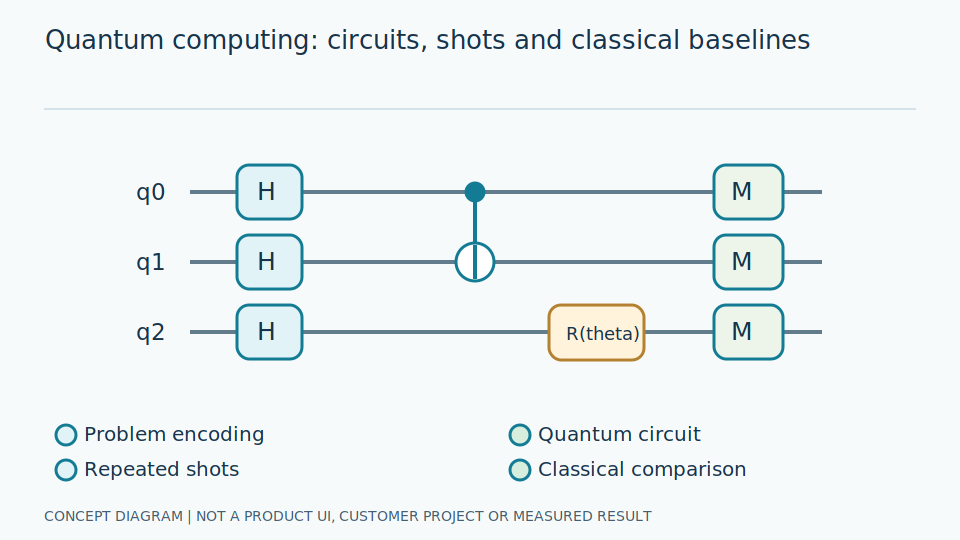
A qubit is a quantum information unit whose state is described by amplitudes related to measurement probabilities. Computation changes and interferes with states rather than independently reading every possible answer at once. Quantum advantage needs a stated problem and comparison method; it does not mean general speed superiority for every computer task. Separate research interest from industrial readiness, which requires verified results.
Engineers define how to encode the problem into a circuit, including data preparation and output-reading costs. Shots are repeated measurements; circuit depth relates to the sequence of required operations. Check noise models and the limitations of the system under study. A simulator runs a model on classical equipment, not quantum hardware. Identify result provenance and do not use simulated findings to guarantee benefits on physical quantum devices.
Scroll the diagram horizontally to inspect all details.
Illustrative Industrial Example
Conceptual example: study a small scheduling problem in a simulator and compare it with a classical solver. Encoding a problem into a quantum circuit does not establish that a factory will operate faster.
Suppose a simulated problem has verifiable jobs and resource constraints. Returning an answer quickly while violating constraints is not better performance. Compare solution quality and complete costs with a suitable classical solver. A fast circuit subroutine may still require extensive preparation or repeated measurement, preventing conclusions about total performance. Research need not connect to actual machinery or disrupt production scheduling to demonstrate the concept.
Engineers begin with small problems whose answers can be checked, recording qubit count, depth, shots, and simulation seed. Add noise under stated assumptions and examine differences across repeated runs. Include encoding, circuit preparation, waiting, and answer interpretation in timing. Do not send confidential factory data to a service without approval. Having a quantum circuit does not mean a product already reads instruments or optimizes production using quantum computation.
Study and Trial Workflow
- 1 Specify the problem and the cost of encoding its data.
- 2 Experiment with bounded circuits, a noise model, and recorded seeds.
- 3 Compare end-to-end timing and answer quality against suitable classical methods.
Evaluation and Metric Definitions
Report qubit count, circuit depth, shots, variability, and total costs including preprocessing and queues. Do not claim speedup from the circuit portion alone.
Speedup is a timing comparison requiring the same baseline scope. Report answer correctness with full-path timing, not one circuit stage against a classical program doing the entire job. Measurement or simulation variability needs repeat counts and conditions. A single best answer is not representative performance. Distinguish noiseless-system results from those including assumptions about real errors.
Engineers check answers against problem constraints and an appropriately effective baseline, using new experimental data not employed to select parameters. Larger problems require renewed assessment of encoding and resource costs; a small example does not imply continuing advantage. IBM Quantum documentation and the NISQ paper are learning references, not evidence of product certification or commercial readiness.
Scroll the diagram horizontally to inspect all details.
Limitations and Failure Cases
Noise, error correction, and system size remain important constraints. Simulator results are not hardware results and do not establish commercial benefits.
Noise introduces operational and measurement errors. Error correction manages errors with resource overhead; it must not be assumed fully available in every system. Describe the studied version's limitations instead of using qubit count alone as a measure of problem-solving capacity. Classical simulation has its own costs and cannot prove the advantage of quantum equipment that has not been tested.
Select research problems by explaining where a quantum approach might be relevant, not by converting every image or data task for novelty. Maintain classical baselines and verifiable boundaries. This article is research-level information, not confirmation of current quantum services, savings, speed, or certification. Conceptual results must not be presented as customer cases or demonstrated operational capabilities.
Practical Checklist
- Is the research status of the work clearly labeled?
- Is the classical baseline appropriate for the selected problem?
- Are simulated and physical-hardware results distinguished?