
Principles and Suitable Contexts
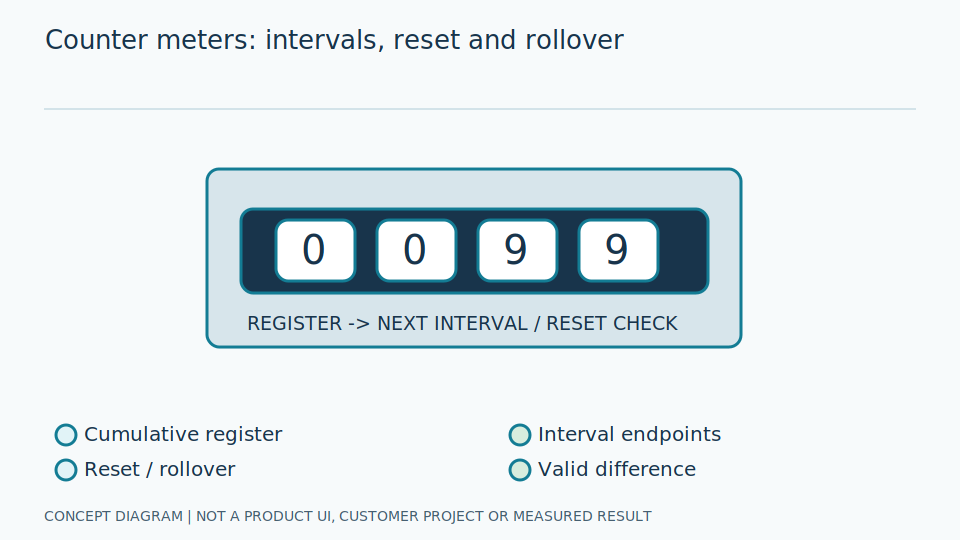
A cumulative counter is not a rate. Calculate increments from timestamped observations when a quantity per interval is needed. This works when reset rules and digit count are known. A decreasing value could mean rollover, reset or a reading error; those explanations require different contextual evidence.
A counter adds events from a starting point, while a difference describes additions between two observations. In an illustrative sequence, 120 items followed by 150 items one hour later means 30 additional items and an average of 30 items per hour. It does not establish steady production throughout that hour or describe the quality of the counted items.
Rollover returns the display to its beginning when all digits reach their limit; an operator reset for a new job is a different event. Preserve event order alongside readings. With only two observations separated by a data gap, the exact increment may be unknowable. Reporting an unresolved interval is more honest than manufacturing a continuous positive total without evidence of how many rollovers occurred.
Scroll the diagram horizontally to inspect all details.
Data and Preparation
Register digit count, multiplier, unit and reset events. Capture mechanical wheels while digits are changing. Choose a reading interval that does not conceal multiple rollovers. Retain observations before and after shift changes or job changes, together with a record of the person confirming any reset.
Specify whether the counter represents items, cycles or another accumulated quantity, and the documented increment for each event. Calculations across shifts need actual shift start and end times, not filenames. When replacing an instrument, start a new sequence identity and retain the old closing reading and new starting reading wherever evidence exists. Do not silently treat a replacement as the same uninterrupted source.
Frequent sampling reveals digit transitions but also produces more images of moving wheels. Use sequences to confirm settled digits without erasing uncertain intervals. Restrict reset recording and retain reasons for audit. Corrections should preserve the original value, calculation method and approving person separately, allowing another reviewer to reconstruct interval totals from source observations rather than relying on the final edited report alone.
Failure Cases and Limitations
A wheel between two digits can produce an apparent jump. After a long gap, the number of rollovers may be unknowable, and replacing the counter breaks the previous sequence. Do not automatically reinterpret every decrease as rollover when there is no event record to support that explanation.
When several wheels turn together, one frame can mix old and new digits and exaggerate the increment. Inspect surrounding images and job records rather than choosing the number that makes totals look tidy. Filtering out every decrease also harms data quality: it can conceal a real reset and cause quantities accumulated before that reset to be counted again in a later shift.
Incorrect capture times or out-of-order arrivals can create negative differences even while the counter increases normally. Order by capture time and identify late records before recalculation. If units or multipliers change mid-sequence, divide the sequence and review affected totals. Applying today's formula retrospectively to everything can silently alter the meaning of historical quantities and invalidate comparisons between shifts.
Evaluation Methods
Compare both individual counter values and shift totals against reference records. Test sequences containing resets, rollovers, missing images and instrument replacement. Report unexplained negative increments separately, as well as accumulated-total error after confirmed events have been handled, rather than reporting only the proportion of correct digits.
Use complete time sequences, not only easily read settled displays. Include independently confirmed reset records and check that interval boundaries are correct. Compare totals with an independent reviewer following the same rules, both before and after corrections. This separates reading quality from the contribution of people resolving events, rather than crediting the automated reader for the accuracy of a manually repaired total.
Acceptance should identify intervals that are calculable, intervals with only approximate bounds and intervals that cannot be summarised. A high proportion of readable images is insufficient if one error corrupts an entire shift total. Examine its quantitative impact and resolution time. After changing digit count or reset rules, retest sequence calculations before combining new results with reports from the previous instrument configuration.
Review Checklist
- Record digit count and multiplier.
- Keep traceable reset records.
- Test several digits changing together.
- Exclude increments while an event remains unexplained.
References and Further Reading
References explain principles, not product certification. Requirements from another jurisdiction do not automatically replace local requirements or the actual equipment manual.