
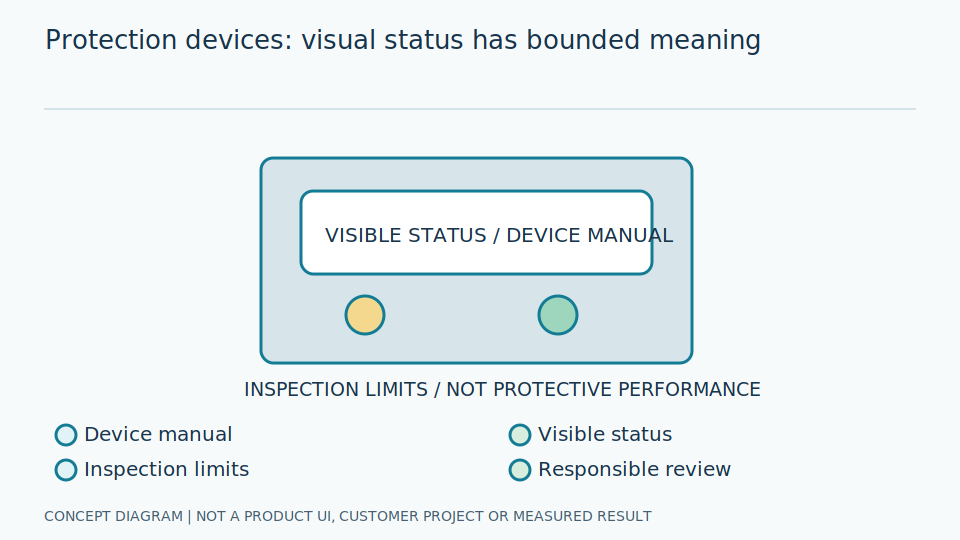
Principles and Suitable Contexts
Tie observation to a defined equipment type and a visible defect, such as a missing cover or damaged label. Do not group all protective devices into one generic class. Images can supplement an inspection checklist, but cannot replace the responsible inspection process or the device-specific functional test.
Condition inspection searches for visible features; functional testing proves operation through methods suited to the device. A complete cover does not establish every mounting point's strength, and an intact seal does not prove internal operation. Name results as observations, such as cover visible or label unreadable, not ready for use. That distinction prevents a visual checklist from implying functions it never tested.
Defect definitions must identify equipment type and inspection point. Different shapes can place essential components in different locations. A single normal/abnormal class hides coverage. Separate inspectable, uninspectable and out-of-scope features, retaining independent functional inspection and any safety instrumented system, interlock or emergency shutdown duties. Cameras add an observation layer; they do not reduce the evidence required to establish protective performance.
Scroll the diagram horizontally to inspect all details.
Data and Preparation
Define equipment scope, inspection points and normal appearance from the manual. Collect examples for each model with its equipment identifier. Use safely obtained defect examples rather than damaging or disabling actual protective equipment to build a dataset. Specify which visual details must be visible to make an assessment.
Start from the responsible inspector's existing checklist, selecting only points visible without opening covers or entering hazardous areas. Qualified personnel should identify marks requiring referral, rather than inventing criteria from colour or apparent newness. Identification-label images help registry matching, but their recognition must remain separate from equipment-condition conclusions. A correctly read asset number is not evidence that the associated device is functional.
Organise reference images by model and actual viewing angle, including incomplete views so rejection is learned alongside pass states. Record the lighting and distance at which important features remain visible. Cameras must not hinder maintenance access. Obtain defects from authorised inspection work; do not break seals, scratch equipment or disable protection to complete a dataset. Explain missing coverage rather than producing it through unsafe changes.
Failure Cases and Limitations
An intact exterior may conceal an internal failure, and dirt can resemble a crack. A recent inspection label does not prove current condition. When a critical inspection point is not visible, record that it could not be inspected rather than treating the image as a pass.
Lighting changes can conceal an existing mark or cast a shadow resembling damage. Keep the original image and suspected location for review rather than declaring failure from one ambiguous frame. Conversely, clean or new-looking equipment may not perform its function. Attractive imagery is not a substitute for device-specific inspection methods, and consistent recognition of its exterior is not evidence of operational readiness.
Hidden labels or seals and incorrect registry matching can attach another device's inspection history. Verify identity separately from condition; incomplete evidence must remain incomplete, not pass. Observations should lead to authorised inspections, never independent activation or dismantling by users. Image output must not approve machine operation or removal of safeguards, even when no visible defect is found within the limited photographed area.
Evaluation Methods
Compare detected visible defects with a qualified inspection. Report recall for each defect type and the proportion of uninspectable images. Readiness conclusions require the appropriate device-specific tests; they do not follow from an image score or confer SIL certification. Keep condition inspection and functional verification as separate outcomes.
Recall is the proportion of independently confirmed defects detected by the system. Separate defect types: finding missing labels says nothing about finding loose mounting points. Qualified reviewers should define reference answers only within visible scope. Store functional-test outcomes separately so a normal-looking image does not acquire a ready-for-use label without the appropriate additional evidence. This keeps the visual test's denominator meaningful.
Acceptance should count missed defects, unnecessary referrals, further-inspection images and wrong asset associations. Use equipment and capture days not previously used to tune criteria, identifying types lacking defect examples. Machine-guarding references help organise inspection duties and questions; they do not certify image software or installed protective performance. Limit conclusions to the visible defects actually represented in the independent evaluation dataset.
Results should name the observation's location and type so responsible personnel can continue the inspection, not just receive an unlocatable fail. Check an authorised example from image referral through the actual inspection workflow. Confirm that closing a task requires device-specific inspection evidence, rather than merely the image system ceasing to alert after lighting, cropping or appearance changes.
Review Checklist
- Define defects by equipment type.
- Do not count obscured inspection points as a pass.
- Separate condition checks from functional tests.
- Do not replace SIS, emergency circuits or interlocks.
References and Further Reading
References explain principles, not product certification. Requirements from another jurisdiction do not automatically replace local requirements or the actual equipment manual.