
Principles, Scenarios and Suitability
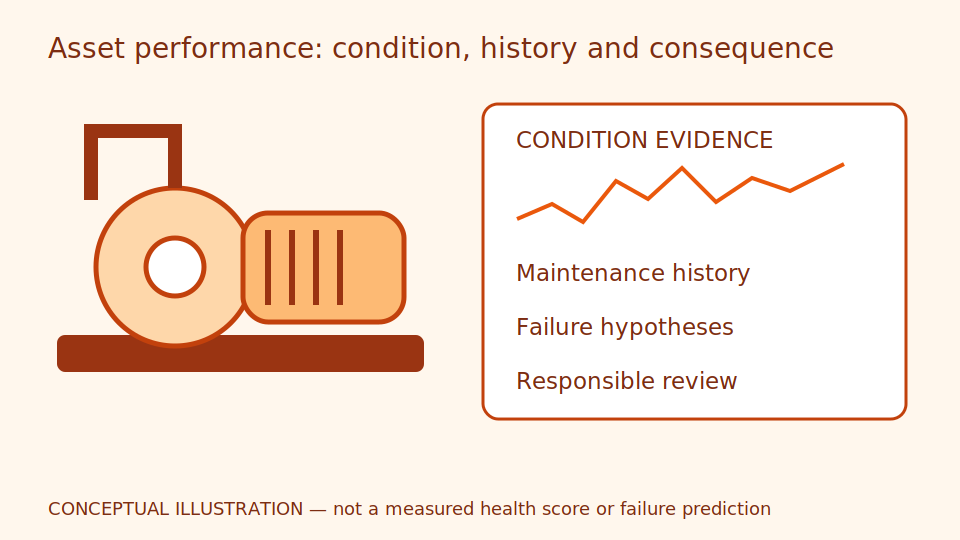
APM combines condition data, maintenance history and process criticality to prioritise work. It is not a health score derived from one signal. Separate measured evidence, failure-mode hypotheses and the decisions made by the responsible asset team.
APM means asset performance management. An asset is equipment requiring care; criticality describes the consequences of its failure. A failure mode is a type of damage, such as wear or blockage. Similar symptoms can warrant different inspection times when standby arrangements differ. Prioritisation combines likelihood and consequences rather than selecting the highest signal alone.
Link condition evidence with work history and load context. A combined score can hide detail, so show the signals changing it and missing information. Earlier inspection supports preparation but adds unproductive checks. Planners should weigh risk and resources, with engineers reviewing hypotheses before work is created. A score is not permission to continue operation.
Scroll the diagram horizontally to inspect all details.
Illustrative Design Scenario
Illustrative design scenario: two pumps show similar vibration increases, but the one without a standby and with greater process impact may receive higher inspection priority. The score assists planning; it does not predict an exact failure date.
Suppose one pump recently had mounting work and the other changed flow rate. Review both records before attributing vibration to bearing deterioration. Installation or operating conditions may explain the increase. Compare similar loads using appropriate instruments; do not deliberately operate equipment abnormally to obtain damage examples.
Inspecting the critical pump first uses fewer resources but may miss a shared-system cause. Surveying the whole group takes longer. Maintenance and production should choose according to consequences, then return findings to the hypothesis record. Otherwise the same warning can recur without learning from real inspection work.
Inputs and Prerequisites
Prepare asset registers, criticality, failure modes, work orders, operating hours and quality-checked condition signals. Ensure asset identifiers match across sources before linking maintenance records to measurement trends.
A work order states what was inspected or repaired. Separate symptom discovery, repair and record-entry dates. Identifiers should follow the physical equipment even after relocation, rather than merging different machines because their informal names match.
Output should list proposed inspections with evidence, priority reasons and missing information. State insufficient history explicitly. Do not manufacture a precise number of remaining-life days without supporting data; uncertainty in the records is part of the planning context.
Trial and Integration Workflow
- 1Build an asset hierarchy and a method for assessing failure consequences.
- 2Link signal trends to inspection and repair records with explicit timestamps.
- 3Have engineers review priorities and close the loop using actual inspection findings.
Evaluation and Acceptance Criteria
Assess how often prioritised work finds real problems and how much relevant work is missed. Break results down by equipment type and operating hours. Avoid using post-failure records as predictive features, which would leak future information into the evaluation.
Split records by time and confirm every feature existed before the actual decision date. Leakage uses later knowledge to predict an earlier event, producing impressive historical tests that cannot work prospectively. Record availability dates matter as much as event dates.
Inspectors should record problem found, no problem found and inconclusive outcomes. Sample unflagged machines to reveal missed work. Compare prioritisation with the previous method under similar workloads. A changing score alone is not evidence that downtime was reduced.
Scroll the diagram horizontally to inspect all details.
Failure Cases and Limitations
Incomplete maintenance history and inconsistent failure-mode names can mislead models. Assets with very few failures may lack enough evidence for remaining-life estimates. A health score is not assurance that the equipment is safe to keep operating.
No recorded failure may mean incomplete paperwork rather than healthy equipment. Check historical data quality before training. Retain only operator information necessary for context, and do not automatically rank individuals from equipment outcomes that may have many causes.
APM supports planning but does not replace manufacturer requirements, mandatory inspections or protection circuits. Future prediction requires machine-type-specific evidence and validation. It is a proposed extension, not a capability this guide claims is already installed or proven.
Practical Checklist
- Do asset IDs match across all data sources?
- Do scores expose evidence and uncertainty?
- Can inspection findings revise the original hypotheses?