
Content Level: Overview / Implementation considerations
Principles and Suitability
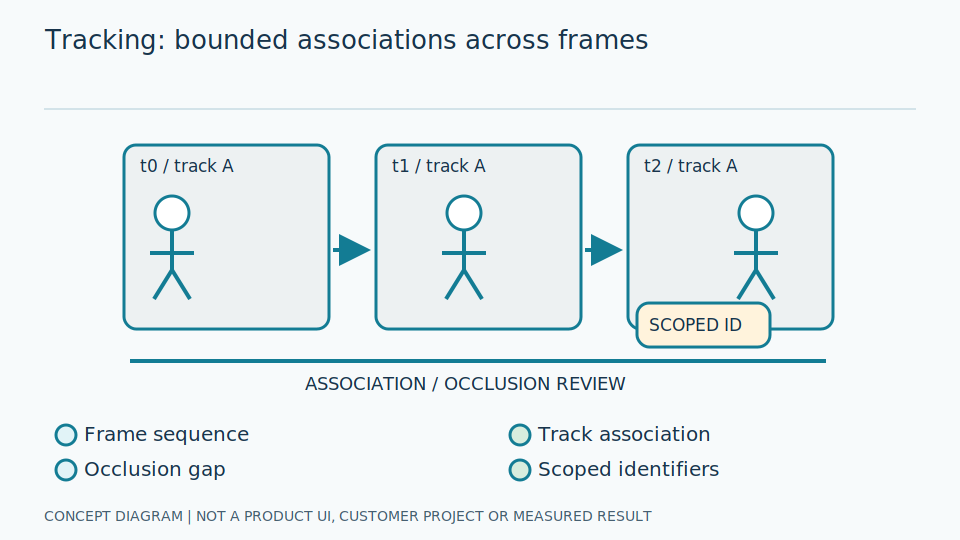
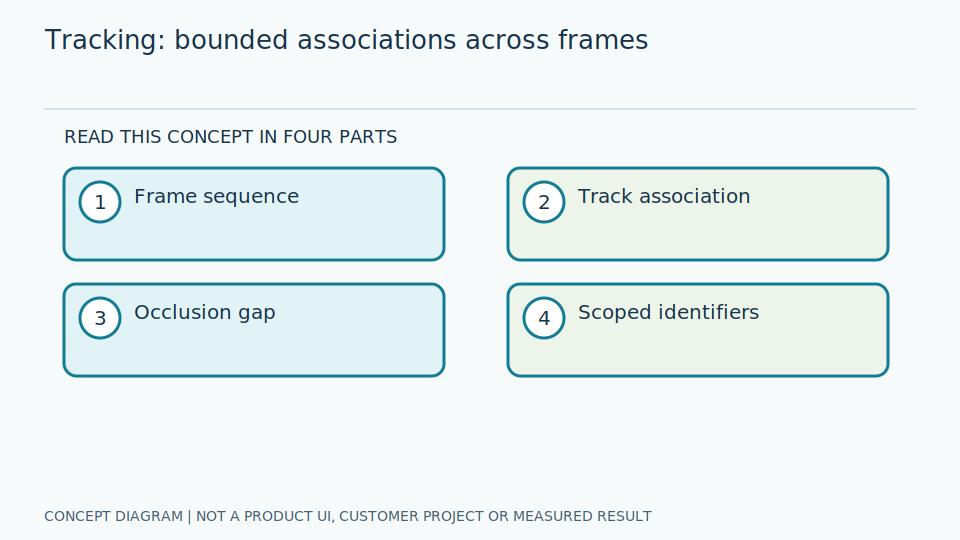
Tracking connects detections across time using motion and appearance. Re-identification compares image representations to help reconnect IDs after disappearance or across cameras. A tracker ID is a hypothesis, not a verified equipment identifier.
Tracking asks whether the currently observed object is the one seen before, requiring time and image sequence rather than appearance alone. A track is a linked path and its ID an internal name. Disappearance behind an obstruction can cause a new track for the same physical object. Counts and exported data therefore need explicit handling of identity uncertainty, not the assumption that every new track represents a new object.
Re-identification compresses appearances into representations for similarity comparison, but identical workpieces can look nearly indistinguishable. Apply time, direction and spatial constraints instead of joining cameras on appearance alone. Define tolerated disappearance, track termination and cases left unmatched. Keep tracker identifiers distinct from workpiece codes verified by another process; a plausible image association is not independent identity confirmation.
Scroll the diagram horizontally to inspect all details.
Illustrative Industrial Example
Illustrative design scenario: track a workpiece through an inspection point and count it once when it crosses a line. For a stationary gauge panel, linking verified regions of interest to instrument tags may be more suitable than relying on re-identification.
Suppose identical workpieces travel in opposite directions and briefly occlude each other. IDs may switch after separation. Review paths before and after occlusion, not just final images. Line-based counting needs direction and already-counted status; a box remaining on the line across many frames must not add a count on every frame.
Use sequences with reference tracks to test association and counting, including actual frame times when frames drop. Define fresh ID scope after restart to avoid collisions with previous records. For stationary gauges, checking panel positions and tags may be simpler than retaining re-identification representations. Choose according to what must be verified, not simply because a tracking tool is available.
Study and Trial Workflow
- 1 Define when a track starts and ends and how long disappearance is tolerated.
- 2 Synchronize camera times and define physically possible transition regions.
- 3 Test occlusion, opposite-direction movement and visually identical workpieces.
Evaluation and Metric Definitions
Count ID switches and track fragmentation alongside IDF1 or HOTA, separately from detection AP. Also inspect errors in final event counts, because a satisfactory detection result does not establish consistent identity tracking.
An ID switch is an incorrect identity change; fragmentation breaks a genuinely continuous path into pieces. Good box detection does not establish good tracking. IDF1 and HOTA assess identity relationships and detections under defined rules, but also report wrong events and consequences for counts or record association. A summary score cannot replace verification of the events users rely on.
Evaluate complete ordered sequences, not randomly selected frames without temporal context. Separate occlusion, opposite movement and stationary intervals, checking cross-camera timing. Correct totals can coexist with swapped workpieces and therefore fail individual inspection-record association. Fix duplicate-event rules before evaluation; do not adjust retrospectively just to match totals without preserving evidence of each association.
Limitations and Failure Cases
Highly similar objects or prolonged camera absence can lead to switched IDs. Person re-identification has privacy implications even when names are not known, so anonymity must not be assumed from unnamed tracker IDs.
Joining a path across missing observations is inference, not observation of the complete movement. Longer waiting can reconnect tracks but also attach new objects to old tracks; earlier termination reduces wrong associations but increases fragmentation. Choose for the intended use and allow unconfirmed states. Verified real-world identifiers may require evidence deliberately designed separately from image similarity.
Representations of people can link activities without names. Define purpose, access and retention rather than assuming numerical IDs remove personal-data concerns. Tracking also adds queue and continuous-state costs, requiring appropriate recovery tests after disconnection. Image paths alone do not verify a person's identity or a workpiece's condition; they describe associations supported by the available observations.
Practical Checklist
- Are tracker IDs reset when the system restarts?
- How are duplicate event counts prevented?
- Has a retention period for image representations been defined?