
Content Level: Overview / Implementation considerations
Principles and Suitability
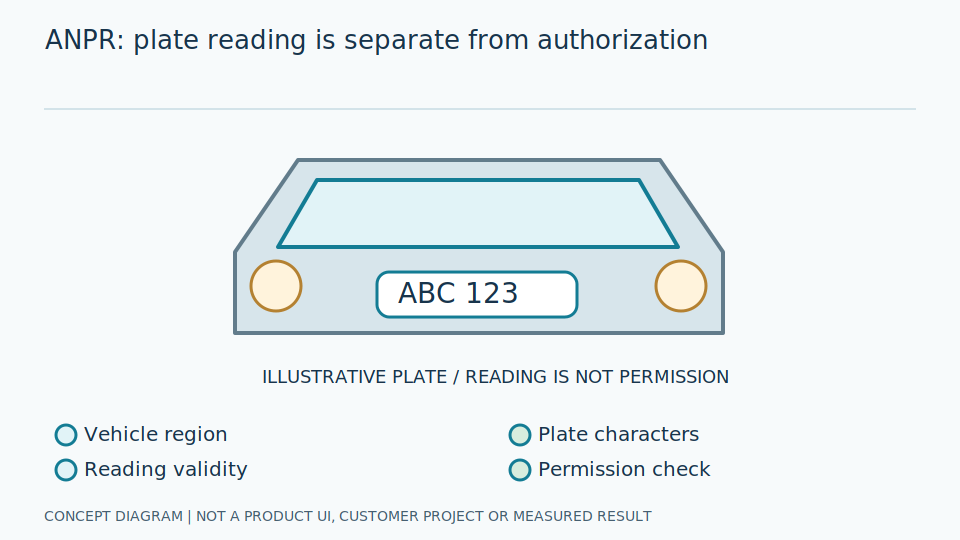
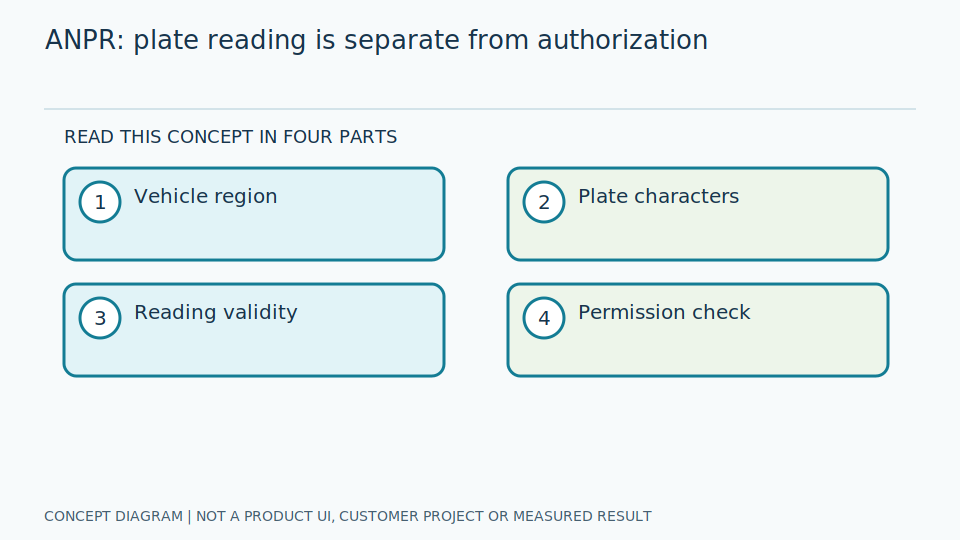
ANPR/LPR combines vehicle or plate detection, image correction, text recognition, and format checks for the plate jurisdiction. Finding a plate does not mean reading its complete registration. An unsuccessful reading should produce no-read rather than a value guessed from historical records.
A registration reading must contain the complete text required by the defined format, not just visible digits. ANPR and LPR describe automatic plate recognition approaches, which must separate detection, perspective correction, and reading from vehicle authorization. If region or province text is required, that part also needs ground truth. Text matching a valid format is not, by itself, evidence confirming a vehicle or its owner.
Engineers define the countries, languages, and plate types in scope, together with an output format preserving raw text and incomplete states. Combining frames must stay within one vehicle track, without filling gaps using characters from neighboring vehicles. Check plate coordinates after image resizing and actual capture times, and reject conflicting readings. Do not substitute an expected registration from an arrival history for what the camera sees without human confirmation.
Scroll the diagram horizontally to inspect all details.
Illustrative Industrial Example
Design example: read plates at an entrance and send incomplete text or province information to staff for review. Do not grant passage from OCR alone when the task requires additional authorization checks.
Suppose reflections obscure some characters on a plate. The system might read every digit but miss the region. Display the readable parts with the evidence image and request review under the defined rules. Do not choose a similar registration from an old list and report it as a successful reading. Passage authorization needs a separate process from OCR, and the recognition result must not operate equipment while bypassing checks required for the task.
Engineers examine image sequences collected through safe procedures, covering different plate conditions rather than arranging risky vehicle movements or modifying a live barrier themselves. Test text aggregation within a track, the state when a vehicle leaves the image, and event identifiers that remain unique after reconnection. Compare complete plate answers with reference images. Define access and retention before using registration data that may identify people, and do not send images to services outside the approved boundary.
Study and Trial Workflow
- 1 Define the countries, languages, plate formats, and daytime or nighttime conditions included in scope.
- 2 Position the camera so plate size and exposure suit the vehicle speed.
- 3 Combine readings across frames within one track, with explicit no-read and review rules.
Evaluation and Metric Definitions
Measure plate detection recall, exact plate match, and no-read per vehicle, separated by plate group and lighting condition. Character accuracy is not a substitute for reading the complete registration.
Exact plate match asks whether the entire registration agrees with the defined ground truth. State how letters, regional text, and symbols are included. Counting vehicles differs from counting frames because one vehicle has several images. Define the aggregation method before evaluation, and report vehicles with no detected plate separately from those with a detected but unreadable plate. Selecting only sharp plates would exaggerate performance relative to actual image acquisition conditions.
Engineers reserve independent vehicles or recording periods and examine daytime and nighttime results within scope without tuning answer thresholds on test images. If detection is good but complete readings are poor, inspect plate size, lighting, and image correction before selecting another detector. Examine registrations wrong by just one character against authorization requirements, since they can still identify a different vehicle. OCR and privacy documentation provides evaluation guidance, not confirmation of supported plate types or product-controlled passage.
Limitations and Failure Cases
Dirty or obstructed plates, headlights, and new formats can cause errors. Registration data may identify individuals, so define its purpose and retention.
An unfamiliar plate format may be converted into text the system recognizes, even with a high score. Include rejection of out-of-scope cases. Format-based correction catches some errors but cannot guarantee the text is correct, and plate information does not establish ownership or authorization. Keep image-derived readings separate from reviewer-confirmed results. Registration similarity alone must not justify opening an entrance or associating an event with a person without further evidence.
Multiple frames help in some cases but add latency and data storage. Choose their use according to the task and check that different vehicles are not mixed. Partial masking can reduce disclosure, but necessary evidence must remain available under policy. This article describes evaluation methods, not current ANPR support or accuracy across every plate language. Personal-data guidance does not replace assessing the legal basis and purpose of the system in its actual context.
Practical Checklist
- Is the scope of supported plates specified?
- Are inferred results distinguished from confirmed results?
- Is access to registration images controlled?