
Content Level: Overview / Implementation considerations
Principles and Suitability
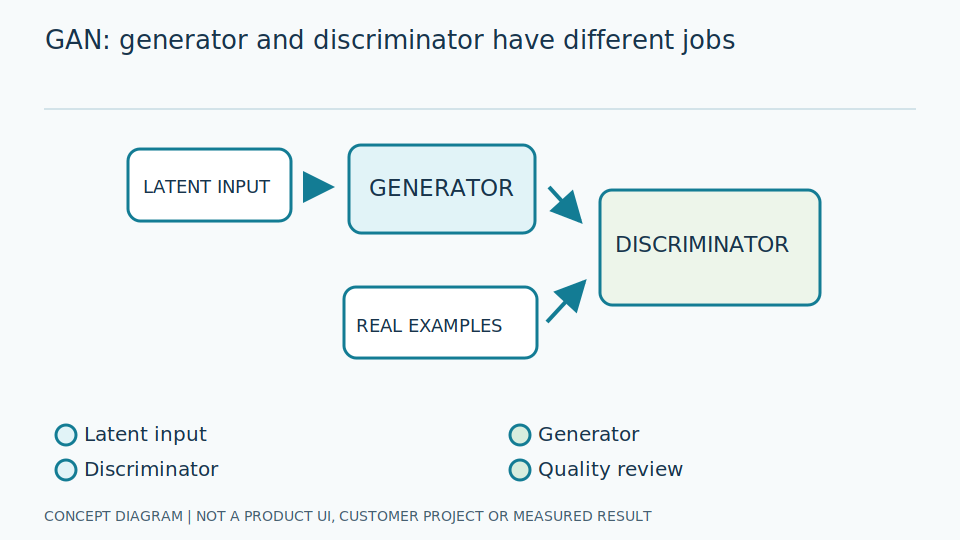
A Generative Adversarial Network (GAN) trains a generator to produce samples in competition with a discriminator separating real and generated data. It can increase image variety, but realistic appearance does not guarantee correct structure or labels.
The generator creates images while the discriminator learns to distinguish created and real ones. Competition encourages resemblance to training data, but does not enforce numerical consistency between pointer angles and printed scale numbers. A gauge-like image may contain conflicting scale information. Treat it as experimental material, not an actual measurement image or evidence of a recorded event.
Define permitted changes and required relationships, such as changing backgrounds without altering units or pointer tips. If generated details affect reference answers, correct the answers or exclude the image instead of automatically retaining labels. Check duplicates, malformed content and task-specific component correctness, always recording generated provenance separately from real-image sources. Visual plausibility and label validity require different checks.
Scroll the diagram horizontally to inspect all details.
Illustrative Industrial Example
Illustrative design scenario: simulate contamination or lighting variations to augment a gauge-image inspection dataset. Check that image generation has not changed the pointer position, digits or decimal points on which the original labels depend.
Suppose simulated glare intended for unreadable-image training adds a second pointer-like line. The change is no longer lighting alone. Check whether the original training question remains answerable. If occurrence within the task's scope is unsupported, separate it as a sensitivity study rather than claiming complete representation of genuine instrument faults or operational conditions.
Establish a real-only baseline, then add generated images only to training while keeping the same real test set. Inspect targeted conditions, such as fog or reflections, together with previously readable images to detect harm. Improvement only on synthetic images does not establish operational improvement. Check that creation inputs do not leak test-source information into training.
Study and Trial Workflow
- 1 Specify which image regions may change and which must preserve their original labels.
- 2 Remove artifacts and duplicates through both automated checks and human review.
- 3 Compare training on real data alone with a real-and-generated mixture using a real-image holdout.
Evaluation and Metric Definitions
Prioritize final task results on real images and also inspect diversity and relationships to source data. A Fréchet Inception Distance (FID) score alone does not establish that gauge readings have improved.
FID compares distributions of image representations under a specified method; it does not measure unit or decimal correctness in every image. Have reviewers familiar with task criteria inspect generated examples, reporting exclusion counts and reasons. Diversity should cover reading-relevant components, not merely many background colours counted as many independent new examples.
Compare training conditions with fixed real test data and thresholds. Inspect subgroup errors and new images unrelated to original creation sources. State bounded benefits when only one group improves instead of issuing general guarantees. Examine near-copies for memorisation: almost duplicate generated images add no independent evidence and can disclose source information unexpectedly. Their attractive appearance does not remove that concern.
Limitations and Failure Cases
Mode collapse reduces diversity. A generator may memorize training data or create physically implausible defects, and generated images must not be treated as evidence of events that occurred in a factory.
Mode collapse repeatedly produces limited patterns despite random sampling. More files therefore do not automatically mean broader coverage. Check what actually varies and its relationship to sources. Assess rights and disclosure before training or sharing images containing personal or confidential information. Regeneration does not automatically remove the original restrictions or make potentially identifiable content safe to publish.
Generated data can help investigate some hard-to-collect conditions but adds answer-review and provenance work. A detector may learn creation artefacts rather than genuine abnormalities. Always confirm with real images and avoid safety conclusions from synthetic-only evidence. GAN references explain a research approach, not assertions that a product offers image generation or has measured improvements. Any proposed benefit still requires a declared real-data evaluation scope.
Practical Checklist
- Are provenance and usage rights for source images recorded?
- Are labels still correct after image generation?
- Are synthetic images excluded from the real-image test set?