
Content Level: Overview / Implementation considerations
Principles and Suitability
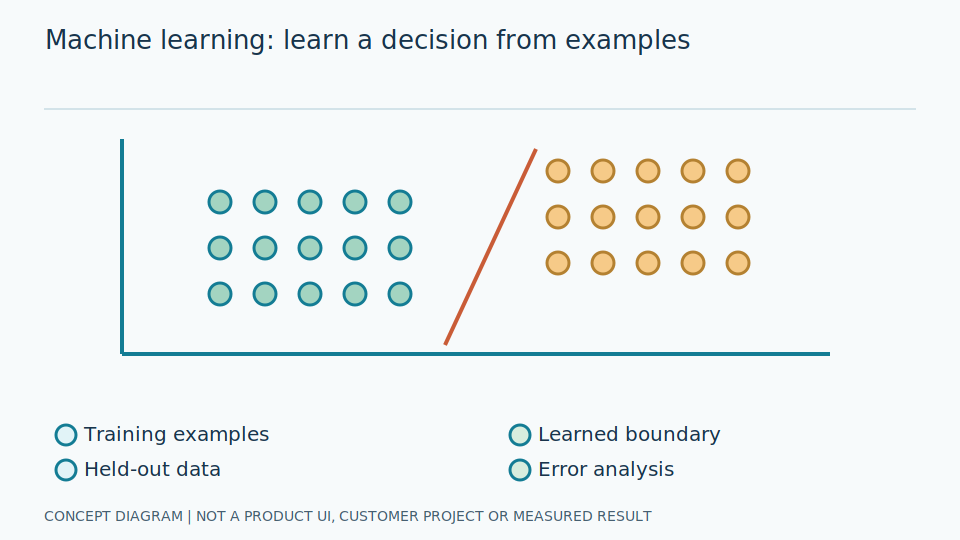
Machine Learning learns relationships from data, not rules that guarantee correctness in every situation. Supervised learning needs reference answers; unsupervised learning seeks patterns without those labels. Deploying a model does not mean it will continue learning on its own.
Think of learning from examples with a limited scope. If most examples are bright, a system may associate brightness with readability, although an image brightened by glare can be unreadable. Labels must describe the actual requirement, such as full visibility of the pointer and unit, rather than a reviewer's impression that an image looks good. Visual preference and an operational reading criterion are not interchangeable answers.
A feature is a value supplied to learning. Training estimates parameters from examples; inference applies fixed parameters to new data. Separate these stages clearly, including feature scaling and decision thresholds. A test should represent what happens with information the system has never seen, not another opportunity to reproduce known answers. Keep preprocessing rules attached to the model so that inputs retain the same meaning during use.
Scroll the diagram horizontally to inspect all details.
Illustrative Industrial Example
Illustrative design scenario: use sharpness, brightness and the proportion of reflective areas to classify gauge images as readable or needing another check. Compare this approach with a simple sharpness rule before choosing a more complex model.
Suppose one camera produces sharp images with glare covering the pointer tip, while another produces darker images with all required details visible. Labels should reflect readability, not substitute camera names or brightness for the answer. Give reviewers borderline examples and record their reasons for disagreeing. Clarifying the definition can avoid wasted model changes when inconsistent answers are the real problem.
Compare the simple rule and classifier on the same independent split, then inspect images on which their decisions differ. If the model uses filenames or capture dates to guess answers, remove that information or justify its suitability before relying on it. Export the threshold and classifier version with scores. This establishes whether changed accepted-image counts came from data changes or a changed decision rule.
Study and Trial Workflow
- 1 Define readable-image labels so that reviewers apply the same criteria.
- 2 Split training, validation and test data by camera or capture day before tuning parameters.
- 3 Fit preprocessing only on training data and fix the threshold using validation data.
Evaluation and Metric Definitions
Inspect the confusion matrix, focusing on unreadable images incorrectly allowed through. Break down results by camera and lighting conditions. Training accuracy describes fitted data and must not be presented as an independent test result.
A confusion matrix compares reference and predicted answers, distinguishing rejection of readable images from acceptance of unreadable ones. Choose the threshold according to both consequences, not just the overall percentage correct. Users should identify cases requiring another check, while engineers report sample counts in every cell. Small groups need counts shown so apparent success is not mistaken for strong evidence.
Check for leakage between groups from the same gauge or capture session: similar images crossing splits can make results look better than deployment. Inspect missing features and values outside the training range. If performance falls only on a new camera, investigate source-data differences before declaring the algorithm unsuccessful or immediately retraining. Retain the previous threshold for comparison to distinguish data changes from threshold changes.
Limitations and Failure Cases
Data collected only during daytime may not represent night-shift conditions. Relationships learned from the dataset also do not establish cause and effect in the industrial process being observed.
Labels can be wrong or inconsistent, and many images do not automatically fix that. If some reviewers accept partly obscured pointers and others reject them, the model learns an ambiguous boundary. Distinguish uncertainty in reference answers from prediction error. Route unresolved cases to a responsible reviewer applying agreed criteria, rather than treating every disagreement as a classifier failure.
A model suitable for one dataset may not suit another. More features can separate cases but increase collection and quality-checking work. Frequent retraining adds validation effort without guaranteeing improvement. Keep the previous version for comparison and rollback. Do not describe an important feature as a physical cause unless evidence supports that conclusion: influence on a prediction does not establish how an industrial process works.
Practical Checklist
- Is there a baseline that does not use Machine Learning?
- Can images of the same gauge leak across dataset splits?
- Who must approve a decision to retrain the model?