
Principles and Suitable Contexts
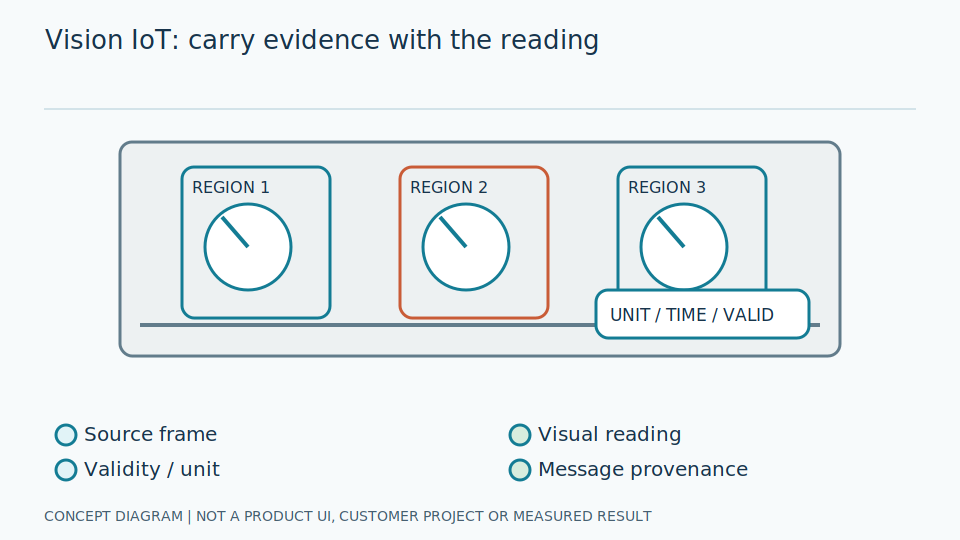
The conceptual sequence is to capture an image, identify the instrument, read its value, check plausibility and transmit a record with status. This can suit visible dial information when direct integration is unsuitable. Model confidence is not automatically the probability that the physical value is correct.
An artificial-intelligence image reading is an interpretation of evidence, not an infallible measurement. Digits may be correct while units are wrong or the neighbouring instrument is selected. Send identity, time and quality together. A schema defines an agreed record format; a quality flag identifies limitations such as obstruction or unconfirmed units, allowing users to understand uncertainty without guessing from the number alone.
Plausibility checks flag values for review, but removing everything different from history can erase real events. Model confidence reflects behaviour under its training method, not instrument health. Separate recognition error from instrument uncertainty. Continuous IoT transmission does not turn a panel image into a substitute for a safety instrumented system, interlock or emergency shutdown signal, even when every record reaches the destination.
Scroll the diagram horizontally to inspect all details.
Design and Data Preparation
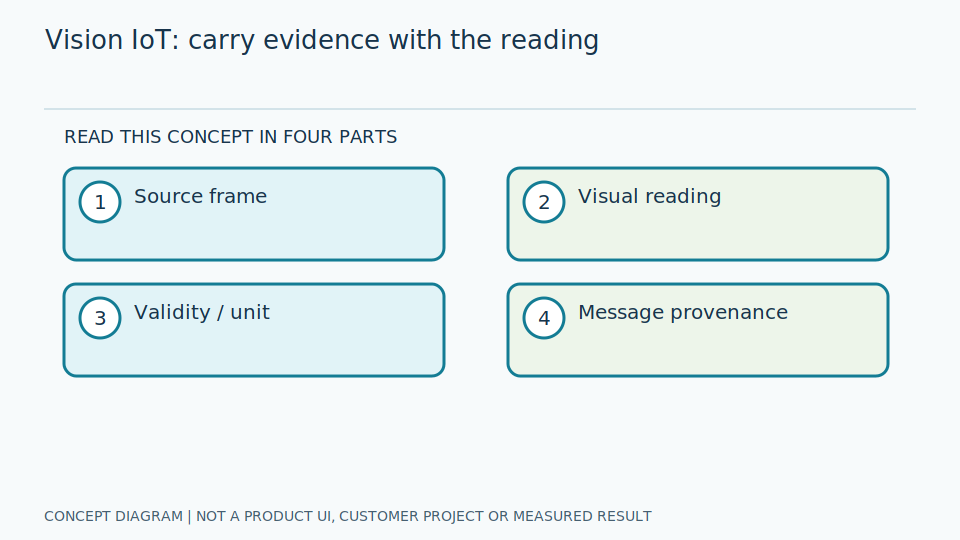
Include device ID, capture time, processing time, unit, quality flag and model version in the schema. Define access-restricted retention for evidence images. Keep human-corrected values separate from the original output, and specify unreadable-result reasons so that rejected observations remain explicit rather than disappearing from records.
Register reviewer-confirmed image-to-device associations instead of relying on filenames alone. Define the region of interest, or ROI, with sufficient labels and references, recording location versions and conversion methods. Capture time locates process evidence; processing time locates the reader's work. Preserve both during retrospective processing so an old image analysed today does not become a current measurement simply through its new processing timestamp.
Define record identifiers and evidence links for retries without duplication. Restrict image scope and retention to inspection purpose, avoiding unnecessary personal details. Human correction should preserve original value, corrected value, reason and editor separately. Send sample unreadable records through the destination before deployment, so missing-data handling is designed and verified rather than improvised after the first real obstruction or unit-recognition failure.
Failure Cases and Limitations
Sending a previous value when an image is unreadable makes it appear current. Changing an ROI may select a neighbouring instrument, and model updates may change error distributions. An image of a safety panel is not a substitute signal for an SIS or an interlock.
Frozen image content may repeatedly arrive with new receipt times. Check capture time and source behaviour, not message receipt, to establish freshness. A slightly moved camera may read another channel still within expected limits, defeating range-only checks. Verify identity and reference landmarks alongside recognition; choosing the instrument whose value looks most plausible cannot establish which instrument the frame actually depicts.
Model changes or resizing can alter decimal-point and pointer detection. Retain versions to identify affected periods, and label historical revisions while preserving originals under policy. Rejection is not a failure to conceal: guessed digits can corrupt totals and alerts. Send unknown status with evidence for responsible review rather than manufacturing a value, and do not let an apparently continuous stream hide intervals of unreadability.
Trial and Evaluation Methods
Test the complete path from image to database using held-out images. Measure errors in engineering units, rejection proportion and data age. Break down results by lighting and device. Check that an incorrect record can be traced back to the image and processing version that produced it.
Independent reviewers should label units and ambiguity before seeing output. Test transmission, deduplication and downstream status using records from the same images. Strong recognition scores are insufficient if the destination strips quality flags or replaces capture time with receipt time. Inspect what users actually see rather than stopping at model output, since integration can remove essential meaning after a correct recognition result.
Acceptance should cover evidence tracing, human corrections and rejection of incomplete images or units. Revalidate camera or model changes against data never used for tuning. Report unrepresented conditions. AI-risk guidance structures uncertainty and responsibility; it does not establish product accuracy or authorise safety-signalling use. A traceable record supports review of an interpretation, not automatic confirmation of the underlying instrument or physical process.
Review Checklist
- Preserve source time and units.
- Transmit a quality flag even when reading fails.
- Distinguish stale values from current readings.
- Revalidate after changing the camera or model.
References and Further Reading
References explain technology principles or requirements. They do not establish product certification or support for every requirement.