
Principles and Suitable Contexts
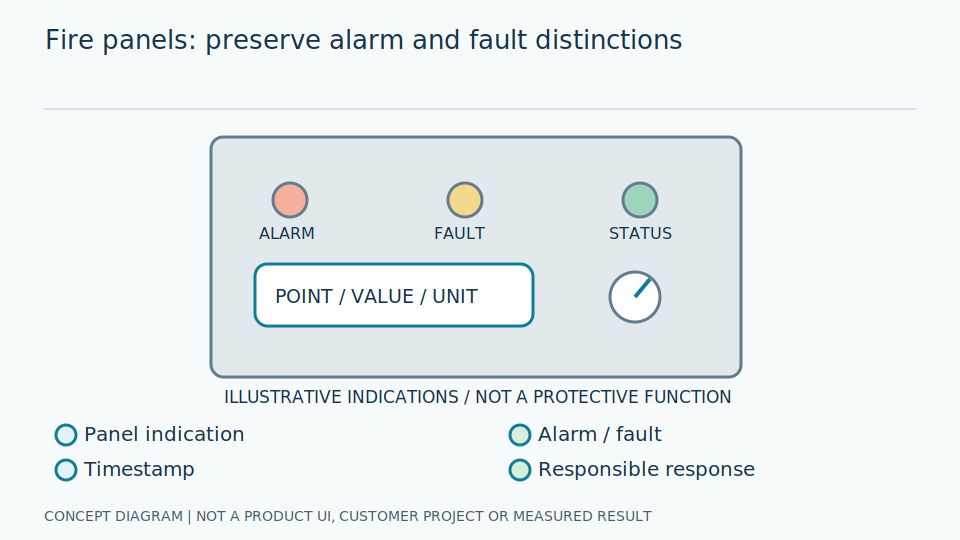
A panel can display fire alarms, trouble conditions and supervisory events as distinct categories. Interpret these using the particular model manual and zone map. Images may support event-sequence review, but must not be assigned the role of the primary emergency signalling channel or taken as proof of detector performance.
Alarm identifies the panel's defined alarm state, trouble a system fault, and supervisory a condition requiring oversight under its design. Do not collapse these into one abnormal label because responses differ. A zone is the system's defined boundary, not necessarily the room a reader expects. Consult the zone map before interpreting location; correctly recognised text can still identify the wrong physical area if that mapping is misunderstood.
Across multiple pages, preserve the event set and time order rather than letting the latest page replace everything. Separate event occurrence time from the time a camera observes a rotating entry. A clear image does not verify detectors, wiring or downstream signalling. It supports review of displayed information only, while the fire alarm and evacuation procedures remain independent of image capture, recognition and communication.
Scroll the diagram horizontally to inspect all details.
Data and Preparation
Document zones, abbreviations and page rotation when several events occur together. Collect images during authorised tests alongside the panel event log. Ensure the camera does not obstruct indicators, labels or access to the panel, and record how timestamps will be aligned for comparing displayed events.
Responsible personnel should confirm current zone mappings and abbreviations, including pages with multiple entries. Keep normal reading and button access unobstructed. Define the fields to capture: event category, zone, text and acknowledgement state, distinguishing unreadable elements. Do not generate examples with smoke, heat or detector stimulation outside authorised procedures. Coverage limitations are preferable to an unsafe attempt to obtain rare display states.
Choose capture intervals from observed page-rotation behaviour and retain capture and receipt times. Restrict access to historical event text and distinguish it from current status. Trial clearly labelled recorded test material, asking another reviewer to confirm that new events, persistent events and incompletely observed lists remain distinguishable. Successful recognition of one page does not prove that the full event set has been collected.
Failure Cases and Limitations
A rotating display may show only one of several affected zones. Acknowledging an event does not mean it has ended, and a dark panel does not establish absence of fire. Images cannot confirm that every detector works or that an alarm reached its intended downstream destination.
Acknowledgement means recognition of the event according to the panel's definition, not confirmation of resolution or area safety. A return to the main screen may leave active events in another list. Do not remove an event simply because one frame omits it, or use an image as permission to stop the emergency procedures specified by responsible personnel. Display visibility and event status are separate matters.
Misread zone characters can direct reviewers to the wrong area, while mixing trouble and alarm can distort priorities. Retain raw text and images for interpretation checks. If frames are missing or page coverage is incomplete, state what remains unknown. Waiting for stronger visual confidence must never delay primary alarms or evacuation-plan actions; uncertainty in this supplementary channel does not suspend the established response.
Evaluation Methods
Compare the set of interpreted events with the event log by category and zone. Measure missed events and the time needed to observe all pages. Test stale-data handling after image loss. These results do not test detector performance or certify the fire alarm system.
The event log is the panel's event record; verify its time basis before matching images. Note that a photograph covers only the entries displayed at that instant. Independent reviewers should inspect text and zone together. Separate entries not yet displayed from entries displayed but misread, reporting the observation time needed to cover the logged set instead of attributing all omissions to recognition alone.
Acceptance should verify preservation of event categories, acknowledgement not treated as clearance, and unknown status during image loss. Include multiple zones and unfamiliar text from safely obtained material. Fire-detection references help organise inspection questions and scope; they do not certify the image reader or installed panel. Required maintenance and functional testing of the alarm system continue under their existing responsibilities regardless of image-test results.
Review Checklist
- Separate alarm, trouble and supervisory states.
- Test multiple zones and rotating pages.
- Do not wait for images before emergency action.
- Retain required maintenance and functional testing.
References and Further Reading
References explain principles, not product certification. Requirements from another jurisdiction do not automatically replace local requirements or the actual equipment manual.