
Content Level: Overview / Implementation considerations
Principles and Suitability
Few-shot learning adapts to a new task using few labeled examples and representations or experience learned elsewhere, such as prototypes in embedding space. This does not establish that a handful of images suffices for every operating condition. The apparent economy of labels must be assessed alongside prior training, example selection, and the variation that independent deployment images will actually contain.
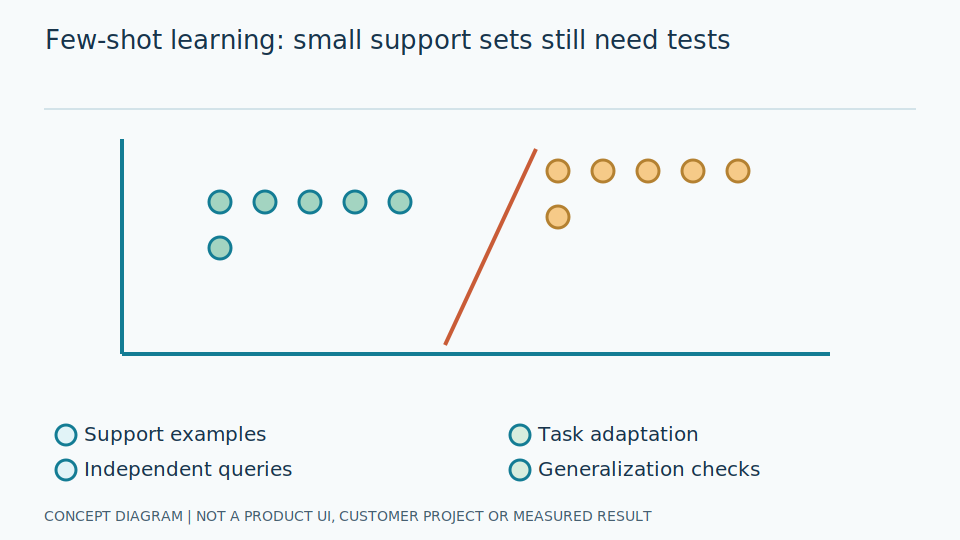
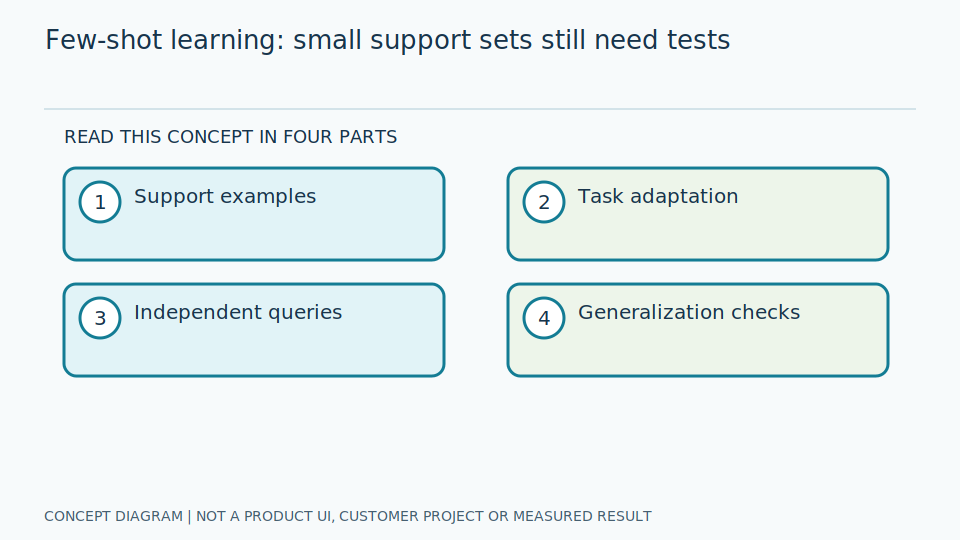
A support set supplies examples of the new task; a query set contains images to answer using those examples. A prototype represents a group in numerical space. Representation similarity supports classification, but a small support set may omit lighting, angles, or damaged appearances encountered later. Few-shot learning generally starts with prior knowledge rather than no knowledge, so the origin and relevance of that representation are part of the evidence.
Engineers define N-way, the number of classes, and K-shot, examples per class, with pretraining sources and representation construction. Count correlated images carefully: adjacent frames or crops from one source provide less independent evidence than different instruments. Episodes simulate new tasks and must separate support and query by device and collection session according to the intended conclusion, rather than treating related images as independent demonstrations of transfer.
Scroll the diagram horizontally to inspect all details.
Illustrative Industrial Example
Design example: add a new dial type to an experimental classifier, using support images from some instruments and queries from others, not crops of the same photograph in both sets. The experiment concerns identifying a dial type, with independent evidence about how the representation transfers. It does not automatically test needle-tip localization, unit reading, or the conversion needed to produce an actual measurement.
Suppose support images come from one camera under good lighting. Same-camera queries may be easy, while a new camera changes colors and angles enough to alter representations. Evaluate tasks close to the source domain and genuinely different tasks separately. Classifying a new dial type from few examples does not imply reading its value from few examples, because type labels and pointer-and-unit evidence answer different questions.
Engineers sample multiple support sets without using query outcomes to select examples. Compare ordinary fine-tuning with metric learning, which learns representation distances, under equal data conditions. Include unknown images with rejection rules. If a person helps choose prototypes, record that step rather than comparing it with an automatic method as though both receive identical information. Do not select only the highest-scoring support set to summarize performance.
Study and Trial Workflow
- 1 Specify N-way, K-shot, and pretraining sources.
- 2 Sample multiple support/query episodes separated by device and session.
- 3 Compare ordinary fine-tuning and metric learning under equal data conditions.
Evaluation and Metric Definitions
Report averages and variability across episodes, including unknown classes and new domains. State shot counts after considering duplicates and correlated images. A mean result over convenient familiar-looking classes does not establish transfer to every unfamiliar dial, and the choice of support images can materially affect outcomes even when the nominal count of labeled examples remains exactly the same across experiments.
An unknown class lies outside the supplied examples and should not be forced into the nearest known type without acceptance criteria. Measure known-class correctness and rejection of images that could legitimately be answered. Episode variability shows sensitivity to examples, but class counts and dataset boundaries remain necessary. Report the scope clearly rather than presenting successful few-shot classification as a universal guarantee about future instruments or operating conditions.
Engineers hold out test classes according to a protocol that prevents their use in method or pretraining-source selection. Check queries from different instruments and cameras as declared. Verify matching preprocessing and representations before comparing distances. Low scores may reflect insufficient image detail or ambiguous class definitions, not a need for more technique names. Prototypical Networks informs experiments rather than confirming an existing product ability to add new classes.
Limitations and Failure Cases
Few examples cannot cover every lighting condition or damaged appearance. Success on classes resembling pretraining may not transfer to substantially different gauges. A representation learned from general imagery can emphasize color or texture over scale structure, making visually similar types difficult to separate. Evidence about its learned features and the actual query conditions therefore matters alongside the reported number of shots.
Diverse examples may help more than changing distance methods, but require verified labels and use permissions. A low shot count should not be the ultimate goal when the task needs dependable performance across multiple conditions. Collect adequate evidence and show unverified boundaries instead of claiming that a few pictures always suffice. The practical requirement is justified task performance, not merely satisfying an attractive description of minimal labeling effort.
Few-shot approaches reduce some initial labeling work but increase sensitivity to example choice and cross-episode evaluation. Provide rejection and human review when classes are unclear. This is classification research, not confirmation of automatic training or new-instrument reading in a current product. Evaluation references help define experiments; they do not certify a universal minimum image count or establish operating results that have not actually been independently checked.
Practical Checklist
- Are the support examples and query images kept independent?
- Are test classes excluded from method selection?
- Is rejection defined for unknown classes?