
Content Level: Overview / Implementation considerations
Principles and Suitability
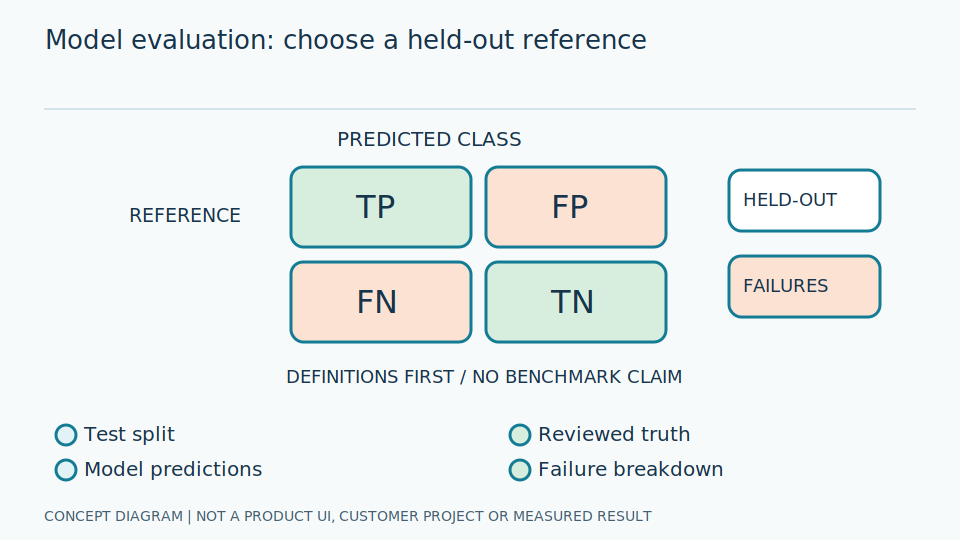
Model evaluation is a protocol joining the question, test data, and acceptance criteria, not selection of a metric after seeing results. Separate model selection on validation data from conclusions drawn using an independent holdout. The process must preserve that distinction even when the initial outcome is disappointing or reveals a narrower usable scope than anticipated.
A protocol agrees beforehand what to test, which data to use, and acceptable outcomes. Start with user decisions: must every dial be read, or can some cases go to human review? Tolerance is the task's permissible error, not a score chosen to match the model. Defining it early makes low results useful for locating needed corrections and identifying conditions not yet suitable for use.
Engineers define examples around new devices, days, or sites, preventing shared context from leaking across the boundary. Lock the reader, image preparation, thresholds, and reference answers. Whole-process evaluation includes no-read cases and missing data, not only successful images. State reference independence and instrument uncertainty so discrepancies from every part of the process are not automatically attributed to the model.
Scroll the diagram horizontally to inspect all details.
Illustrative Industrial Example
Design example: test a gauge reader on new devices and days, compare with reference values, and specify tolerances for the operating range and actions when reading fails. This tests the intended use rather than simply seeking a favorable average, and makes the handling of rejected images part of the observed process.
Suppose average performance is good but one gauge type repeatedly fails. Aggregation may pass overly weak rules. Report group results and conditions requiring no value, such as unclear units or an obscured needle. Reviewers need images and answer origins to distinguish reading error from mismatched comparison times. Do not delete that group and claim readiness for every gauge type on the panel.
Engineers prepare a test manifest with system versions and reference-reading procedures. Use simulated data to check formulas and states before measuring appropriately collected real images. After inspecting failures and changing a version, record that the opened set now supports development and select independent data for renewed conclusions. Defined no-read procedures reveal review burden rather than enabling acceptance criteria to be rewritten after answers are seen.
Study and Trial Workflow
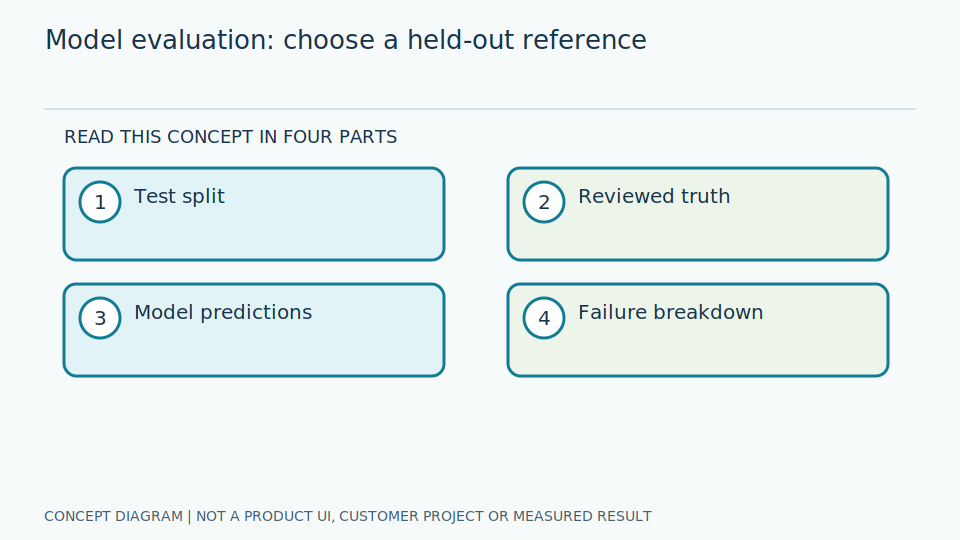
- 1 Agree acceptance criteria based on the consequences of wrong readings, misses, and no-read outcomes.
- 2 Hold out sites, devices, or times matching the intended deployment.
- 3 Lock the model, thresholds, and protocol, then test and analyze failure slices.
Evaluation and Metric Definitions
Report sample size, errors with uncertainty intervals, the proportion within tolerance, and coverage. When frames are related, resample or estimate intervals by suitable groups rather than treating every frame as independent. A large count of closely repeated observations should not create an unsupported impression of certainty about new devices or future conditions.
Coverage is the proportion of in-scope data producing usable results, with an explicit denominator. Reading only easy images can yield low error and low coverage, so report both and separate rejection causes. Uncertainty intervals depend on the estimation method and data dependence; they do not guarantee every future error falls inside them. Explain their meaning and limits in language understandable to users.
Engineers inspect results by device, lighting, and scale range, including mistakes affecting decisions. Use appropriate groups for near-identical adjacent frames rather than gaining apparent confidence from repetition. Check reproducibility with the same manifest and thresholds. State which acceptance requirements pass or fail instead of declaring overall success from one favorable metric or an absence of errors in a small group.
Limitations and Failure Cases
Small tests may not reveal rare failures. Passing at one factory does not establish suitability everywhere, and repeated test inspection for adjustment biases results. Evaluation claims must remain tied to the examined population, the separation rules, and the independence of the process rather than expand beyond the evidence simply because a summary score looks favorable.
Not observing a failure does not mean it cannot occur. Report actual scope and group counts, especially for rare cases with serious consequences. More images from familiar scenes cannot replace new-site data with different materials, angles, and settings. When evidence is insufficient, state that suitability remains unevaluated and plan monitoring or human review instead of extending assurances beyond tested conditions.
Rigorous evaluation costs more but discourages methods winning only on development data. Maintain the boundary between adjustment and conclusions, with review criteria for system or data changes. Documentation guides evaluation design, not product certification or suitability for hazardous control circuits. Deployment decisions must consider work processes and responsible personnel alongside model results, rather than treating a model score as authorization for safety-critical use.
Practical Checklist
- Was the protocol established before testing?
- Are references and reviewers sufficiently independent?
- Are retesting criteria defined for system changes?