
Principles, Scenarios and Suitability
OT security must consider continuity and physical safety alongside confidentiality. Start with assets, networks and remote-access paths before choosing AI tools. Adding cameras or gateways expands the attack surface and introduces components that require ongoing management.
OT concerns physical operations such as machine control. Unlike some office systems, interruption can immediately affect a process. The attack surface comprises potential entry points for unauthorised access. Adding equipment brings information benefits and duties to maintain accounts, software versions and networks; installation is not the end of the work.
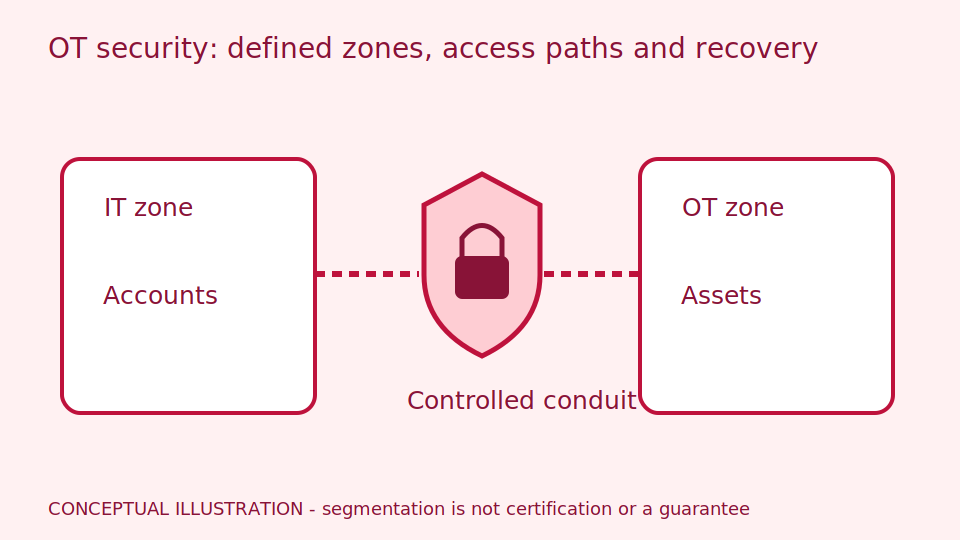
A zone groups systems with related functions or risks; a conduit connects those groups. Segmentation limits consequences but must preserve necessary operating paths. Excessive blocking can prevent monitoring; broad access increases risk. OT owners and security staff should jointly apply least privilege. AI tools do not replace an inventory or recovery plan.
Scroll the diagram horizontally to inspect all details.
Illustrative Design Scenario
Illustrative design scenario: a gateway reads through an authorised path from OT to analytics without a write-back route. Administrators use individual accounts and access logs. Rule changes are tested for process impact before deployment.
Suppose remote maintenance is needed for image reading. Use an approved path limited to the account and required period, not external exposure of every device. Shared accounts obscure who acted. Assign an approver and revocation method after work, and never put passwords into documents or image results.
Updating during a maintenance window can correct defects but risks compatibility problems. Restricting access while waiting is a temporary measure, not a permanent fix. Test changes on a copy and rehearse configuration rollback. Do not scan or disrupt production equipment to demonstrate that it is secure.
Inputs and Prerequisites
Provide asset inventories, firmware versions, network diagrams, system owners, service accounts and required ports. Collect patching constraints and maintenance windows from the operations team.
An inventory records equipment and its owner; firmware is software inside a device. Establish versions and necessary communication paths through documentation and authorised inspection. Do not seek confidential information beyond the agreed task boundary.
Output should list risks and controls with owners, review dates and verification evidence, not an all-safe label. Restrict access-log viewers and retention because logs may contain operator information and sensitive system details. Collect only what supports the authorised defensive purpose.
Trial and Integration Workflow
- 1Develop a threat model and define zones and conduits according to risk.
- 2Reduce privileges, disable unused services and control remote access.
- 3Back up configurations, rehearse recovery and develop incident playbooks jointly with OT staff.
Evaluation and Acceptance Criteria
Check permissions and network rules against the approved scope. Test recovery and incident detection without disrupting production. Avoid active scanning of fragile equipment without assessment and authorisation; a test plan must account for operational impact.
Use test accounts in an isolated system to check permitted and denied actions. Rehearse account revocation and restoration from a verified configuration copy. Having backup files does not prove that operation can actually be restored with the required settings.
OT staff should review operational effects and test-stopping criteria before work begins. Record unresolved exceptions and their risk owners. Do not remove a problem from reporting merely because older equipment cannot support a common control; its residual risk still needs management.
Scroll the diagram horizontally to inspect all details.
Failure Cases and Limitations
A firewall does not guarantee complete security. Encryption protects data in transit but does not correct overprivileged accounts. Vulnerability assessment and certification require an actual agreed scope. This article provides defensive guidance, not an audit result.
Segmented networks may still have indirect paths through accounts or portable equipment. Review people and work practices alongside technical controls. Standards guide management; they are not evidence that equipment or an organisation has already achieved certification.
Cyber controls must not block protective functions or emergency procedures without assessment. Proposed future incident detection does not establish a continuously staffed security service or eliminate residual risk. Preserve process safety while planning and validating defensive changes.
Practical Checklist
- Are asset owners and inventories kept current?
- Is remote access approved and revocable?
- Have backups been restored in a test system?