
Content Level: Overview / Implementation considerations
Principles and Suitability
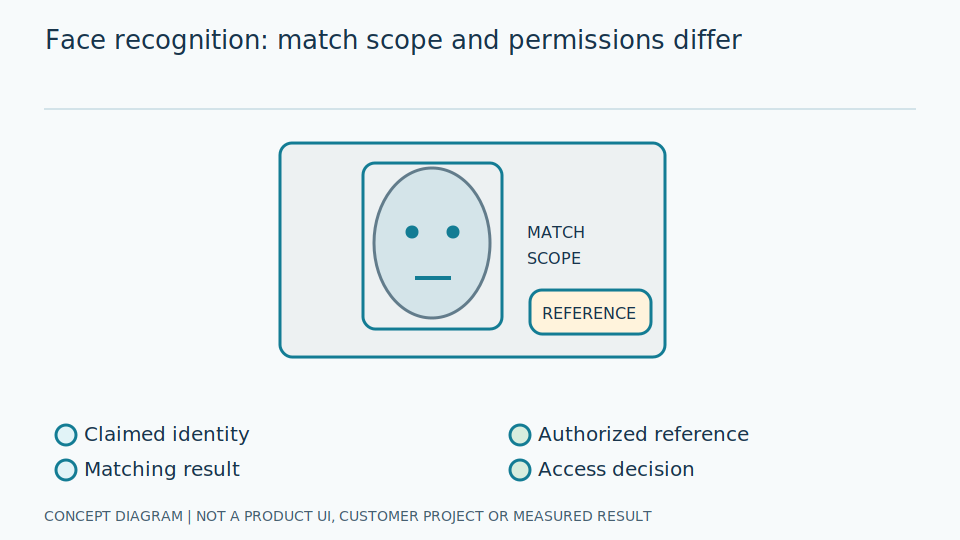
Face verification compares one claimed identity with one reference, or 1:1, whereas identification searches many candidates, or 1:N. Their risks and metrics differ. Face detection merely locates a face; it does not identify a person, and embedding comparison does not establish that a real person is physically present before the camera.
Verification asks whether an image matches the claimed person. Identification searches among multiple possibilities. A gallery is the collection of representations used for that search, and its size affects false-match risk. Separate these operations from face detection, and do not interpret similarity as proof of physical presence at the capture location. Assess necessity and non-biometric alternatives first, because these data affect people more directly than ordinary object readings.
Engineers separate enrollment, the creation of reference representations, from testing and select thresholds according to the harm of false matches and false rejection. An embedding is an image representation that still relates to personal data. Liveness, or checking whether a presentation is a real person, requires separate evaluation rather than a face similarity score. Access, retention, legal review, and impact review are needed before considering biometric uses.
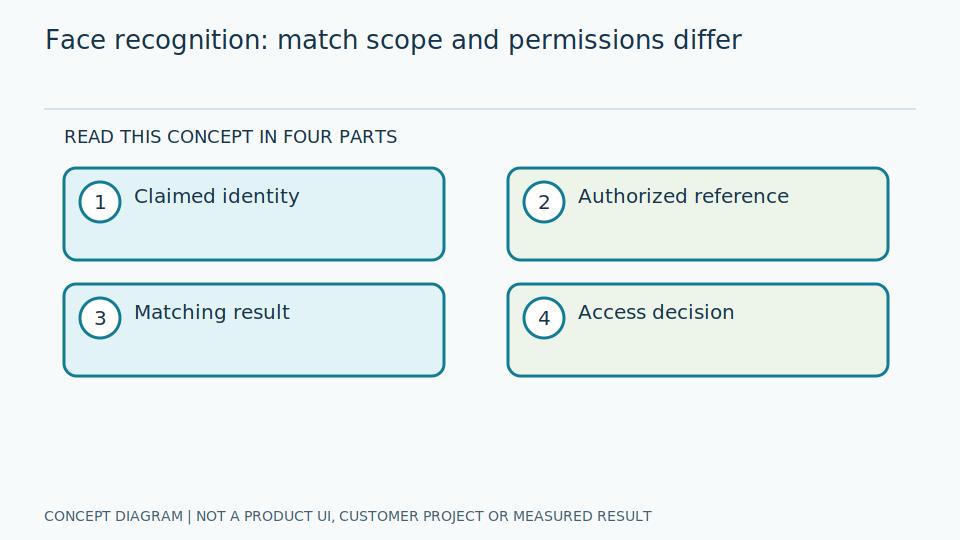
Scroll the diagram horizontally to inspect all details.
Illustrative Industrial Example
Design example: study verification in a process with another confirmation route and human review. Do not claim a match alone is sufficient for high-impact authorization decisions.
Suppose an unclear image produces a comparison near the threshold. Provide an appropriate alternative rather than forcing the user to accept rejection by a single system. Reviewers need relevant information and limitations; the word match is not complete evidence of authorization or a person's actions. Research must use authorized, protected data, not collect or search people from public images without an appropriate purpose and basis.
Engineers test capture, representation generation, and decisions within the approved scope, including images that cannot be compared and non-biometric routes. Examine camera and lighting differences without collecting unnecessary sensitive information. Store the threshold and representation version with results. Evaluate presentation attacks separately under specialist procedures, rather than attempting to bypass authorization or opening passage with these results while omitting real-world risk checks.
Study and Trial Workflow
- 1 Assess necessity, legal basis, and alternatives that do not use biometrics.
- 2 Separate enrollment from testing and define thresholds according to risk.
- 3 Evaluate presentation attacks and liveness separately from face-comparison accuracy.
Evaluation and Metric Definitions
Report false matches and false non-matches at the same threshold. For 1:N, specify gallery size and search metrics, and test appropriate groups and lighting conditions.
A false match associates different people as one; a false non-match rejects a pair that ground truth identifies as the same person. Report the threshold and number of test pairs together. Results at different thresholds cannot be compared as though conditions were identical. Searching multiple candidates also requires ranking rules and gallery size: pairwise results do not guarantee performance in a large search collection. Include cases where the correct representation is absent from the gallery.
Engineers use authorized test data and separate people or collection periods according to the protocol. Examine camera changes, poor images, reviewer workload, and consequential rejection. Describe sample limitations appropriately. Do not present FRTE results from another model or condition as the accuracy of your system. NIST documentation offers evaluation methodology, not product certification or confirmation that a biometric application is lawful.
Limitations and Failure Cases
Liveness does not guarantee resistance to every spoofing method. Results may vary with age, camera, and demographic group. Biometric data needs strict protection under applicable law.
Face comparison does not establish intent, authorization, or actions in an event. Similar scores can occur, and unsuitable images can reject the correct person. Assign responsibility and provide a route to challenge outcomes; an automated score must not be the sole basis of consequential decisions. Stored biometric representations remain risky even when they are not original images. Control access, changes of purpose, and retention according to law and the assessed context.
Larger galleries and additional verification increase review burdens and data risks. Decisions should begin with necessity, not technical convenience. This article explains comparisons and limitations, not current product face-recognition or liveness capabilities, and does not propose attacks on live systems. Evaluation frameworks and personal-data documentation are not certificates of security, fairness, or complete compliance.
Practical Checklist
- Are alternatives and an appeal route available?
- Is the retention period for biometric templates defined?
- Are accuracy claims kept within their stated thresholds?