
Content Level: Overview
Principles and Suitability
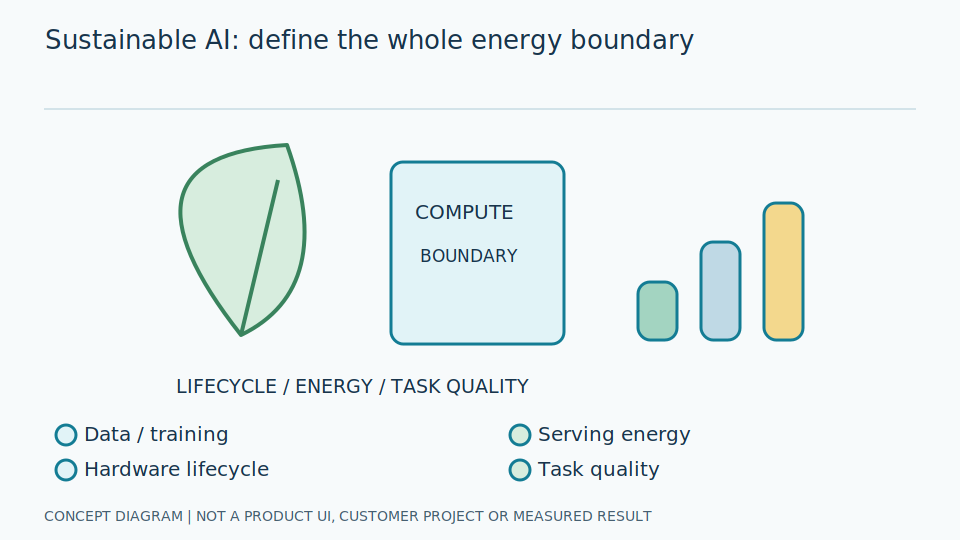
Sustainable AI assesses lifecycle impacts rather than inference energy alone. Define boundaries covering training, equipment, networks, storage, and service life. Software Carbon Intensity relates energy, electricity carbon intensity, and embodied emissions to a specified unit of work.
Sustainability asks how much impact is associated with completing quality work, not merely whether a model is small. A functional unit defines comparable work, such as one correct and fresh reading. An emission factor estimates emissions for an energy source. Embodied emissions cover specified equipment production and lifecycle impacts, separate from electricity during operation. State boundaries so reduced computation in one component is not mistaken for a reduction across an entire factory.
Engineers list training, inference, network, and storage energy included in the study, with equipment lifetime and allocation per work unit. SCI connects these components under defined rules; it is not a certification score. Separate measured quantities from estimates based on assumptions. Factors need sources, years, regions, and uncertainty. Do not compare figures from different boundaries as though they measure the same thing.
Scroll the diagram horizontally to inspect all details.
Illustrative Industrial Example
Design example: compare reading gauges on every frame with sampling according to need while preserving quality and deadlines. Less computation cannot be described as lower factory carbon emissions without assessing the complete relevant boundary.
Suppose selective frame processing reduces computational energy, but cameras, networks, and computers remain equally powered. Total savings may not follow the assumed proportion. Measure the same boundary for both approaches and check that important events are not missed. If fewer readings require more human review, disclose that burden rather than claiming improved sustainability from computation counts alone without maintaining task quality.
Engineers use identical workloads and a functional unit confirming correct, fresh outputs. Measure energy through safe equipment procedures rather than modifying electrical systems themselves. Record periods and included components. New equipment purchases require assessment of lifetime and embodied impacts using available information, not assumptions that new hardware is always more economical. Retention changes must consider storage and later review together; do not remove necessary evidence merely to improve energy scores.
Study and Trial Workflow
- 1 Define a functional unit, such as one correctly read and fresh measurement.
- 2 Measure total energy and use emission factors with stated sources, years, and regions.
- 3 Compare a baseline under the same workload, including retention and equipment lifetime effects.
Evaluation and Metric Definitions
Report energy per work unit with carbon assumptions and uncertainty. Separate measured and estimated quantities, and do not subtract hypothetical savings without evidence.
The denominator must represent successful work, not received images that may all be unreadable. Report quality and timing together with a baseline carrying the same load. Carbon conversion needs explicit factors and boundaries so estimates do not appear to be direct measurements. Do not deduct unverified benefits from reduced waste or downtime, which could exceed evidence or count the same benefit twice.
Engineers check repeatability and sensitivity to assumptions such as equipment life, workload, and factor selection, separating training from operation. If only GPU energy falls while the overall system remains unchanged, report that honestly. SCI and GHG Protocol documents guide boundaries and assessment, not certification or confirmation of product carbon reductions. Clearly identify measured components and those omitted.
Scroll the diagram horizontally to inspect all details.
Limitations and Failure Cases
Lower GPU use may not proportionally reduce whole-system electricity. Average emission factors do not represent every moment, and new equipment has embodied impacts.
Computational resource use and electricity consumption require measurement; they are not universally proportional. Idle work and shared equipment still consume energy. Average factors estimate particular boundaries rather than every operating period. State assumptions and uncertainty instead of changing factors after seeing data to obtain a desired result. Edge, cloud, or smaller models are not inherently more sustainable without a complete comparative assessment.
Lower resolution or sampling frequency can save resources but lose thin needles or brief events. Preserve original quality and deadline criteria before comparison. New equipment also brings lifecycle costs. This example describes a study method, not current product energy reductions, carbon savings, or environmental certification. Hypothetical business benefits must not be presented as actual results for a customer or factory.
Practical Checklist
- Are the assessment boundary and comparison baseline defined?
- Are the sources of emission factors verifiable?
- Does task quality still pass after reducing computation?