
Content Level: Overview / Implementation considerations
Principles and Suitability
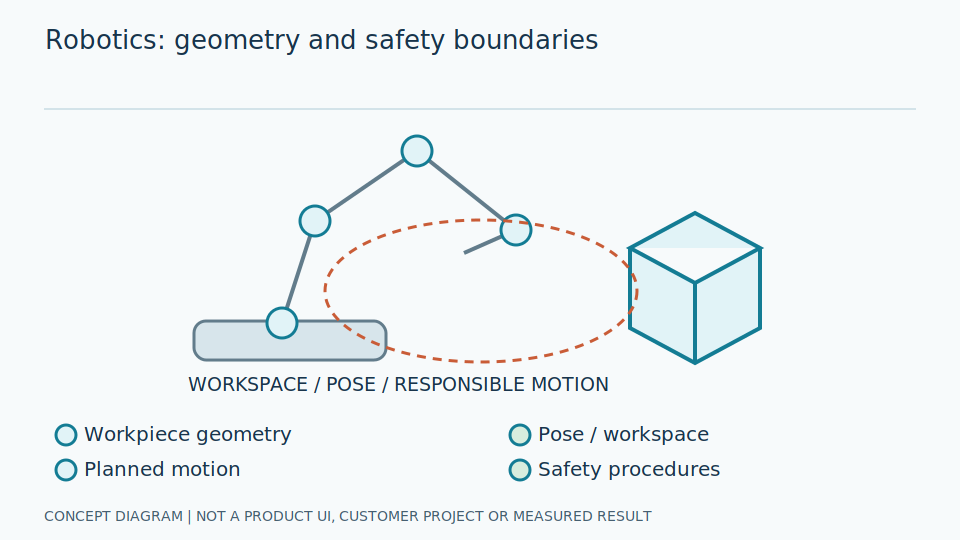
Robotics separates perception for understanding surroundings, planning for selecting paths, and control for movement. Camera and robot coordinates must be transformed correctly, with safety independent of image predictions.
Perception estimates surrounding objects, such as workpiece positions. Planning selects how to reach a goal, and control moves equipment according to requirements. Image results are therefore one input, not a command that is safe in every respect. A cell is a workspace whose people, equipment, and constraints need joint assessment. Correct detection does not guarantee a suitable grasp or path when the workpiece and camera continue moving.
Engineers define coordinate frames, units, and times at every stage. Hand-eye calibration determines the camera-to-robot relationship for the installation. Check parameters and accumulated uncertainty before transmitting positions. The planner must receive insufficient-data or out-of-scope states. Confidence scores cannot replace interlocks or independent protective measures. ROS integration organizes data and coordinates; it does not certify the safety of a physical installation.
Scroll the diagram horizontally to inspect all details.
Illustrative Industrial Example
Design example: vision proposes workpiece positions to a planner in a risk-assessed cell. Uncertain positions must stop command submission under policy, rather than substituting model confidence for protective systems.
Suppose an image shows a workpiece at one location, but processing finishes after it has moved. A position correct at capture time may be unusable at movement time. Check data age and confirmation rules. Better image accuracy alone does not solve the whole problem. If an obstruction hides a grasp point, report rejection under the plan rather than filling in an expected position and trying it on physical equipment to see whether gripping succeeds.
Engineers begin with simulation and reference data that do not command a real robot. Check coordinate transforms and workpiece-relative points before commissioning under an approved integrator plan. Cell testing must respect speed, space, and interlock constraints set by the responsible personnel. Do not alter or bypass protection to collect images or test a planner. Record positions, timestamps, and reasons for withholding commands for later review.
Study and Trial Workflow
- 1 Define coordinate frames and have specialists perform hand-eye calibration.
- 2 Test perception and planning in simulation and approved controlled boundaries.
- 3 Commission with the integrator under defined speed, workspace, and interlock constraints.
Evaluation and Metric Definitions
Measure pose error and task success together with rejection reasons, simulated collisions, and accumulated calibration error. Object AP does not substitute for grasp-point accuracy.
Pose error requires position and angular units in a defined frame. Task success needs explicit definitions of completion and rejection. Bounding-box AP describes approximate localization, not an appropriate grasp point or force. Evaluate each task stage separately, including accumulated coordinate and timing uncertainty. Counting only successes can hide rejected cases that create substantial real workload.
Engineers examine perception and planning in models with independent cases under the test plan, then leave assessment of safe physical checks to responsible personnel. Test invalid inputs, wrong units, and stale data without acting on machinery. Check recovery without executing queued old commands. References to tf2 or OT documentation guide coordinate handling and risk assessment, not safety validation or current product grasping and movement capabilities.
Limitations and Failure Cases
Unseen obstacles, moving workpieces, and latency can invalidate positions. ROS or an AI library is not a cell safety certificate.
Vision has blind areas and missing detail. An empty bounding box does not imply a safe path. Extra cameras can improve some views but add coordinate and clock management. Path models still depend on supplied object information and constraints. Independent safety systems and responsible assessment remain necessary. Do not deliberately cause collisions or move protective devices on a real robot to explore image-model limits.
Integrating perception, planning, and control increases complexity and testing effort. Automation levels must reflect risk; the phrase AI control is not assurance. This example explains integration concepts, not current product support for ROS, robots, or command execution. Simulated results do not establish safety in a physical cell. Acceptance, maintenance, and specialist approval are needed for the particular application.
Practical Checklist
- Do coordinates, units, and timestamps agree?
- Are invalid perception results rejected before use?
- Are risk assessment and safety validation assigned to responsible personnel?