
Content Level: Overview / Implementation considerations
Principles and Suitability
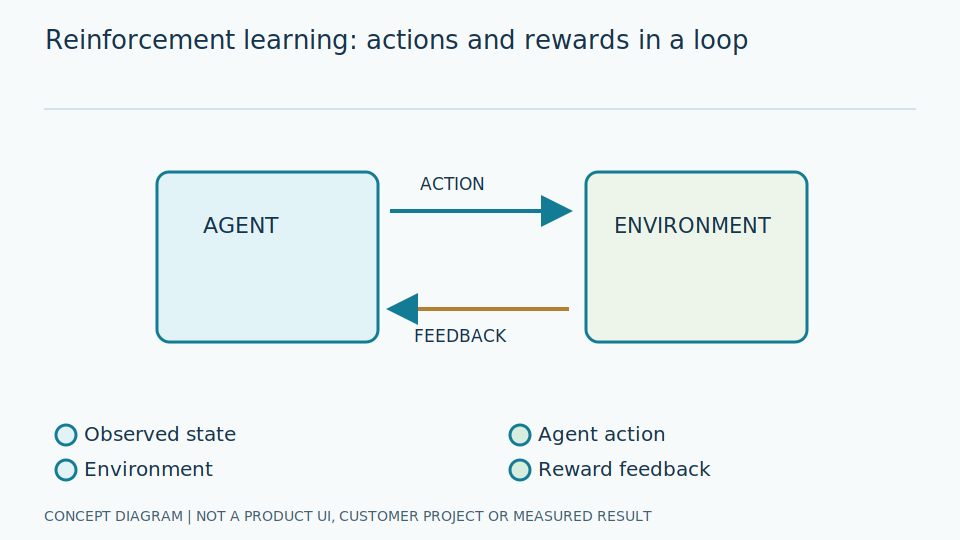
Reinforcement learning learns a policy for choosing actions from rewards in a sequential environment. Incomplete rewards can produce high scores while violating the intended objective. This is a research topic, not confirmation of an available machinery-control system. A policy's numerical success in an experiment must be distinguished from suitability for real equipment and from independently established safety or operational approval.
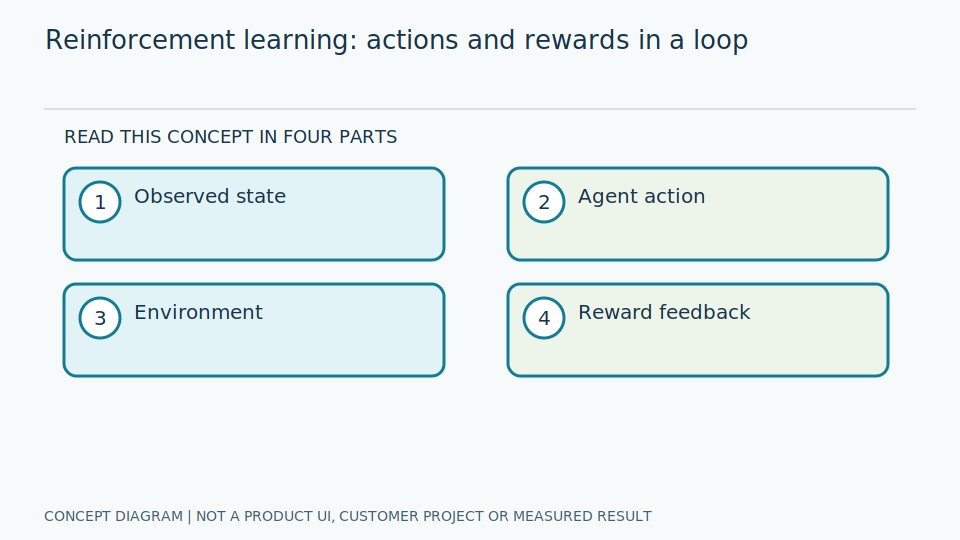
A state describes information used for a decision; an action is an available choice; a reward provides feedback; a policy specifies how choices are made. Incomplete scoring can favor a numerical goal while ignoring real constraints. Define prohibited behavior and simulation boundaries. High reward does not automatically mean appropriate or safe operation, because an objective can omit requirements that matter outside the mathematical score used during learning.
Engineers check whether simulated state information includes what is necessary and genuinely available before an action. Separate hard constraints from rewards: penalties for violations do not replace independent protections. Return aggregates rewards according to temporal rules and supports comparisons only within a simulator whose assumptions have been checked. Maintain research boundaries rather than trialing policies on real machinery without appropriate assessment and authorization.
Scroll the diagram horizontally to inspect all details.
Illustrative Industrial Example
Conceptual simulator example: compare job-scheduling policies with an existing rule under explicit resource constraints, without exploration on real machinery or interlocks. The task studies policy behavior inside a bounded model, where choices can be evaluated without actuating equipment. Results describe the simulated scheduling problem rather than prove readiness to replace an actual operational controller or its protective mechanisms.
Suppose scheduling rewards completed-job count but ignores waiting time for some groups. A policy may leave difficult jobs unfinished to maximize score. This is reward hacking: satisfying the scoring rule while violating its intention. Examine multiple outcomes, including backlogs and constraint violations, rather than return alone. Keep the experiment in simulated data that does not command real equipment, and review whether the objective represents the intended scheduling requirements.
Engineers build scenarios with known constraints and compare the existing scheduling rule over multiple random seeds. Check whether the simulator inadvertently exposes future information to the policy. Offline evaluation from an older policy needs sufficient examples of the new policy's actions. Do not extrapolate unsupported choices into claims of superior real performance, and never explore on safety circuits simply because a simulated policy earned favorable rewards.
Study and Trial Workflow
- 1 Define states, actions, rewards, and prohibited behavior in simulation.
- 2 Check the simulator against permitted data and test reward hacking.
- 3 Evaluate offline with experts before considering any appropriately approved trial.
Evaluation and Metric Definitions
Report return alongside constraint violations, variation across seeds, and baseline comparisons. Offline evaluation must consider coverage of actions the new policy would choose. A high average reward can conceal rare but serious violations, so the evaluation needs explicit evidence about constraints and challenging conditions rather than a single score presented as proof of safe or beneficial behavior in every scenario.
Break down violation types and counts, using challenge cases defined before training. Multiple seeds reveal sensitivity to randomness but do not replace simulator validity. Report assumptions and data used to check the model. Simulation rewards must not be converted into unmeasured real savings or productivity claims, because both the environment representation and the connection between the reward and actual operating outcomes may be incomplete.
Engineers test new simulated situations and compare baselines under identical conditions, including missing data and out-of-range states. When offline conclusions depend strongly on assumptions, disclose uncertainty and what remains unassessable. RL texts and risk frameworks inform research and design; they do not certify a policy or equipment safety and cannot justify bypassing site-expert approval or the assessment required for any consequential operational use.
Limitations and Failure Cases
The simulation-to-reality gap and data distributions generated by an earlier policy can distort evaluation. Safety systems must remain independent, not replaced by reward penalties. A simulator can omit timing, response behavior, or other conditions that a learned policy exploits, so favorable model-based results cannot automatically establish performance or acceptable behavior on the real system the model attempts to represent.
Increasing simulation detail can reduce some gaps but adds cost and leaves limitations. Identify omitted conditions and do not claim that high simulated return means a policy is ready to control machinery or guarantees real-world outcomes. Offline data may also fail to support actions different from those originally observed. These limits affect the validity of conclusions, not merely the amount of numerical optimization performed during training.
Exploration is useful for some learning methods but risky when it acts on real systems. Keep it within this simulator scope and preserve independent safety protections; reward penalties must never justify removing safeguards. This guide explains policies and evaluation, not current product RL or automatic control. Any contemplated use requires accountable personnel and an appropriate assessment process, with research results clearly separated from authorization to affect equipment.
Practical Checklist
- Is the scope of the simulated environment explicitly defined?
- Are baselines and testable constraints provided?
- Are safety systems preserved without bypass?