
Content Level: Overview / Implementation considerations
Principles and Suitability
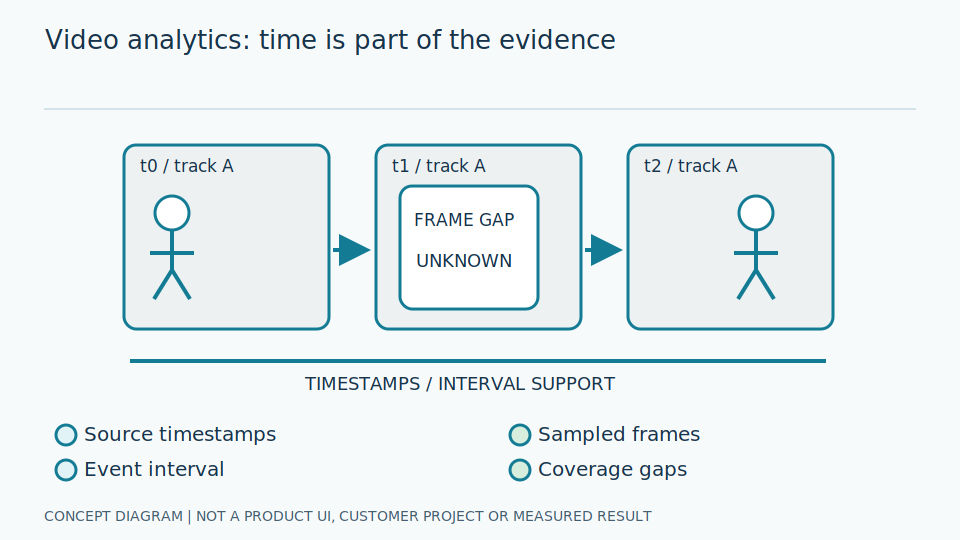
Video analytics combines results from multiple frames into time-based events, requiring definitions for starts, ends, and duplicate counting. Frame sampling reduces processing load but can miss short events. Time continuity is part of the data, not merely image order: a sequence of pictures does not establish uninterrupted observation of the scene.
Video analysis must describe what happened, when, and for how long, rather than simply reading one image. A frame represents one observation; an event is defined from multiple results. Consecutive images in a file do not guarantee equal time intervals. Inspect actual times and data gaps so confirmation of a sustained threshold exceedance does not include periods when the camera supplied no images.
Hysteresis uses different conditions for entering and leaving a state to reduce switching near a boundary, but must match task meaning without hiding important change. Engineers define normal, above-threshold, and insufficient-data states with rules for starting, ending, and reopening events. Sampling must match the duration of events of interest, not substitute the system's convenient frequency for what users actually need to observe.
Scroll the diagram horizontally to inspect all details.
Illustrative Industrial Example
Design example: issue an alert when a gauge reading exceeds a threshold continuously for a defined duration. Distinguish unreadable frames from normal values, and use hysteresis to reduce state switching near a boundary. The confirmation rule should express the intended event meaning rather than assume that every missing or rejected reading represents a normal condition.
Suppose two above-threshold periods are separated by a camera outage. The absence of a low reading does not prove continuous exceedance. Represent the gap explicitly and explain that confirmation lacks data. Different exit and entry conditions can reduce repeated messages when values fluctuate near a boundary, but users should see raw readings and the reason a state has not yet changed.
Engineers test transitions with simulated timestamped readings, without forcing the real process beyond a threshold. Include unreadable images, clocks moving backward, and reconnection. Define event identifiers to avoid repeat delivery after retries, and attach evidence images or clips to capture time. A backlog must not make an old event appear to be happening now merely because processing and notification occurred recently.
Study and Trial Workflow
- 1 Define events and their time reference at capture.
- 2 Choose sampling and confirmation windows according to event duration.
- 3 Test dropped frames, camera stoppages, and mismatched clocks before delivering events.
Evaluation and Metric Definitions
Measure event precision and recall, delay from the actual event to notification, and duplicate events. Frame accuracy alone is insufficient because a single event can span many frames. Evaluation must therefore count the events users need to know about, not allow large numbers of normal frames to dominate an apparently strong overall score.
Define notification-to-event matching and allowable time discrepancies before counting results. Multiple notifications for one event must not inflate correct detections. Report missed events, false notifications, and duplicates separately, with observation duration. Numerous normal frames can yield high frame-level accuracy despite missing an important short event, so event-level evaluation must reflect what the user needs to recognize rather than image classification alone.
Engineers measure delay from the event time until a usable result is available, separating image waiting, processing, state confirmation, and message delivery. Test restart behavior after gaps against declared rules. When changing confirmation windows, compare false notifications and missed short events together instead of selecting only for fewer alerts. Preserve time-reference answers with images so the matching and timing judgments can be reviewed.
Limitations and Failure Cases
Time averaging may hide important brief peaks, and a receiver timestamp differs from capture time when buffering occurs. A sequence processed quickly can still describe old events. Interpretation therefore requires the age and origin of its observations, rather than only processing speed or the timestamp added when results arrive at the receiving application.
Buffering holds images in a queue before transmission or processing, so a newly received image may have been captured long ago. Ordering results by processing time can mislead when queues or networks are slow. Separate data age from program response time and define when stale images cannot confirm current state. Never deliver a retained value as if it were fresh information without a clear label.
Longer averaging windows reduce fluctuation but add waiting and may conceal fast events; shorter windows increase sensitivity and notifications caused by reading errors. Choose according to the task and inspect raw data too. Video analytics aids observation, not proof of suitability as a safety circuit or guaranteed response time. Clip storage also needs appropriate access-rights and retention policies.
Practical Checklist
- Do gaps in the video stream have an explicit status?
- What is the retention period for video evidence clips?
- How does counting stop or a new event open after reconnection?