
Principles and Suitable Contexts
IoT links measurable quantities with communication and the use of data. It is suitable when time-based observations answer questions that occasional manual records cannot. Without someone responsible for decisions, continuous data may add work without changing outcomes. Compare it with alternatives such as improving forms or using existing records.
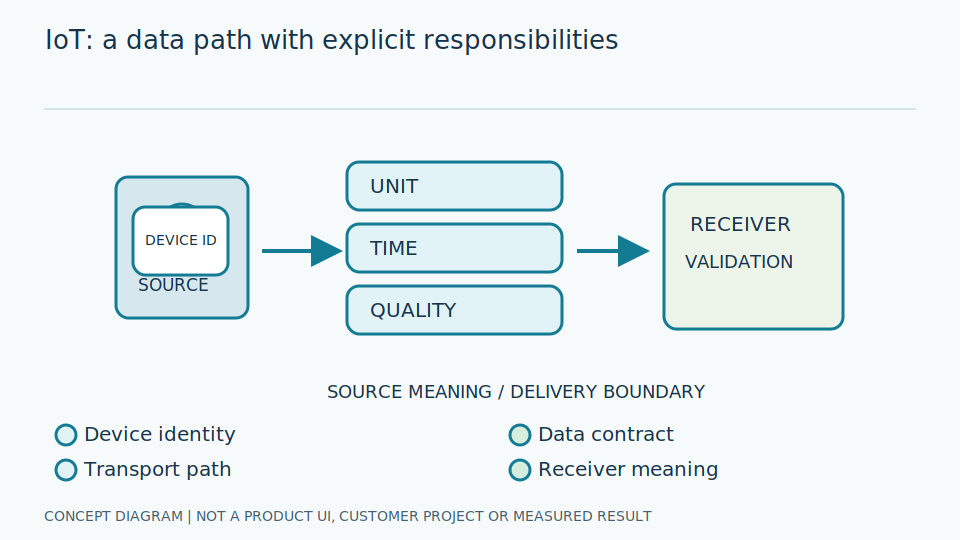
The Internet of Things, or IoT, does not deliver answers simply by adding sensors. It needs a chain from a measurable quantity through recording time and communication to the person using it. Ask what would change if information arrived sooner than a manual record. Without a clear answer, charts and alerts may merely transfer work from recorders to screen viewers rather than improve decisions.
Translate required quality into units, sampling interval, data age and unknown-state requirements. Faster sampling increases the chance of seeing short events but adds records and maintenance; maximum frequency is not automatically best. Separate monitoring from control, retaining independent safety instrumented systems, interlocks and emergency shutdown circuits. Successful data transmission does not demonstrate a safety function or authorise changing the process being observed.
Scroll the diagram horizontally to inspect all details.
Design and Data Preparation
Define one question, such as identifying when instrument data is missing. Specify the measurement source, unit, interval, user and action to take when an event occurs. Collect baseline records before the trial, including time spent recording, checking and maintaining the system, without assuming any savings.
Describe the existing workflow from recording through error checking to delivery to a decision maker, then identify what the trial should teach. Define acceptable results and review conditions before installing equipment; do not target online point count alone. Assign someone to decide whether incomplete data permits limited continued use or requires returning to the previous process. Ownership must include handling uncertainty, not just initial installation.
Map data sources, units, times, authorised viewers and retention. Check actual-model constraints without assuming shared protocol names establish compatibility. Estimate workload from records and inspections actually required. Separate installation, maintenance and retirement costs according to available evidence, so expansion decisions do not depend on the impression that a newer system looks modern. Label estimates clearly rather than presenting anticipated benefits as observed results.
Failure Cases and Limitations
A faulty sensor that keeps transmitting complete records can create false confidence. Excessive alerts may cause people to ignore them, and a system without an owner may stop being maintained when staff change roles. Connectivity alone is not evidence that the data is suitable for the intended decision.
Large record volumes can conceal important gaps, such as continuously transmitted device status paired with a frozen measurement. Check measurement freshness separately from connectivity. When values are wrong, retain provenance and consequences for decisions. Do not silently repair historical charts until they appear complete; tell users which intervals contained errors and which previous decisions may need review using corrected or independently verified evidence.
Alerts without recipients or verification procedures produce a backlog rather than measurable benefit. A new maintainer needs a registry and recovery procedure they can actually follow. Include non-IoT alternatives, such as changing manual sampling intervals or improving forms, in the assessment. Some problems arise from unclear data meaning rather than missing connectivity, so adding a network may leave their underlying cause unchanged.
Trial and Evaluation Methods
Run a small trial against the existing process. Measure data completeness, time from an event to human awareness, and actual maintenance effort. Separate observed results from costs or benefits that remain estimates. Define a stopping criterion if the additional data does not change decisions.
Compare work with similar context, counting missing records and rechecks for both methods. Ask users to record resulting actions and reasons why some information was unused. Message volume or dashboard openings are not automatically benefits. Learning that the system does not yet answer the question is a useful trial outcome and should be reported rather than concealed behind a high connectivity percentage.
Acceptance needs evidence from source through actual use, with an independent reviewer checking sample values, timestamps and status. Include maintenance and recovery effort encountered. Limit conclusions to the observed period and scale if results come from a small short trial. NIST guidance helps structure responsibilities and baseline requirements; it does not certify savings, product readiness or success when device numbers increase.
Review Checklist
- Identify the question and data user.
- Understand the consequences of incorrect data.
- Collect baseline records before the trial.
- Assess connectivity, maintenance and retirement costs.
References and Further Reading
References explain technology principles or requirements. They do not establish product certification or support for every requirement.