
Content Level: Research / Integration concept
Principles and Suitability
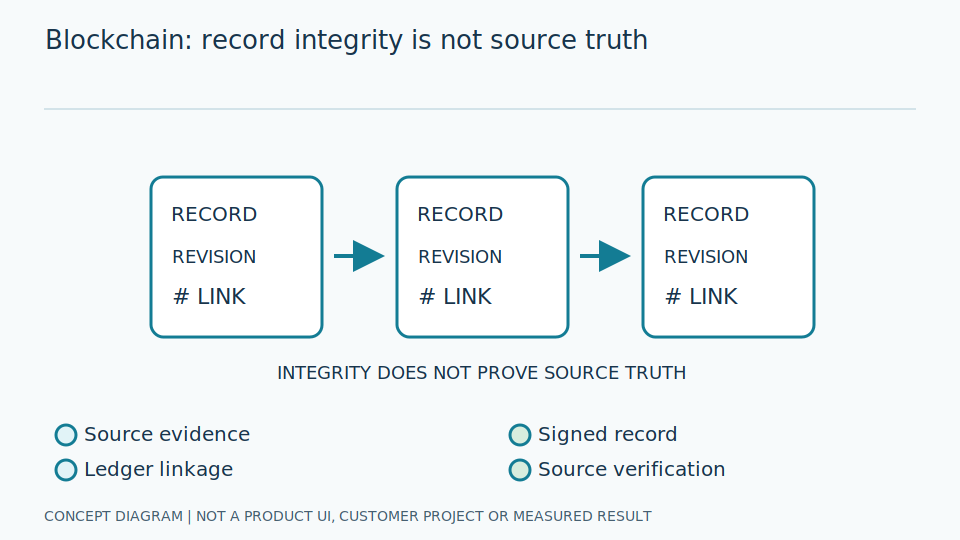
Blockchain is a shared ledger using consensus and linked blocks to make historical changes difficult under network assumptions. It does not guarantee that camera data or human input was true in the first place.
A blockchain supports jointly inspectable history under agreed rules. Consensus determines which entries are accepted, but accepted entries can already contain misread images or wrong units. Preserving history differs from verifying source truth. Maintain verifiable provenance and checks before recording. Difficulty changing records is not assurance that every reading or physical event is correct.
Engineers specify the threat model, participating parties, and authority to change rules. Governance remains dependent on trust in particular roles. A permissioned chain limits participation but does not remove that responsibility. Compare append-only databases, which add history without rewriting earlier entries, and digital signatures, which authenticate signers within a key system, before choosing additional complexity. Do not put confidential data on a chain without assessment.
Scroll the diagram horizontally to inspect all details.
Illustrative Industrial Example
Conceptual example: multiple organizations might need shared evidence histories, whereas an internal gauge-reading system may be adequately served by a database and signed audit log. First establish why a simpler approach cannot meet the need.
Suppose several departments review readings but accept one data owner. A database with history and signatures may suffice. If trust must be distributed, identify who verifies sources and who corrects mistakes. Recording an erroneous image reading in a protected history still requires a corrective entry and new evidence. Its presence on a chain does not make the original value correct.
Engineers trial recording and recovery rules with non-confidential simulated data, including signing-key management and changes to authorized participants. If images stay off-chain and content hashes are recorded on-chain, explain that hashes detect content changes rather than establish image truth. Assess personal-data deletion and correction policies before selecting the design, since permanent history can conflict with purposes requiring limited retention.
Study and Trial Workflow
- 1 Identify participating parties, the threat model, and authority over historical changes.
- 2 Compare append-only databases and digital signatures.
- 3 Only where genuinely necessary, define consensus, governance, and off-chain storage.
Evaluation and Metric Definitions
Test finality, throughput, costs, and recovery, including source provenance checks before recording. Node count alone is not evidence of trustworthiness.
Finality defines when entries are settled under the mechanism. Nodes perform computation or storage according to their assigned roles. Large numbers do not guarantee distributed trust when control remains with one party. Report conditions, authorities, and time until usable settlement, including transmission and storage costs. Comparing one throughput stage with a database performing all required functions does not establish a general advantage.
Engineers check correct, incorrect, duplicate, and corrected entries under the rules, including loss of signing authority in approved tests. Verify that images and reading provenance remain reviewable without unnecessary disclosure. NIST documentation explains blockchain designs, not network certification or product services. Historical integrity must remain separate from physical measurement checks, whose source uncertainty still exists.
Limitations and Failure Cases
Immutable logs complicate personal-data correction. Lost keys and incorrect source data remain problems, and permissioned chains still rely on governance.
Interpret immutability within stated network assumptions and authority, not as an absolute inability to change anything. Lost or misused keys undermine access and verification, requiring auditable recovery and role-change plans. Data wrong before recording remains wrong afterward. Check images, units, timestamps, and corrective entries rather than substituting a chain for data quality or factual approval.
Shared ledgers support review in some boundaries but increase governance, storage, and deletion complexity. Choose them for genuine needs, not technology branding. This article describes research and integration concepts, not current product blockchain, signing, or permanent-record capabilities. Do not claim transparency gains or savings without measurement in an evidenced system with actual participating parties.
Scroll the diagram horizontally to inspect all details.
Practical Checklist
- Is there a genuine need to distribute trust?
- Is confidential information kept off-chain?
- Are correction procedures and key management defined?