
Principles and Suitable Contexts
Device management includes registration, permissions, health checks, updates and revocation. It becomes useful when the number of endpoints makes manual handling error-prone. An online indicator means only that some signal has arrived; it does not confirm that the sensor itself is measuring correctly.
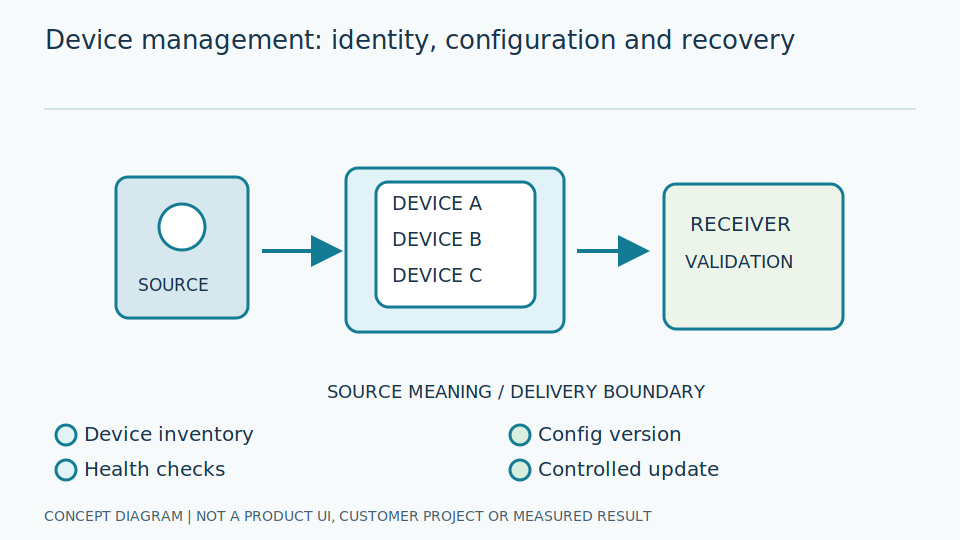
A registry explains which device is where, what it sends and who owns it. Firmware is software running on equipment; a heartbeat indicates communication, not fresh measurement or a healthy sensor. Show connection state, data quality and software version separately rather than combining them into one green lamp. The distinction helps users recognise a communicating device whose measurement channel has stopped updating.
The lifecycle extends from onboarding to retirement. Bind identities and keys to identifiable hardware, preserving replacement history at a reused location rather than treating a point name as the entire identity. Updates must account for data compatibility and actual recovery. Do not assume every device can roll back or receive remote updates; those capabilities need confirmation for the models involved.
Scroll the diagram horizontally to inspect all details.
Design and Data Preparation
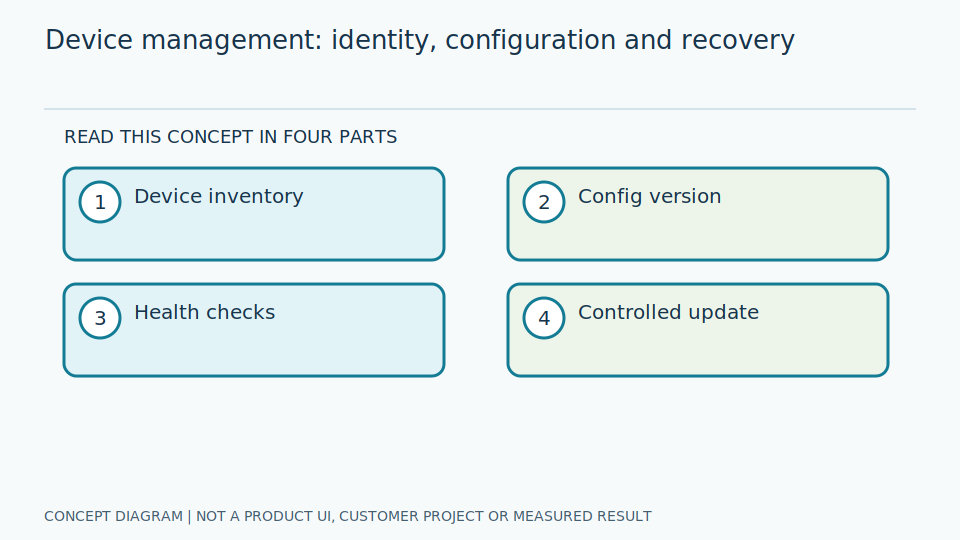
Assign a unique identity to each device. Record the model, firmware, location, owner and certificate status. Separate connection status from measurement age. Use a pilot group for configuration changes, with rollback options and on-site recovery procedures, before making changes across the wider device population.
Define registration that verifies hardware and approver, with statuses for spare, active, repair and retired equipment as appropriate. Record movement separately from identity. For certificates, know expiry dates and renewal owners. Keep keys and secrets out of broadly readable registries, restricting configuration changes by role. A useful asset inventory identifies responsibilities without turning into an unprotected store of credentials.
Choose a pilot group representing relevant models and conditions, not only conveniently accessible hardware. Verify signatures or update integrity through methods actually supported, back up necessary settings and define expansion stopping criteria. OT configuration changes still require the existing approval process. Device-management access does not implicitly grant authority to control machinery or modify the physical process that produces the measurements.
Failure Cases and Limitations
Updating every device at once can interrupt data from the entire group. An expired certificate may disconnect otherwise healthy hardware, and shared credentials make individual revocation difficult. Rolling back may not be possible after a data-format change, so version compatibility must not be assumed.
Command sent may mean only successful dispatch, not completed installation. Verify the device's actual version and settings afterward. If an update changes schemas or storage structure, software rollback alone may not restore service. Document migration steps and irreversible boundaries beforehand, distinguishing the ability to reinstall an earlier program from the ability to recover compatible data and a functioning measurement path.
Retired devices retaining access can mix records with replacements, while reused point names hide source changes. Revoke identities under policy and preserve replacement history. An online display paired with frozen values can conceal maintenance needs; use measurement time and quality codes too. Management software cannot replace instrument inspection or existing safety duties simply because it reports firmware and connectivity correctly.
Trial and Evaluation Methods
Test successful updates, failed updates and power loss during updates in a trial group. Verify that installed versions can actually be identified. Test revocation for retired devices and key rotation. Measure restoration time and the number of devices requiring on-site assistance rather than only counting completed updates.
Use trial hardware or simulations separate from live processes for failure scenarios. Independent reviewers should compare registry versions with device-reported versions, checking that completion messages reflect installed results. Test continuing heartbeats with stopped measurements to show that health status is not derived from connectivity alone. A communications success must not become a pass for the measurement channel without evidence that it is updating.
Acceptance should cover individual revocation, key changes and settings recovery within confirmed constraints, including relocation and replacement history. State untested models and actual on-site assistance requirements. NIST's IoT baseline helps organise capabilities to consider; it does not establish that any device or platform implements them all or is certified. Report recovery evidence separately from planned features and assumed version compatibility.
Review Checklist
- Assign a unique identity and an owner.
- Separate heartbeats from measurement quality.
- Start configuration changes with a pilot group.
- Revoke access and remove data at retirement.
References and Further Reading
References explain technology principles or requirements. They do not establish product certification or support for every requirement.