
Content Level: Overview / Implementation considerations
Principles and Suitability
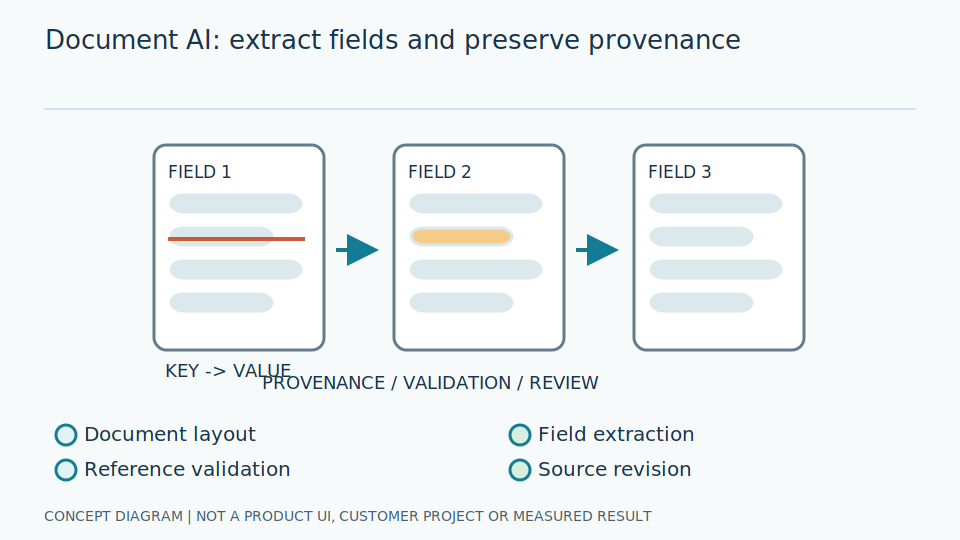
Key Information Extraction, or KIE, turns documents into schema-defined fields using text, position, and context. Correct OCR can still associate a number with the wrong heading. Evaluate downstream extraction separately from character recognition because readable text does not establish that the selected value belongs to the intended instrument, date, unit, or other field in the structured record.
KIE selects text for meaningful fields, such as calibration date, rather than copying a whole page. A field is a data slot; its schema specifies names, types, and conditions. Documents with perfectly recognized text may contain multiple dates or identifiers. Check heading and position relationships instead of taking the first number matching a pattern and assuming that it answers the intended question.
Engineers separate raw text, normalized values, and location evidence. A date may be standardized while retaining its original wording. Define required fields, missing values, and conflicting candidates before recording results. Context can help association but must not invent absent information. Check page numbers and coordinate transformations after rotation or resizing so reviewers can find the selected text at the correct location in the original document.
Scroll the diagram horizontally to inspect all details.
Illustrative Industrial Example
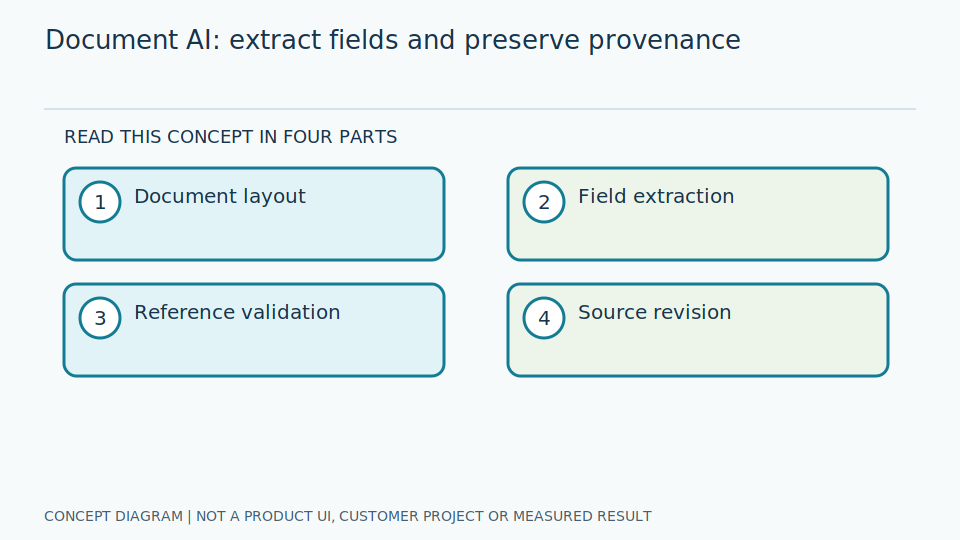
Design example: extract instrument identifiers, calibration dates, and units from a report, distinguishing the issue date from the calibration date and checking conflicts before storage. The intended output is a structured record tied to visible source evidence, not an assertion that every date recognized on the page describes the same event or that the report's underlying certification is valid.
Suppose preparation and inspection dates differ. A program may recognize both correctly but fill the wrong field. Reviewers need the selected heading and text, not just a standardized value. For multiple instruments, associate each identifier with its row's result rather than applying a page-header number everywhere. An empty field should remain missing, not receive a value copied from a previous document simply to complete the record.
Engineers label each field with its page region and test cross-page tables and repeated headings. Consistency rules can route conflicts for confirmation but do not prove every passing value correct: a plausible date may still belong to another field. Store the schema version and supporting evidence so reviewers can trace structured data to actual text without interpreting extraction as a broader claim about certification.
Study and Trial Workflow
- 1 Define the schema, required fields, formats, and unknown-value representation.
- 2 Label fields with supporting locations on their source pages.
- 3 Check constraints and request human confirmation for important fields with low confidence or rule conflicts.
Evaluation and Metric Definitions
Report precision, recall, or exact match for each field and complete-document correctness. Distinguish normalized values from raw text and test new templates. Field extraction needs its own evaluation because recognizing every character does not guarantee correct association, and a mostly correct record can still be unusable when an important instrument identifier or date has been assigned incorrectly.
Normalized values use consistent formats for comparison, such as standardized dates, but conversion must not silently change meaning. State whether exact match compares original text or normalized outputs. Include missing and misassociated fields. Many correct fields do not establish complete-document correctness if a critical identifier is wrong. Report full-schema success and important-field results separately, with the comparison rules made explicit before evaluating the outputs.
Engineers hold out document templates to assess unseen layouts, including multiple pages, skewed text, and overlaid stamps. Check exported page and region evidence against stored values. If OCR is correct but the field is wrong, investigate association before retraining recognition. LayoutLM is a reference for combining text and position, not assurance of universal document support or proof that a product currently uses that model.
Limitations and Failure Cases
Layout drift, cross-page tables, and repeated headings can cause incorrect association. Filling absent information from context can create false facts. Extraction should preserve uncertainty rather than force every schema field to appear complete, because a neatly formatted output can obscure whether its value came from the document or from an unsupported assumption introduced during interpretation or normalization.
Layout drift means page arrangements change, such as relocated fields or differently divided tables. Fixed-position rules are simple but fragile; contextual models add flexibility without eliminating wrong selections. Support unknown and conflicting-value states instead of fabricating expected values. Reading text from a certificate must not be presented as verification that the certificate itself is accurate or that its stated certification has been independently established.
Documents may contain personal and equipment information that cannot be freely shared. Define access and retention for images and extracted values. Human review adds workload but can protect important fields; choose it according to recording-error risk, not model confidence alone as legal approval. This example proposes an extraction process for evaluation, rather than confirming current document-processing capabilities in a product or any automatic compliance determination.
Practical Checklist
- Does the document field schema have an explicit version?
- Are source text and page evidence retained?
- Is retention for personal information clearly defined?