
Content Level: Overview / Implementation considerations
Principles and Suitability
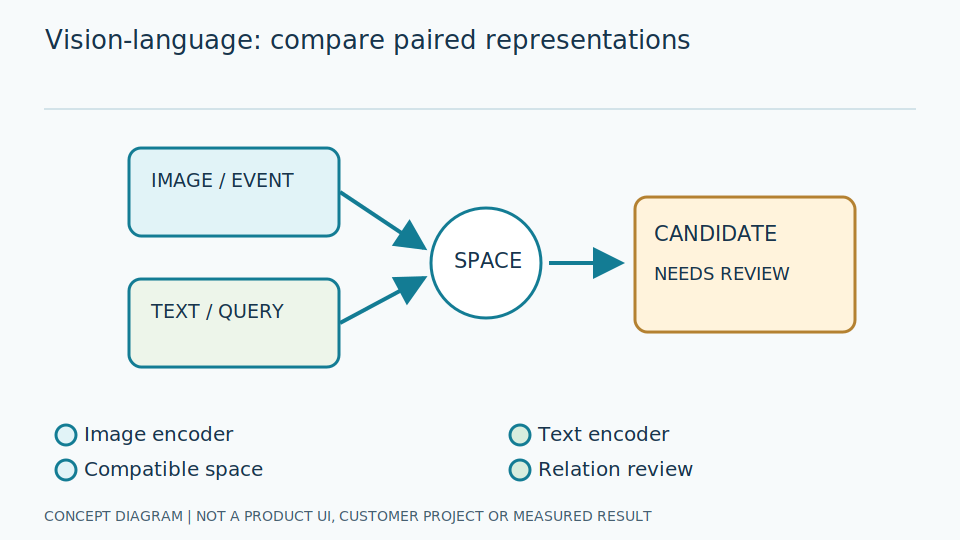
Vision-language models connect images and language for search, classification or descriptive assistance. Some generate text, while models such as CLIP score image-text similarity. Do not assume identical capabilities or interpret similarity scores as probabilities.
These methods allow language-based image queries, such as finding contamination without knowing filenames. Matching a query differs from confirming details. Retrieval models do not produce the same outputs as descriptive models, and fluent descriptions can mention absent evidence. Separate search, summarisation and measurement roles, each requiring different checks. Language convenience does not make these roles interchangeable.
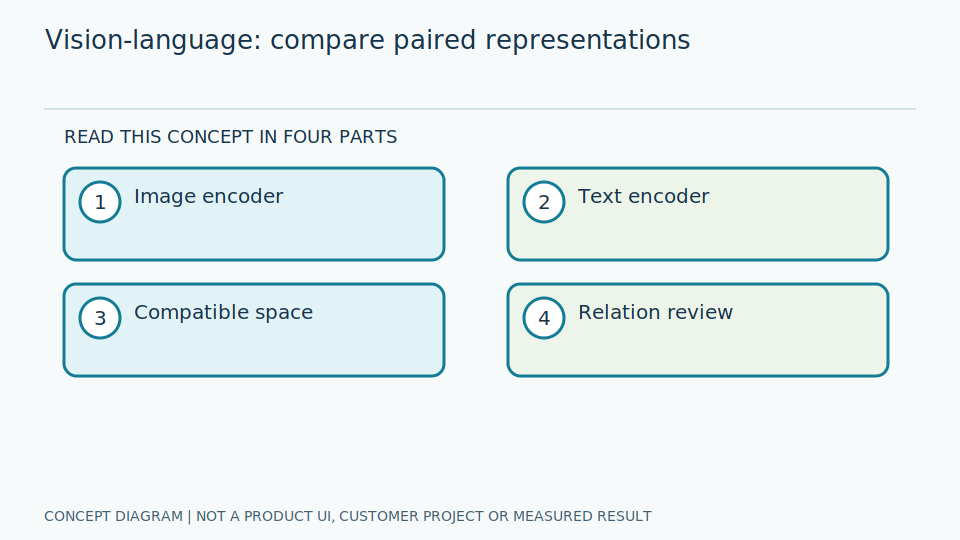
Define accepted questions, output formats and data scope before selecting a model. An embedding is a numerical representation used to compare text and images. Similarity depends on alternatives and scoring, not a probability that fog genuinely exists. Test operational Thai terms and related expressions, including cases without matching images, so the system is not forced always to select the nearest available result.
Scroll the diagram horizontally to inspect all details.
Illustrative Industrial Example
Illustrative design scenario: help staff find images of fogged dials in an image library, then have a person review them. Pressure values used for control require dedicated reading and calibration methods; a description must not replace measurement.
Suppose retrieval returns both fogged glass and camera-blurred images. Similar appearance can require different remedies. Staff should inspect images with times and sources rather than use generated descriptions as confirmation. If a question asks for a value with an unclear decimal, report insufficient evidence instead of filling digits from familiarity with that dial type.
Prepare verified queries and answers and check that exported metadata belongs to the correct image. Generated descriptions should separate observation from assumptions. Inspect hidden image text that might steer answers: image contents are analysis data, not instructions changing system policy. External service transmission must remain within approved data boundaries, regardless of how useful a model's assistance might appear.
Study and Trial Workflow
- 1 Restrict questions and the data permitted to be sent to the model.
- 2 Prepare questions with reference answers and images that cannot support an answer.
- 3 Show image evidence and require human approval for consequential conclusions.
Evaluation and Metric Definitions
Test task correctness, confidently wrong answers, rejection when evidence is insufficient and latency including service calls. Evaluate image retrieval separately from answer generation because their outputs and failure modes differ.
For retrieval, check whether leading results genuinely match verified queries. For descriptions, compare every assertion with evidence rather than equating fluent language with truth. Include unanswerable images and out-of-scope questions. Separate appropriate rejection from rejection of answerable cases to expose the tradeoff between helpful assistance and unsupported answers. A system that refuses everything and one that guesses everything have different shortcomings.
Fix model and prompt versions, where prompts are task instructions, then test new questions excluded from tuning. Include network waits and retries in service timing. Check synonymous Thai formulations and distracting image text. After version changes, rerun the same evaluation; previous and new answers are not automatically comparable without reviewing changed behaviour and its consequences.
Limitations and Failure Cases
A model may invent details absent from an image, misread units or follow hidden instructions in image text. Confidential data must not be sent to external services without approval, and generated explanations still need review.
Unsupported answers can sound reasonable enough to escape notice. Display reference images and verifiable details, requiring human approval for important conclusions. Enforcing an output format organises text but does not guarantee truth. Cautionary instructions alone do not replace failure-case tests or restrictions on actions outside the model's information-assistance role.
Language interfaces improve access but increase disclosure and overinterpretation risks. Define access, retention and deletion for the context. Separate semantic help from calibrated numerical measurement. References provide assessment guidance, not assertions of current product model support or transmission to particular providers. Neither a persuasive explanation nor an image-search score constitutes independent evidence that a physical instrument reading is accurate.
Practical Checklist
- Is semantic assistance separated from numeric metrology?
- Is human review included before approving important conclusions?
- Are model and prompt versions pinned and data policies defined?