
Principles and Suitable Contexts
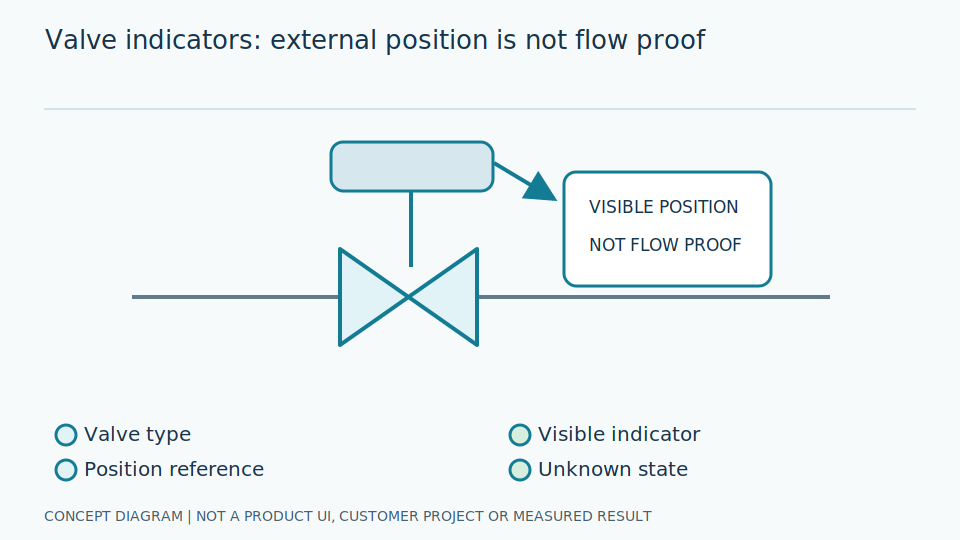
A position indicator or valve stem reveals a visible mechanical condition, not necessarily the position of internal valve parts. It can support consistency checks against operating records. It does not prove tight shutoff or absence of leakage through the valve, even if the indicator appears fully closed.
Commanded state describes what the system wants, indicated state what the device shows, and verified position the outcome of an appropriate independent check. They can differ during travel or faults. A partly open valve does not necessarily pass a proportional flow rate because valve characteristics and system pressure difference also matter. Do not turn a position observation into a flow measurement without the required evidence.
Images may locate an indicator angle or stem displacement against reference marks. Use type-specific mappings, not a universal rule that a handle parallel to a pipe means open. Percentage conversion needs confirmed endpoints and stated uncertainty. If only the external indicator is visible, name the record accordingly; calling it flow or tight shutoff would imply properties that were never measured by the image.
Scroll the diagram horizontally to inspect all details.
Data and Preparation
Document valve type, opening direction, endpoints and travel from the equipment records. Capture open, closed and intermediate positions. Choose a view unobstructed by insulation or other equipment. Record timestamps and command states for comparison without treating the command itself as an independently verified physical position.
Start with the valve registry and indication normally inspected by operators. Responsible personnel should identify usable evidence without anyone independently removing covers or insulation. Show reference marks and moving parts together to detect camera displacement. Use operating events or authorised inspections rather than commanding the valve to produce all dataset states. Unobserved states remain testing gaps, not reasons to change the process.
Define moving and unreadable states in advance, including time alignment with command records where access is authorised. Endpoint confirmation may need several frames to reduce vibration effects, but that observation delay must not delay the original control system. Retain repairs and indicator replacements in the registry so reviewers know when an old positional mapping requires verification before being reused.
Failure Cases and Limitations
A loose linkage or displaced indicator can disagree with the internal mechanism. Occlusion can resemble an endpoint, and some valves require several turns. Do not move a valve to collect examples without an authorised procedure. Keep moving and unknown states available instead of forcing every image into open or closed.
An unchanged image after a changed command could mean stale imagery, unfinished travel or an equipment fault. Check image age and other evidence before concluding actuator failure. No visible change is not proof of safety, and an endpoint indication does not prove fluid isolation: leakage through internal seating is not visible in an external position marker. Maintain that distinction in reports as well as individual records.
Perspective can overlap distinct positions, while cropping may remove endpoint marks and invite a false conclusion. Retain rejection reasons and route images for independent inspection. Discrepancy handling must follow plant procedures, not experimental open-close commands from image-reading software. Valves involved in emergency shutdown must retain their original channels and duties separately; supplementary observation is not permission to alter their protective function.
Evaluation Methods
Compare image states with authorised mechanical checks. Treat seat-tightness testing as a separate activity. Measure errors by state and assess transition timing using verified events. A command record alone is not always ground truth for physical position, so document which observation actually confirms each reference label.
Keep one reference set for visible position and time and another for authorised physical checks. This distinguishes misreading from an indicator disagreeing with the mechanism. Test actual recorded sequences from travel onset through intermediate position to endpoint, including obscured views and unfamiliar indicators. Without evidence of internal position, limit the evaluation to the external indicator rather than claiming a physical-valve position score.
Acceptance must state the valve types and positional ranges covered, including false endpoint conclusions and unnecessary referrals. Do not let numerous stationary images hide transition errors in an average. Check that historical records clearly distinguish commands from observations. Results do not assess seat leakage, actuator capability or suitability for an instrumented safety system, and they do not authorise using images as control permissives.
Review Checklist
- Separate commanded, indicated and verified states.
- Include moving and unknown states.
- Specify the dwell time needed to confirm a state change.
- Do not substitute images for leakage testing.
References and Further Reading
References explain principles, not product certification. Requirements from another jurisdiction do not automatically replace local requirements or the actual equipment manual.