
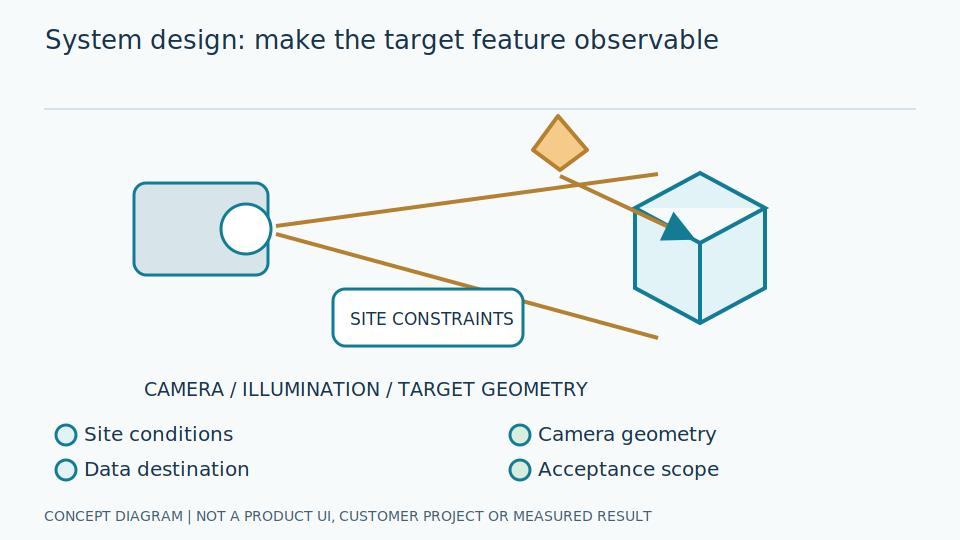
Design from user questions and site constraints
Define the information users need and the decisions it supports, such as history or inspection review. Then ask whether images contain sufficient evidence or another measurement should be used. Do not select cameras or models before establishing scope.
Survey equipment, lighting, movement, mounting, power, networking and ownership. Close images show detail; wide views show placement and occlusion. Both prevent designs based on readable samples that cannot be reproduced at the installation.
Separate initial requirements from proposals, such as read-only collection before alerts. Write-back and safety functions involve different risks and require specific assessment rather than inference from successful data transport.
Scroll the diagram horizontally to inspect all details.
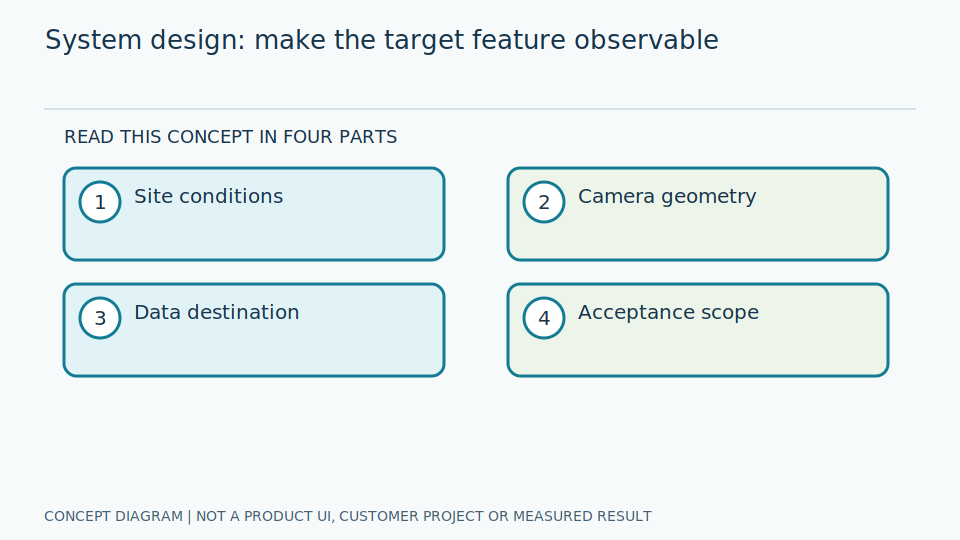
Make design and acceptance jointly verifiable
Diagram image paths, outputs, timestamps, units and validity together with integration boundaries. Explain unreadable and offline behavior and who reviews each state.
Agree on trials and acceptance before development. Separate reading error, completeness, latency and review effort instead of one overall score. Record questions lacking sufficient data for surveys or further experiments.
These are matters to agree within actual scope. Document quantities, schedules and deliverables require an SI partner agreement. Using industry guidance does not establish product certification or approval of a specific project design.