
Content Level: Overview / Implementation considerations
Principles and Suitability
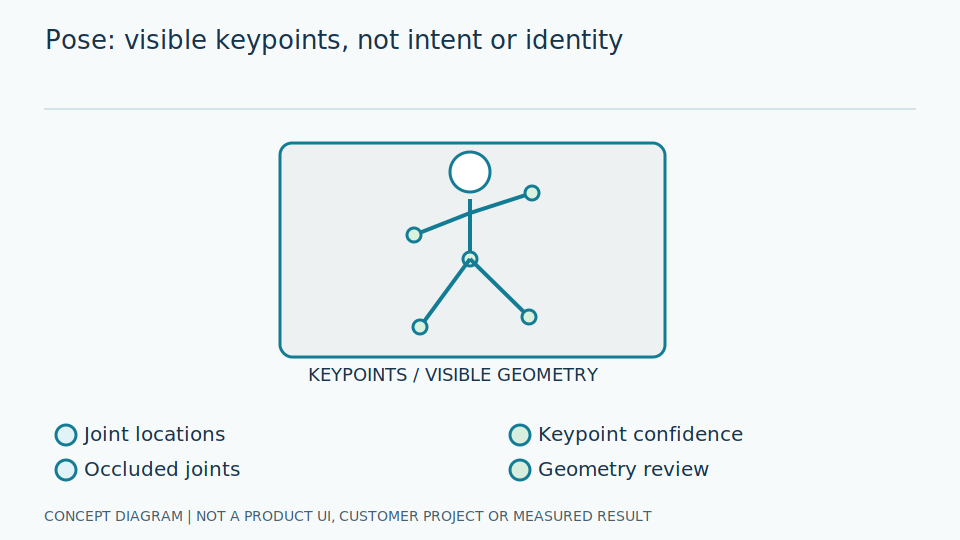
Keypoint detection locates predefined points, such as a pivot and pointer tip, before calculating geometric relationships. Pose may describe a two-dimensional configuration or three-dimensional orientation. Define the coordinate system and point meanings before training.
Keypoints reduce a shape to positions needed for calculation: two points can describe pointer direction. Define tip consistently for annotators. Selecting a counterweight instead reverses direction even though the point genuinely lies on the pointer. Definitions must follow the reading function, not merely choose the most conspicuous point or the one farthest from the centre.
Pose describes configuration, potentially including direction and position; keypoints supply only part of that information. State whether coordinates are image-based or physical and how invisible points are treated. Perspective correction transforms points as well as images. A front-facing angle formula cannot simply be applied to tilted images as though the difference were only a translation.
Scroll the diagram horizontally to inspect all details.
Illustrative Industrial Example
Illustrative design scenario: calculate an angle with atan2 from a pointer pivot and tip, then compare it with the reference scale angles. A counterweight on the pointer must not be confused with the actual pointer tip during annotation.
Suppose one dial has a short pointer and another a long one. Identical tip-position errors can produce much greater angular error for the short pointer. Inspect pivot and tip jointly rather than accepting a point simply because it is near a pointer edge. If the tip is obscured, mark it invisible instead of forcing a precise prediction from incomplete evidence and treating that prediction as observed.
Atan2 uses differences along two axes with directional information, but image vertical coordinates commonly increase downwards. Check signs and rotation direction using hypothetical points in each direction and near angle boundaries. Validate mapping to actual scale endpoints. Undo resizing and padding before overlays, so coordinate-conversion bugs are not mistaken for failures of the keypoint model.
Study and Trial Workflow
- 1 Define each point and its visible or occluded status.
- 2 Correct perspective or restrict installation angles to match the value-conversion method.
- 3 Test scale crossings and reflections without guessing locations that cannot be seen.
Evaluation and Metric Definitions
Report point-position error normalized by dial size, then add angular error and numeric-reading error. The same point displacement produces a larger angle error for a short pointer, so pixel error alone is not sufficient.
Normalisation scales distance by a stated reference, such as dial diameter, to compare different image sizes. Handle circular angle boundaries correctly rather than interpreting nearby start and end angles as almost a whole turn apart. Separately handle scales occupying only part of a circle: wrapping must not hide errors lying outside the usable reading span.
Report errors per point and visibility state, explaining any inferred occluded points instead of pooling them with clear observations. Check angles and values after unit interpretation. A consistently shifted pivot can bias certain scale positions; examine errors by pointer location. Show counterweight-tip swaps explicitly, since mean positional errors may obscure the severity of reversed direction.
Limitations and Failure Cases
Two-dimensional points do not establish depth on their own. High model confidence does not resolve ambiguity between multiple pointers or hidden points, and uncertain geometry still needs a rejection or review route.
Image positions also depend on camera viewpoint and lens. Precise image localisation does not verify a physical angle when the dial plane is tilted or the pointer stands above the scale. Use suitable installation constraints or geometric models and assess conversion uncertainty. A method's use of the word pose does not turn two-dimensional coordinates into complete three-dimensional information.
Extra points may check shape consistency but add annotation work and ambiguous cases. Many poorly defined points are not inherently better than two verifiable ones. Reject geometrically conflicting points or invisible tips, recording reasons. Model scores cannot replace checks on pointer type, units and scale span that establish the reading task's actual scope.
Practical Checklist
- Are ambiguous point definitions illustrated with examples?
- Are coordinates mapped back correctly after resizing?
- Have zero-angle crossings and rotation direction been tested?