
Content Level: Overview / Implementation considerations
Principles and Suitability
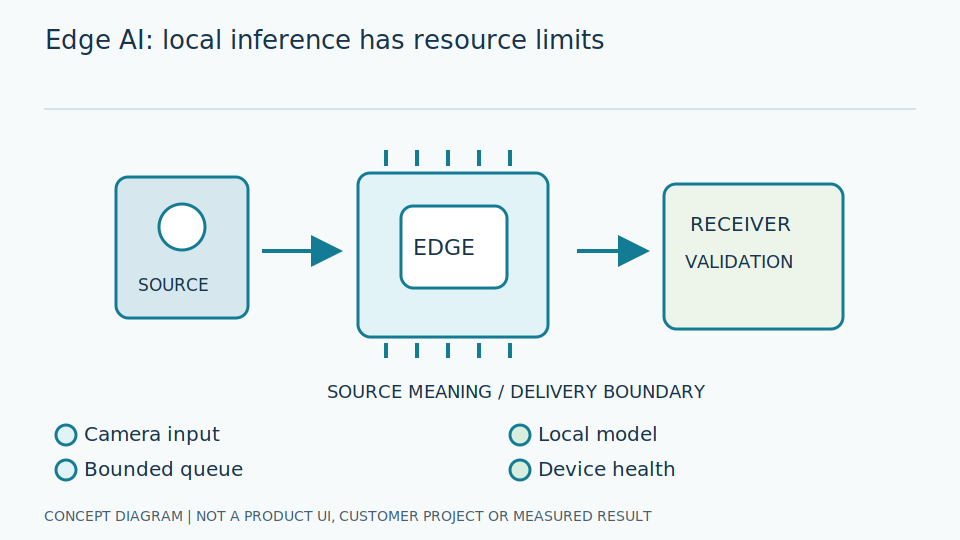
Edge AI processes near data sources to reduce network dependence, but still needs resource, heat, update, and security management. Offline inference does not mean results reach a central system during an outage. Local processing success and successful delivery are different outcomes, and both require explicit status rather than a single indicator suggesting everything is complete.
An edge location is near a camera or device; it does not imply a particular box size. Local reading may continue during an external outage while delivery and updates remain separately constrained. A gateway receives and forwards information and needs visible status. Users should distinguish a reading completed locally from a result received at its destination, especially when a central display has not yet caught up.
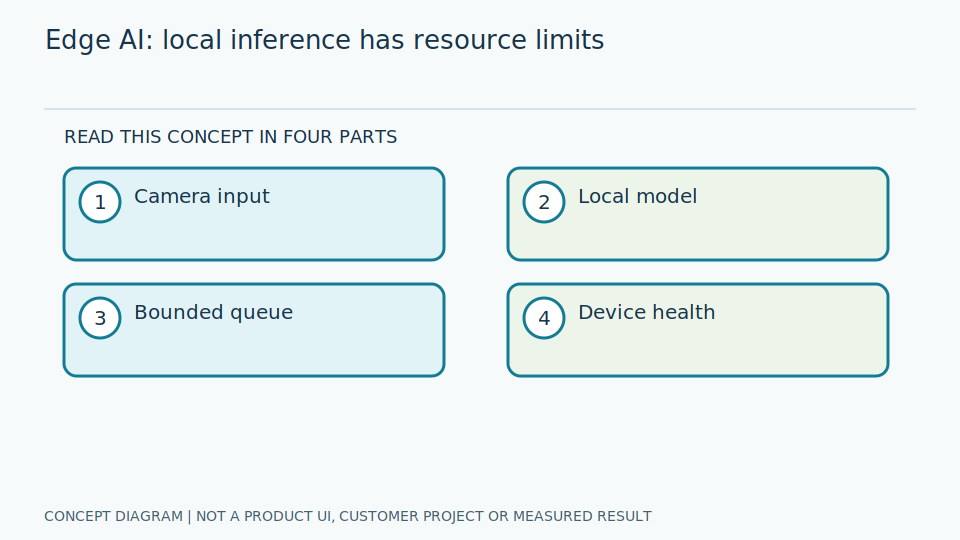
Engineers calculate loads from camera counts, image sizes, preparation, and output requirements rather than one-image inference time. RAM holds working data; persistent storage holds queues and versions. Define limits for both, full-resource policies, and verifiable recovery. Local placement still requires control of physical access, configuration, and update permissions just like the other parts of the system.
Scroll the diagram horizontally to inspect all details.
Illustrative Industrial Example
Design example: a gateway reads gauges locally, stores timestamped results in a bounded queue, and forwards them in order after connectivity returns. Historical data must not be interpreted as current values. This proposed arrangement distinguishes acquisition and delivery times instead of presenting delayed records as events that just occurred at the moment of transmission.
Suppose the central network fails while local cameras still send images. The gateway may continue reading and storing results. A full queue needs a declared decision, such as preserving important records according to rules or pausing some work, not silent discards followed by a completeness claim. Backfilled records must distinguish original observation time from delivery time so summaries do not display old events as current readings.
Engineers test queues and retries with simulated data and identifiers that let destinations prevent duplicate records. Test verified updates and rollback when results are unsuitable, preserving camera settings and unit mappings together. Recovery checks should follow appropriate equipment procedures rather than cutting power to real production systems. Inspect retained records before declaring readiness after restart.
Study and Trial Workflow
- 1 Measure stream counts, image sizes, and deadlines to select CPU, GPU, and RAM.
- 2 Test sustained concurrent work at temperatures appropriate for the site.
- 3 Design offline queues, reversible updates, and maintenance procedures.
Evaluation and Metric Definitions
Measure destination latency, peak memory, temperature, throttling, power, and behavior during power interruption or full storage. A single inference benchmark is not capacity evidence. The evaluation needs sustained operation and recovery within an appropriate test setup, not unsafe disruption of production equipment or an assumption that a fast isolated model represents the complete gateway workload.
Capacity is supported load under defined conditions; throttling reduces work to remain within constraints such as heat. Test continuous concurrent workloads within safe equipment limits and report output quality alongside data age. A short run before the device warms or queues fill does not establish that the same camera count is always sustainable throughout operation.
Engineers separate decoding, model, storage, and delivery resource use. Check runtime support for computational operators before selecting an export, including disconnected-network and bounded-storage cases. Investigate queues and heat when time increases; do not reduce resolution until the needle disappears without reevaluating readings. OT security guidance supports design, not certification of the equipment or product.
Limitations and Failure Cases
Small devices may slow when hot or lack support for some operators. Factory placement does not automatically secure data. Local processing reduces one kind of dependence, but equipment capability, physical access, network delivery, and administration remain separate concerns that need examination within the actual operating requirements rather than assumptions based solely on location.
Local equipment can be physically accessed or have unsuitable configuration accounts. Avoiding cloud upload removes one path, not every risk; responsible people still need to inspect permissions, updates, and storage. Offline reading also does not notify the destination promptly. If the task requires a central response, assess network-outage risk separately from the ability to keep reading locally.
Combining work on one device reduces equipment but increases failure impact; distributing it increases maintenance and synchronization work. Choose against requirements and verify rollback. Do not claim edge systems always save energy or run faster without measuring the entire path. This architecture example does not confirm current support for particular gateway models, offline operation, or product update mechanisms.
Practical Checklist
- Are electrical power and heat-dissipation budgets defined?
- What is discarded or stopped when the queue fills?
- Are rollback and recovery after power loss tested?