
Principles and Suitable Contexts
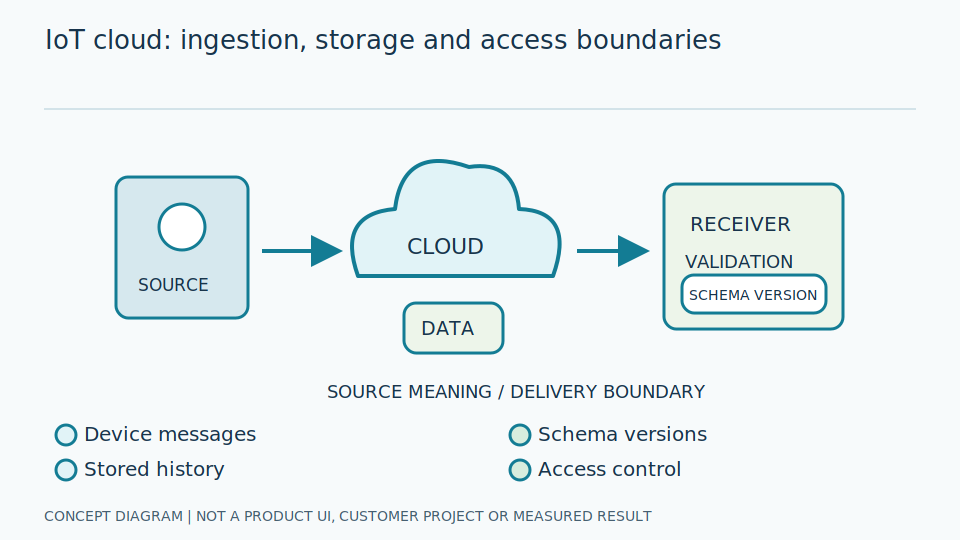
A cloud layer commonly separates message ingestion, storage, processing and user access. It can suit multi-site aggregation where access responsibilities are clearly managed. Using cloud services does not by itself provide an SLA or automatic backups across every service; these depend on the selected arrangements.
Cloud computing uses resources through defined service arrangements, not simply an internet-hosted graph. Know each layer's responsibilities: accepted messages may not yet be stored or processed. A tenant is a user or organisational boundary requiring data isolation. A screen name does not prove access separation. Verify the underlying data boundary rather than assuming a dashboard labelled for one organisation cannot reveal another's records.
Occurrence time can differ from service receipt time. Decide which governs graphs and totals and how late data will be handled. Detailed history supports review but increases storage and governance work. Cloud reference definitions help divide responsibilities; they do not establish a service-level agreement, or SLA, for an unspecified product without actual contractual evidence. A working trial cannot supply those missing terms.
Scroll the diagram horizontally to inspect all details.
Design and Data Preparation
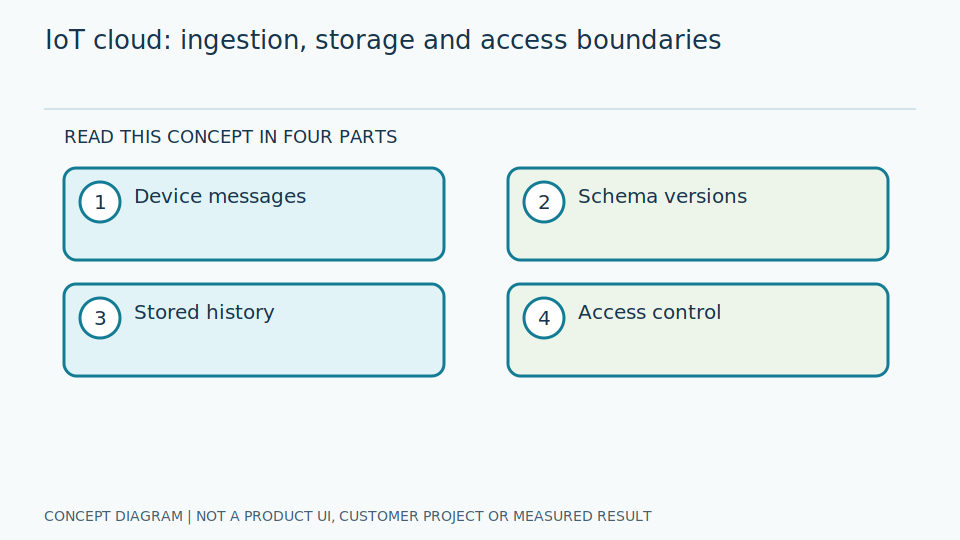
Define device identities, tenants, schema versions and retention policies. Separate event time from ingestion time. Specify data-location requirements, export options and the division of responsibilities between provider and user. Estimate costs from ingestion, storage, reads and data transfer out, based on the expected workload.
Event time describes the event or measurement; ingestion time describes entry into the system. Preserve both with clear time zones. Keep identifiers and schema versions for historical conversion without changing original meaning. Enforce access at actual data boundaries across screens, exports and program interfaces. Hiding a menu is not a permission check and cannot replace restrictions on the underlying request or record.
Document agreed retention, deletion, backup and export policies, distinguishing provider functions from settings users must configure themselves. Estimate workload from record counts, reading frequency and historical queries without inventing service prices. Verify that exports preserve units, timestamps and quality, keeping data usable independently of one dashboard. A recoverable archive and a visually complete chart answer different operational needs.
Failure Cases and Limitations
Duplicate or late messages can change historical charts. Incorrect permissions may expose data across tenant boundaries, while unlimited retention increases costs. Having multiple copies is not equivalent to a backup that can restore data after accidental deletion; recovery needs its own design and verification.
Without stable deduplication identifiers, retransmissions can increment totals twice. Late data can change results users previously saw; identify revisions instead of silently rewriting history. When a new schema introduces different units, separate versions and verify conversion rules. Values within an expected range do not prove their meaning is correct, so plausibility checks cannot replace field-level and version-aware validation.
Copies following deletion immediately may all lose the same records, making restoration testing essential. Permissions or keys can allow cross-organisation reads or unauthorised sources, so record incidents and containment procedures. Monitoring cloud services must not make safety instrumented systems, interlocks or emergency shutdown depend on internet access. Backup design and access control are separate responsibilities from recognising and plotting measurements.
Trial and Evaluation Methods
Test invalid schemas, cross-tenant access, late arrivals and duplicates. Measure source-to-user visibility time using percentiles alongside workload size. Restore from an actual backup and record any lost data. Do not infer an SLA from a short experiment or a period of normal operation.
A percentile states the proportion of observations at or below a level, revealing delay tails averages may hide. State start and end points, sample count and workload. Use known identifiers and tenants, having independent reviewers compare ingestion with what each role can see. Include historical queries and exports rather than checking only that a graph opens; every access path belongs to the data-isolation test.
After restoration, verify records, units, times and permissions, not merely backup-file existence. Confirm that duplicate messages do not increase totals and late messages revise results under agreed rules. Report trial limits and residual risks. Cloud and security references help design checks; they do not certify a service or guarantee future availability. Acceptance must remain bounded by the tested workload and selected recovery arrangements.
Review Checklist
- Separate access by user and device.
- Specify retention and export paths.
- Test restoration, not just backup creation.
- Monitor costs against workload volume.
References and Further Reading
References explain technology principles or requirements. They do not establish product certification or support for every requirement.