
Content Level: Overview / Implementation considerations
Principles and Suitability
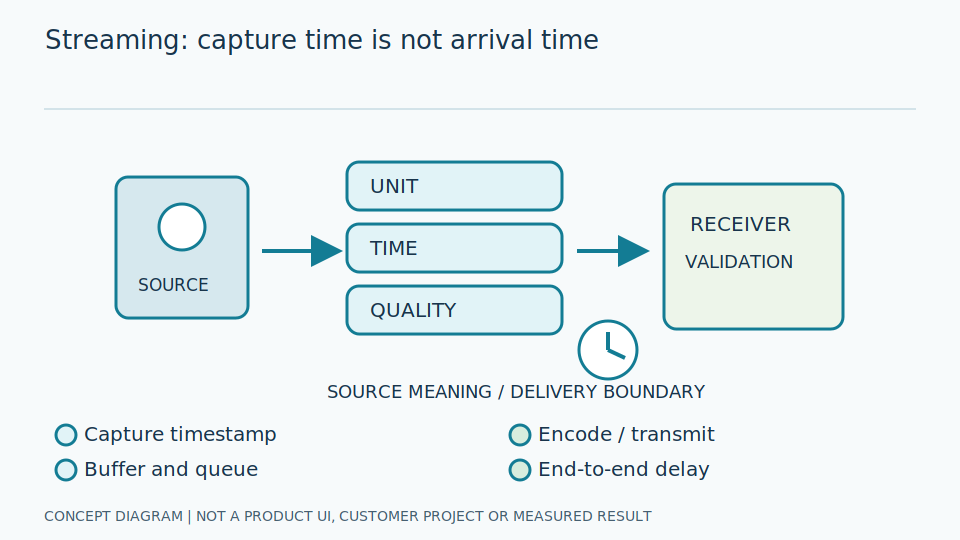
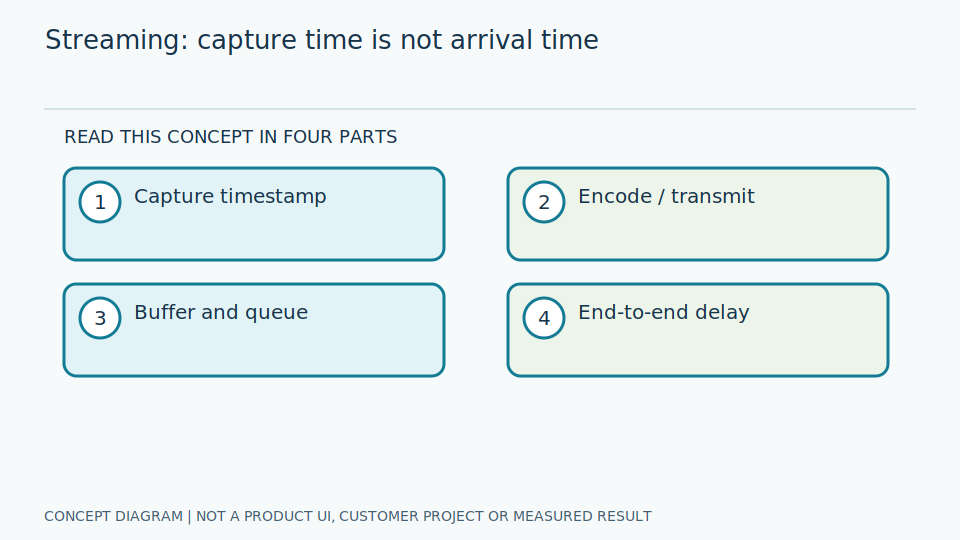
RTSP manages media sessions, while codecs, packet transport, decoding, and queues affect image freshness. Real-time operation needs a task deadline, not a claim that continuously displayed video has no delay. Receiving a smooth stream does not establish when its images were captured or whether their results are timely enough for the intended decision.
Smooth video can consist of old images retained in a queue. A codec defines image encoding and decoding, whereas RTSP manages media connections. Continuous reception does not reveal image age: establish capture time and when results become usable. A deadline is the latest acceptable result time for the task, derived from the user's decision rather than average processor speed alone.
Queues retain work. If images arrive faster than they can be read, data age rises even when each inference is fast. Engineers choose completeness versus freshness and identify discarded frames and stale status. Inspect capture, receive, and output times separately, documenting clock origins and synchronization. Do not subtract unsynchronized timestamps across machines and present the resulting delay as an exact measurement.
Scroll the diagram horizontally to inspect all details.
Illustrative Industrial Example
Design example: a gauge reader selects the latest frame with trustworthy capture time, discards old frames under a defined policy, and reports stale data when the camera freezes even if the receiver remains connected. Connection status and information freshness are separate facts, so one should not be used as evidence of the other.
Suppose a slow network creates a backlog of gauge images. When connectivity improves, reading those images may look like normal continuous operation. Users need data age and status; a new processing timestamp must not make an old image look fresh. Current-value tasks may select the newest image, but tasks requiring complete short-event records need separate recording arrangements evaluated against frame-dropping losses.
Engineers use simulated arrival times and image gaps to test bounded queues. Check removal of old data after reconnection and return to readiness only when genuinely new images arrive, not merely when a port opens. Verify that selected frames match output evidence and timestamps. If capture time is absent or unreliable, disclose that limit instead of presenting receive-time estimates as certain image ages.
Study and Trial Workflow
- 1 Measure capture, decoding, inference, and destination timing separately.
- 2 Bound queues and choose dropping policies according to freshness or completeness priorities.
- 3 Test jitter, packet loss, reconnection, and clock synchronization.
Evaluation and Metric Definitions
Report end-to-end result age at p50 and p95, dropped-frame proportions, and stale events alongside throughput. State clock discrepancies when timing crosses machines. These measures describe different aspects of the stream, so high completion rates should not conceal stale output or be used as a substitute for assessing the deadline of the actual task.
Throughput is completed work per unit time, unlike the age of information delivered to users. Percentiles locate values in the measured distribution; they do not guarantee every result meets its deadline. Include sample counts, measurement duration, concurrent conditions, gaps, and recovery. Do not select only periods of good network behavior to imply timely responses under every operating condition.
Engineers separate decoding, preparation, reading, and delivery times, reconciling counts of received, used, and discarded frames. Test arrival jitter with controlled simulated data and inspect clock errors. If output is old despite high throughput, address queues rather than only selecting another model. RTSP documentation provides connection guidance, not certification of latency or product quality on an unevaluated processing path.
Limitations and Failure Cases
High frame rates do not guarantee fresh frames. Long groups of pictures and buffers can add delay, while dropping frames may miss short events. Real-time terminology must therefore retain explicit deadlines and loss policies, rather than obscure a trade-off between the completeness of the record and the timeliness of its newest usable observation.
A group of pictures, or GOP, can contain frames requiring other frames for decoding. Starting reception or losing data may require waiting for necessary information; opening a connection does not guarantee an immediately usable image. Small queues limit age but increase discards, while large queues absorb slow periods but risk historical readings. Choose and test according to the stream's role.
Untrustworthy clocks make age evaluation ambiguous. Define status and operating boundaries when cameras or clocks change. Reconnection must not deliver retained readings as current values or duplicate events without identifiers. Streaming is the data-input component, not proof of support for a particular camera model or a product's guaranteed response time without evidence from the actual end-to-end path.
Practical Checklist
- Are capture and receive times distinguished?
- Is a timeout defined for marking image data as stale?
- Is the previous queue cleared after reconnection?