
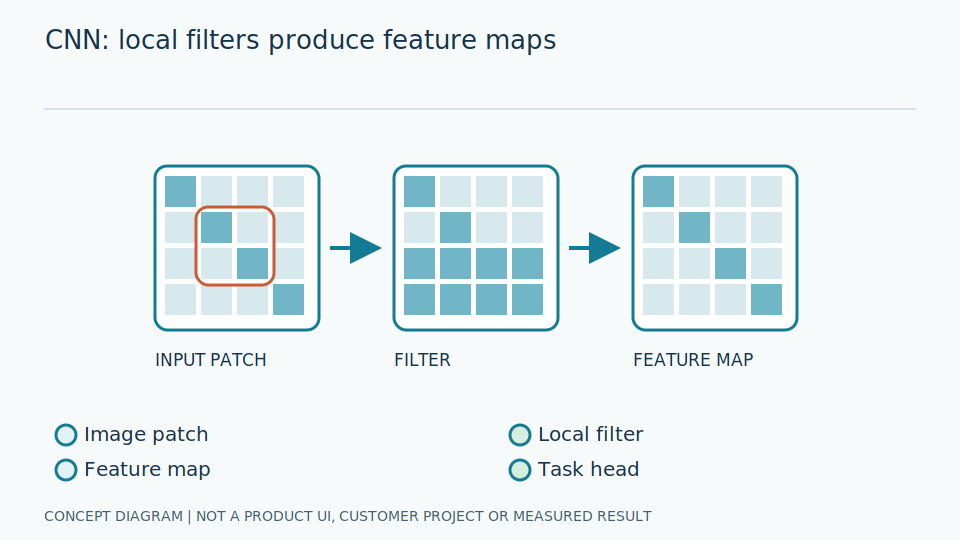
Content Level: Overview / Implementation considerations
Principles and Suitability
A Convolutional Neural Network (CNN) shares convolution weights to learn local features. Deeper layers increase the receptive field, and CNNs often serve as backbones for classification, detection or segmentation. Similar behaviour under translation does not imply robustness to every angle or scale.
A CNN applies the same learned filters across image regions and combines responses into broader patterns. Convolution computes from neighbouring values using learned weights; it is not simply searching for a fixed predefined picture. Sharing weights supports similar patterns at different locations, but training still needs relevant angles, lighting and details. Architectural structure cannot supply examples of conditions missing from training.
A receptive field is the original-image region influencing a value in a computational layer. Pooling reduces size and some detail by combining information. Select resolution and reduction stages that retain thin pointers and decimal points. A backbone only extracts representations; it needs a task-appropriate head and clearly interpreted outputs. The name CNN alone does not explain whether an application succeeds.
Scroll the diagram horizontally to inspect all details.
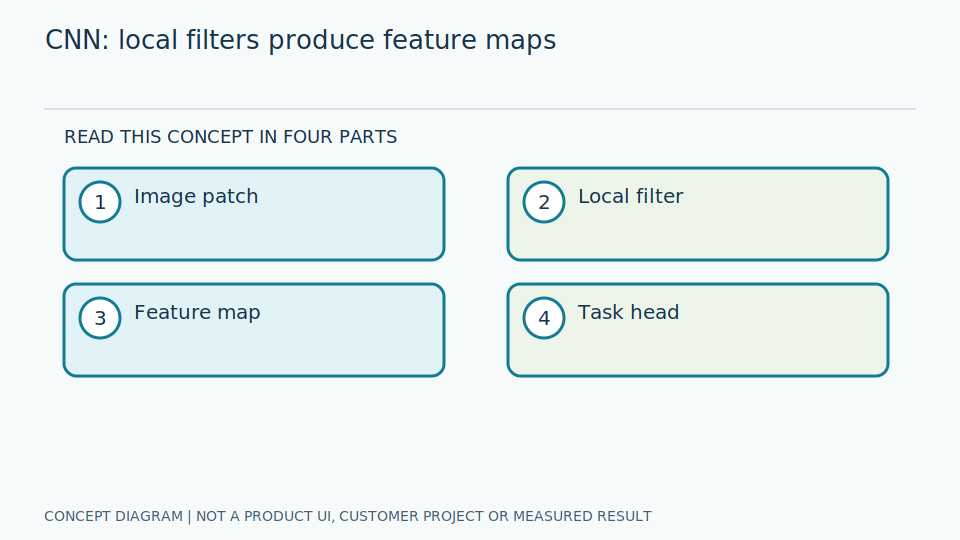
Illustrative Industrial Example
Illustrative design scenario: a CNN classifies a region as an analogue dial or a digital display, then routes it to an appropriate reader. The class name describes the instrument type, not the value displayed on it.
Suppose analogue training examples always bear one manufacturer's logo, while digital examples bear another. The classifier may learn logos rather than instrument structure and fail on new brands. Reduce misleading correlations and appropriately test background changes. Correct equipment-type classification does not establish correct text or pointer-angle reading; those require separate evidence and evaluation.
Inspect crops after resizing and normalisation, which sets pixel ranges consistently with training. Test unknown cases: empty images and wrong boxes should not be forced into a known type. Pass class, score and confirmation status to readers so a classification error cannot quietly become a plausible final number. The downstream method should receive evidence that the region suits its assumptions, not just an unqualified class label.
Study and Trial Workflow
- 1 Define classes with an unknown case or a route for rejecting unrecognized inputs.
- 2 Compare backbone sizes using the same dataset splits and image dimensions.
- 3 Test gauge brands and camera types different from those in the training set.
Evaluation and Metric Definitions
Report a per-class confusion matrix and processing time for the complete region-of-interest pipeline. Investigate whether backgrounds or manufacturer logos drive predictions instead of the actual dial structure.
Identify which class errors route images to the wrong reader and which merely require reinspection. Frequent classes can hide rare-class failures in an overall percentage. Evaluate held-out gauges and cameras, plus images outside the equipment scope. An unknown state prevents forced answers, but measure how often it rejects valid images too. Useful rejection and unnecessary rejection have different operational consequences.
Compare backbone sizes with identical data and preprocessing, separating resolution effects from layer counts. Check reference predictions before and after export and include crop receipt and preparation in timing. If failures occur only on incomplete crops, correct region selection or acceptance criteria before increasing layers. Retain error images to investigate which evidence actually drives class separation.
Limitations and Failure Cases
The model may rely on background texture rather than shape. Pooling can discard decimal points or thin pointers, and domain shift still requires testing rather than assuming that a pretrained backbone is suitable.
Texture may correlate accidentally with labels, such as metal colours or backgrounds. Response maps support investigation but do not prove correct reasoning. When material changes reduce performance, inspect data ranges and answers. Translation-related architecture properties do not establish robustness to every lighting or viewpoint change. A plausible visual explanation of the response is not a validated account of the decision.
Image reduction saves resources but can destroy task-specific details; more resolution may not help ambiguous labels. Choose from final-task results and maintain out-of-scope rejection tests. CNNs are one experimental image-processing approach, not confirmation that a product uses this architecture or can read every device resembling training examples without further checks. Similar appearances do not establish identical scale conventions, units or usable evidence.
Practical Checklist
- Does normalization match the pretrained model requirements?
- Does training data represent every defined class?
- Have incorrect crops and blank images been tested?