
Principles, Scenarios and Suitability
Preventive maintenance schedules work by time, usage or manufacturer requirements, unlike predictive maintenance that estimates risk from condition data. Choose intervals from failure modes and consequences. Do not change them solely on a model recommendation without a responsible decision maker.
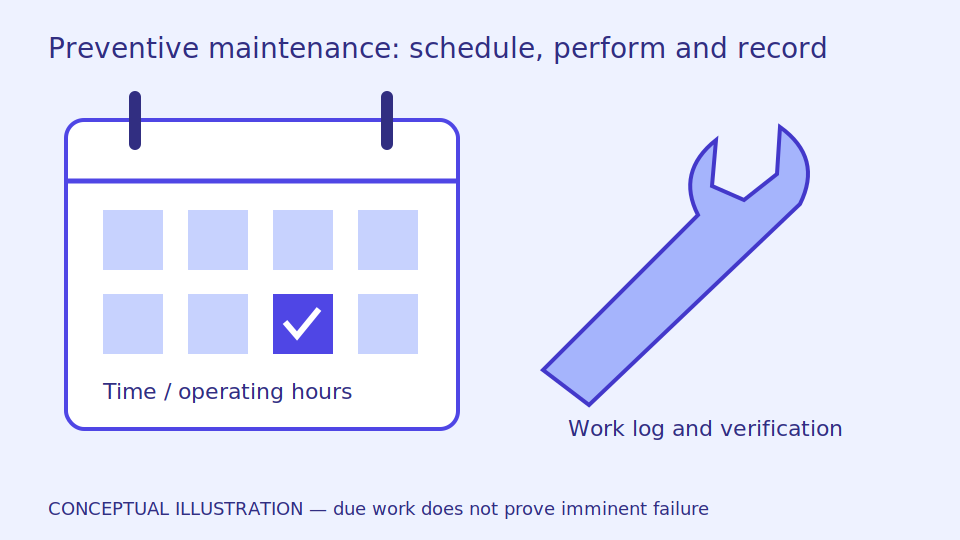
Think of servicing a car by mileage, but with different degradation mechanisms for each machine. Some tasks follow calendar dates, others hours or production cycles. Predictive maintenance uses condition evidence to estimate risk; it is not another name for scheduled work. Normal-looking trends do not remove duties imposed by manuals or site requirements.
OEM means equipment manufacturer. Define a cycle according to the wear mechanism. Counting idle time may trigger work too early; ignoring heavy loading may trigger it too late. Separate inspection, lubrication and replacement tasks with completion evidence. Fewer visits save resources but require engineering and risk-owner approval, not untraceable automatic model changes.
Scroll the diagram horizontally to inspect all details.
Illustrative Design Scenario
Illustrative design scenario: a filter inspected by operating hours also uses differential pressure to help plan spare parts. An engineer reviews history and requirements before deferring replacement; one normal gauge reading is insufficient evidence to extend the interval.
Suppose an inspection is nearly due while production continues. Planners might prepare spares and arrange a planned stop, or request review only of tasks whose timing may legitimately change. Consider consequences and history. One pressure reading cannot justify deferral, especially for mandatory or protection-related work.
After inspection, technicians should record actual findings and actions. Receiving a work order is not completion. These records help judge interval suitability and failures before due dates. Study revised plans with history and simulated scenarios; do not run equipment beyond its approved boundary to demonstrate a proposed schedule.
Inputs and Prerequisites
Prepare OEM manuals, task intervals, actual hours or cycles, maintenance history, spare parts and shutdown constraints. Separate mandatory or safety-related tasks from ordinary maintenance work.
Link counters to physical equipment and record resets after replacement or major repair. Manuals need the applicable model and edition. Do not borrow an interval from similarly named equipment without checking its actual operating conditions and maintenance requirements.
Each task needs a due date, owner, reason and inspection evidence. Deferred and completed are different states. Retain the approving person and revised date for deferrals. Rewriting the original due date must not make historical work appear always on schedule.
Trial and Integration Workflow
- 1Define tasks by failure mode and identify who approves each interval.
- 2Link usage counters to due-date alerts, handling counter resets explicitly.
- 3Close work with findings, parts used and deferral reasons so intervals can later be reviewed.
Evaluation and Acceptance Criteria
Track planned-work completion, failures between services and downtime separately by asset. Compare under similar operating loads. Do not claim a downtime reduction without a reference period and clearly recorded events that allow the comparison to be checked.
Define the start and end of downtime, separating planned stops from breakdowns. Work-order counts alone are misleading: more orders may reflect improved recording rather than greater degradation. State the operational exposure behind each comparison.
Maintenance teams should review sample tasks against site evidence and the person closing them. Distinguish work delayed by missing spares from technically approved deferrals. Revised planning should address the real cause rather than hide outstanding risk beneath a single completion percentage.
Scroll the diagram horizontally to inspect all details.
Failure Cases and Limitations
Too much scheduled work may introduce disassembly errors; too little may miss accelerated degradation. Monitoring supports decisions but does not replace OEM instructions, statutory inspections or authorisation to continue operating equipment.
Degradation can accelerate after load or environmental changes. Review the previous plan when the work changes. An interval that caused no historical problems is not necessarily suitable for every future operating condition or equipment configuration.
Inspection and repair must follow the site's energy-isolation and safe-work procedures. This guide gives no instruction to dismantle running equipment. Due-date notifications and prediction are study proposals, not claims of deployed capability or measured downtime reduction.
Practical Checklist
- Are mandatory tasks distinct from tasks with adjustable intervals?
- Do counter replacements preserve the correct asset history?
- Does every closed task record findings and a responsible person?