
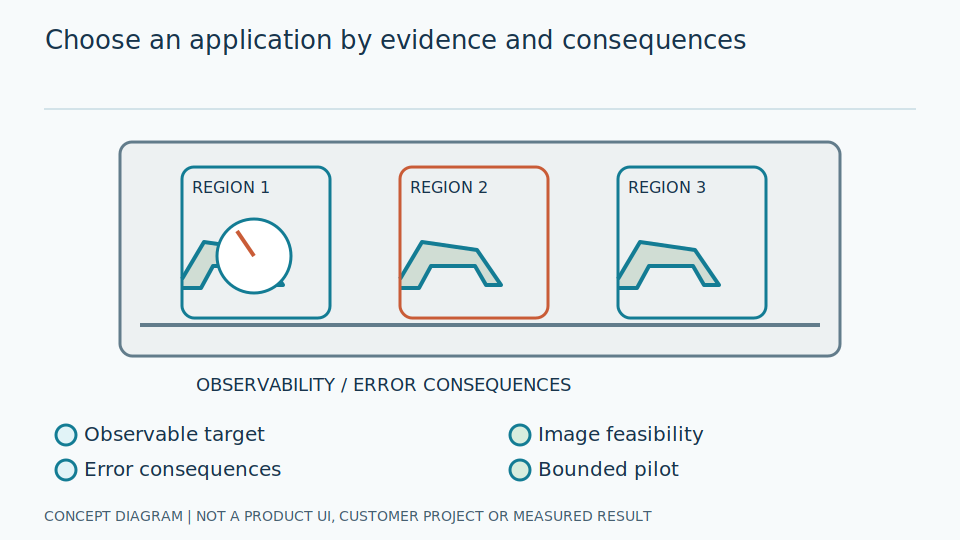
Choose a problem with data and a responsible owner
A useful trial has a process owner and a defined benefit, such as less duplicate transcription or better review of inspection evidence. Collecting more images without knowing their decision role may add burden without verifiable value.
Check whether images contain the required information. Visible dials can be observed, but internal material properties may need another instrument. Compare cameras with existing sensors, simple image rules and current inspection methods rather than mandating vision first.
Measure the existing baseline using the same definitions intended for the new system: cycle time, review effort and completeness. Do not assume entire inspection rounds disappear, since operators may still inspect sound, leaks and other conditions.
Scroll the diagram horizontally to inspect all details.
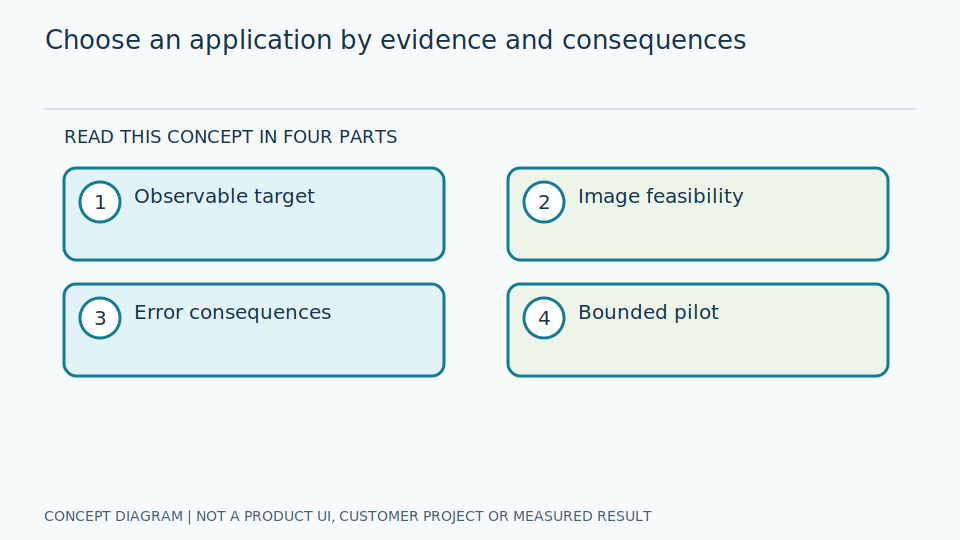
1. Read existing gauges and meters
Visible instruments may support less transcription, more frequent observations and traceability. They do not automatically replace every inspection activity; manual rounds may also assess leaks, sound and machine condition outside the dial image.
- Record scales, units, ranges and images across views and shifts.
- Define acceptable error and unreadable conditions.
- Measure the complete existing task without assuming every activity is removable.
- Begin at low-risk points in shadow mode alongside the existing method.
2. Visual quality inspection
Surface defects, missing parts and incorrect assembly require explicit definitions and representative examples. Many good products but few genuine defects make false-accept evaluation difficult. Images may not reveal internal defects or properties requiring physical measurement.
- Define minimum resolution, lighting, distance and motion blur.
- Separate false rejects that add reinspection from false accepts that release defects.
- Evaluate by product, shift and production condition.
- Do not rely on overall accuracy when classes are imbalanced.
3. Track condition and trends
Consistent gauge histories may reveal trends or anomalies, but finding an anomaly does not automatically diagnose a fault or predict remaining life. Consider operating loads, maintenance history and other signals.
Without verified failure data, describe condition monitoring or anomaly screening rather than guaranteed predictive maintenance. Include time spent reviewing alerts that do not represent genuine faults.
4. People and safety-related tasks
PPE, restricted areas and behavior involve missed events and impacts on people. Define purpose, coverage, access and retention before choosing personal images. Observation is assistance, not complete legal proof or automatic disciplinary evidence.
General monitoring is not a safety-rated protective function. AI, SIL and compliance terminology cannot substitute for design and certification evidence within the actual scope.
Pilot acceptance checklist
- Assign a process owner and measure the baseline.
- Confirm that the image contains the information required.
- Keep representative test data separate from development data.
- Agree on error, invalid rate, latency and review effort in advance.
- Start read-only and preserve the original operational fallback.
- Include integration, maintenance and retesting in costs without double-counting benefits.
Separate feasibility evidence from operational release
Pilots reduce uncertainty rather than showing only successful images. Include different shifts, conditions and cases that should be rejected, with reproducible references. Report successes and boundaries lacking sufficient evidence.
After image feasibility, verify delivery, review ownership and camera or network failure behavior. These can make a system unusable despite a strong model score. Acceptance should cover the workflow, not just a dataset.
Expand after agreed criteria and a maintenance plan are established. Define return to the existing method, version approvals and retest triggers. Lessons from one point do not certify others with different equipment, light or processes.