
1. Make retrieval and answering separate decisions
Retrieval-augmented generation, RAG, supplies retrieved information to a generative model instead of relying only on knowledge encoded in model parameters. The original RAG paper studies knowledge-intensive language tasks using a text index of Wikipedia; it does not establish a video-event verification system. For visual search, first retrieve eligible event evidence, then decide which statements it supports. Retrieval proposes a context for answering, not a license to fill missing observations with a story that resembles common training examples.
Use the translated query “Find a woman in a red shirt holding a box around 13:00”. Confirm the date, timezone and approximate window before executing the source-time search; never silently assume today. Require the shirt and holding relation to belong to the same person and same box at compatible times. Treat the person category as user-described apparent presentation, not proof of gender identity or sex. Do not infer protected traits or personal identity. A partial candidate is not an exact answer, and an unknown relationship must remain unknown rather than becoming false or supported through fluent wording.
Scroll the diagram horizontally to inspect all details.
2. Distinguish text RAG, multimodal RAG and raw detection
Text RAG retrieves text such as event fields, transcripts, OCR or generated captions and answers from that text. A caption derived from an image is still a text intermediary when the answering stage cannot inspect the image. It may omit a hand, misassign an object or describe a relation incorrectly. Preserve how the text was produced and its source references, and make clear when the answer depends on a description rather than direct inspection of authorized visual evidence.
Multimodal RAG can retrieve and condition answering on images, regions or video intervals alongside text, depending on the chosen system. Direct access to pixels can help review a caption, but limited resolution, clip sampling and model errors still constrain conclusions. Raw object detection instead proposes classes and bounding regions from input media; it is not itself retrieval plus generation and does not establish holding or duration. Stored detections can be one input to RAG when their provenance and uncertainty are retained. Evaluate these components separately instead of attributing all errors or improvements to a single RAG label.
3. Separate three different quality questions
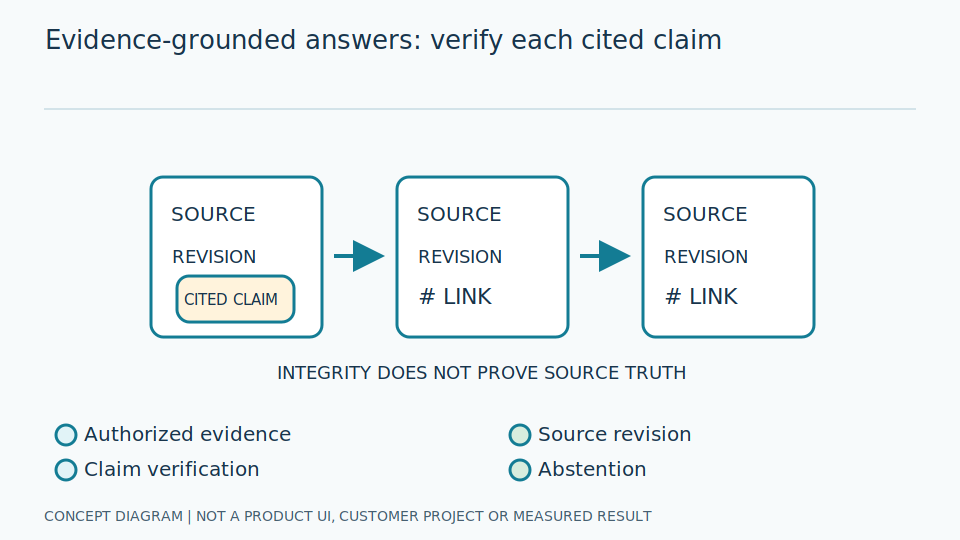
Grounding ties each claim to identifiable evidence that can support it, such as an event revision, a person region and a source interval. A citation existing is necessary but not sufficient: it must cover the actual claim. Faithfulness asks whether the answer follows the supplied context without adding unsupported assertions or ignoring its uncertainty. Correctness asks whether the answer is right under the confirmed question and reviewed source evidence. These properties overlap but are not interchangeable, and each needs its own evaluation examples and failure labels.
An answer can faithfully repeat an erroneous caption and still be incorrect. A correct-looking sentence without recoverable supporting evidence is not adequately grounded. A valid event identifier pointing to the wrong person or time also fails claim support. The illustrative JSON below names a revision, regions and interval while preserving an unknown holding relation; it is not a real observation or an executable answer contract. Its missing time context blocks execution. Structured output makes verification possible, but a schema-valid citation does not certify what happened.
{
  "time": {"clock": "13:00", "date": null, "timezone": null, "window_minutes": null},
  "retrieval_scope": "authorized_only",
  "illustrative_claim": {"predicate": "holding_same_box", "state": "unknown"},
  "evidence_reference": {
    "event_id": "evt-0042",
    "source_segment": "cam-03/segment-017",
    "region_ids": ["region-person-1", "region-box-2"],
    "interval_seconds": [15, 18],
    "interval_convention": "half_open_from_segment_start",
    "source_revision": "r1",
    "event_revision": "r1"
  },
  "answer_state": "abstain_pending_confirmation",
  "playback": "requires_fresh_authorization"
}
4. Verify the claim, not merely the citation string
Resolve citations against existing authorized event and source revisions. Check that the referenced region belongs to the named frame or segment, that interval offsets are within available media, and that the relevant person and box remain compatible across the cited interval. Allow the reviewer to inspect neighboring authorized context when needed to assess a handoff or occlusion. A thumbnail containing both objects is not adequate support for a sustained relation, and a citation to an entire long clip can hide the absence of claim-specific evidence.
Compare each proposed assertion with supporting and contradictory evidence before presenting it. If a caption says holding but accessible frames show the box on a table without the relevant person controlling it, flag the conflict rather than selecting whichever description yields a smoother answer. If the hands are occluded, the relation can remain unknown. Abstain from the unsupported part, label partial matches clearly, or report insufficient evidence for the full query. A no-result statement must distinguish searchable coverage limits where appropriate without disclosing the existence of inaccessible events.
Scroll the diagram horizontally to inspect all details.
5. Keep authority outside retrieved text and generated answers
Enforce hard permissions before retrieval and candidate ranking in every branch, including text indexes, vectors and any additional context fetches. Restrict candidates to authorized sources and preserve confirmed time, camera and valid-value constraints throughout reranking and answer generation. Recheck access before displaying evidence or playback because rights may change. Neither a language model’s query plan nor a generated citation can grant access. Use schema-validated, allowlisted, parameterized read-only operations for data lookup; direct generated SQL is not the authority for eligibility.
OCR, captions, retrieved notes and user queries are untrusted data. An instruction printed in a scene or embedded in a caption must not redefine permissions, request unrelated records or acquire tool authority. OWASP describes indirect prompt injection and explains why RAG alone does not eliminate it. Keep data and instructions separated, constrain permitted actions and validate outputs outside the model, while acknowledging these measures are not a universal prevention guarantee. Do not send confidential evidence to an external model without approval; useful semantic analysis does not override approved data boundaries.
6. Keep evidence fresh and conclusions within scope
Maintain consistency across source media, event records, captions, embeddings, retrieval caches and saved answer references. Expiry, deletion or a changed revision must prevent obsolete evidence from supporting a current answer. A stable event identifier alone does not pin its content; record the source and event revisions actually inspected. Revalidate evidence availability and access before reuse, and ensure delayed processing does not recreate deleted material. Mark an answer stale or unavailable when its support disappears rather than retaining confidence from an earlier successful lookup.
Do not turn a descriptive query into hidden inference about identity, protected traits, intentions or personal history. Bounded tracks are associations within a source sequence, not verified identities. Review consequential conclusions instead of automating punishment from uncertain matches. Evaluate retrieval relevance, citation support, faithfulness, correctness, contradiction handling and appropriate abstention separately, including answerable cases so refusing everything is not mistaken for quality. AIFacon Detection remains planned; this article does not establish an implemented RAG service, a performance or service-level guarantee, a product data policy or certified results.
- Test caption-only answers against source regions, and distinguish text intermediaries from genuinely inspected multimodal evidence.
- Check claim-level event, region, interval and revision references; include citations that exist but support a different subject or time.
- Test contradictory captions, occluded hands and unanswerable questions; unknown is neither false nor permission to invent a fact.
- Test hard permissions before retrieval, untrusted OCR or captions, missing time confirmation and rights revoked before playback.
- Test deletion, expiry, revised events and stale cached answers; forbid hidden identity or trait inference and require review of consequential conclusions.
References and further reading
- Retrieval-Augmented Generation for Knowledge-Intensive NLP Tasks
- CLIP: Learning Transferable Visual Models From Natural Language Supervision
- OWASP: LLM01 Prompt Injection
- Vision AI reading path
- Detection event indexing
- Natural-language search
- Multimodal hybrid retrieval
- Visual search evaluation
- Embeddings and vector search
- Temporal grounding
- Vision-language foundations
- Video analytics foundations
- Object Detection foundations