
1. Define the relationship before locating its interval
Temporal grounding connects a language-described event to a supported video interval. Co-occurrence means objects appear together, not that one person holds another object. Holding calls for evidence of support or control of the same box, potentially while stationary. Carrying adds movement with that object over time; nearby movement alone does not show who carries it. Document operational meanings and what views can support them. TALL studies natural-language temporal activity localization, but its alignment and boundary predictions are hypotheses to evaluate, not guarantees about every relationship.
Use the translated query “Find a woman in a red shirt holding a box around 13:00” without silently substituting carrying for holding. Confirm the date, timezone and approximate window before restricting the source-time search. The person category is user-described apparent presentation, not evidence of gender identity or sex; do not infer protected traits or personal identity. Shirt evidence must refer to that person and holding evidence to that person and the same box. A high language-video score does not establish this composition or authorize the underlying footage.
2. Work through interval overlap without confusing it with proof
Use explicit interval conventions, such as half-open intervals [start,end), in seconds relative to a named source segment. The intersection duration is max(0,min(endA,endB)-max(startA,startB)). The union duration is durationA plus durationB minus the intersection. Temporal intersection over union, tIoU, is intersection divided by union when union is positive. Intervals that merely touch have zero overlap under this convention; zero-duration annotations need a separate policy rather than an undefined division disguised as a successful match.
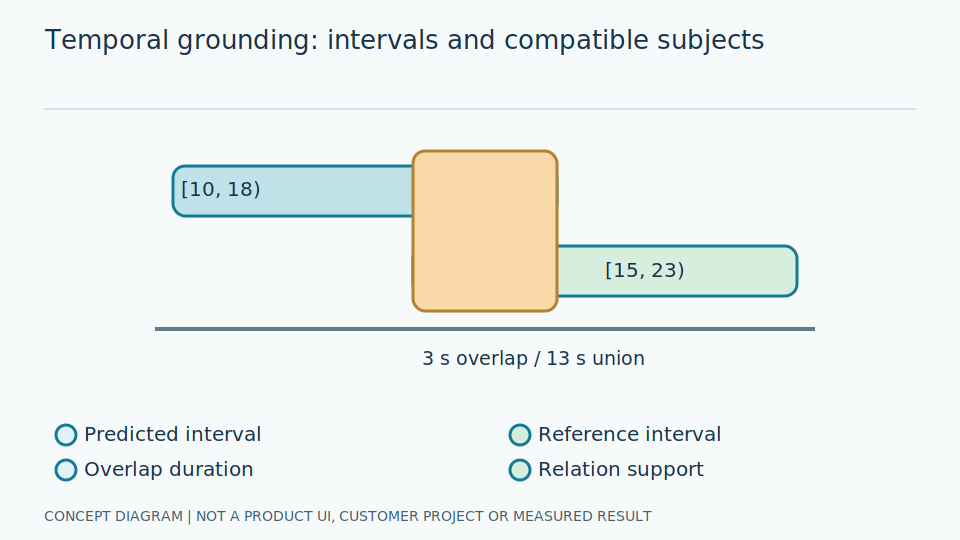
For a predicted interval [10,18) and a reference interval [15,23), each duration is eight seconds, the intersection is [15,18) with duration three, and the union duration is thirteen. Thus tIoU is 3/13, approximately 0.231. The JSON records this illustrative arithmetic, not a measured model result. For composite evidence, intersect shirt-support and holding-support intervals only after checking subject and box compatibility. Overlap involving different people proves nothing about the requested relation, and a generous interval can cover the action while localizing it poorly. Overlap quality and semantic support require separate judgments.
{
  "event_id": "evt-0042",
  "source_segment": "cam-03/segment-017",
  "interval_convention": "half_open_seconds_from_segment_start",
  "predicted_interval": [10, 18],
  "reference_interval": [15, 23],
  "intersection_interval": [15, 18],
  "intersection_seconds": 3,
  "union_seconds": 13,
  "temporal_iou": 0.230769,
  "time": {"clock": "13:00", "date": null, "timezone": null, "window_minutes": null},
  "relation_state": "unknown",
  "execution_state": "needs_user_confirmation"
}Scroll the diagram horizontally to inspect all details.
3. Treat unsampled time as missing observation
Frame sampling limits what an analysis can observe. If retained frames occur at seconds zero and two, a handoff between seconds 0.6 and 0.9 may leave no sampled image of the action. That is an illustrative loss mechanism, not a performance claim. More frequent sampling can reduce this gap but cannot remove occlusion, blur or upstream frame loss. Averaging a clip representation may further dilute a brief action, and matching a scene before or after the handoff does not establish its duration.
Preserve actual capture timestamps and the sampled frame list, not just nominal frame rate or consecutive frame numbers. Adaptive resampling of an authorized candidate can inspect surrounding source footage when it still exists, but cannot recover frames never recorded or already deleted. Mark missing spans and explain any interpolation rule. Do not bridge a long gap to claim continuous holding simply because the first and last views look alike. Evaluate brief events and boundary errors separately from long, easy-to-observe actions so aggregate results do not conceal systematic short-event losses.
Scroll the diagram horizontally to inspect all details.
4. Keep clock uncertainty separate from action uncertainty
A local source timestamp, an ingestion timestamp and the user’s intended clock expression are different quantities. Preserve source clock offset or timezone, synchronization status and correction provenance where known. Converting everything to UTC does not fix a drifting camera or clarify which date the user intended. Playback offsets must map to the actual source timeline, including discontinuities. An action may be visually well supported while its relationship to a requested absolute time remains uncertain; report these two uncertainties separately.
For example, a recorded boundary with an estimated uncertainty of plus or minus one second should not be presented as precise to a millisecond. Describe the assumed error bounds and, where useful, assess earliest and latest plausible boundaries without implying a particular error distribution. If the uncertainty can move an event outside the confirmed window, mark time eligibility unresolved rather than silently widening that window. Cross-camera comparisons need independent clock and source checks; overlapping recorded times alone do not establish simultaneity. Never use arrival order as proof of the order in which actions occurred.
5. Keep subject associations bounded and reviewable
A track links observations under an association hypothesis within a bounded camera or sequence. Its number is not a person’s identity and must not silently become a cross-camera identifier. Occlusion, crossings, restarts and similar clothing can fragment tracks or switch associations. Retain the scope, observed regions and association uncertainty. The same track label appearing on two frames does not independently prove that the physical subject is unchanged; inspecting the sequence remains important for evidence that combines attributes and relations.
Build support around compatible observations: a shirt region associated with the person, hands and box evidence for the holding relation, and intervals during which the association remains supported. If a different person holds the box after a handoff, do not borrow that later relationship to complete the earlier person’s description. Distinguish persistent attributes from actions and document any allowed propagation across frames. Propagation is an inference requiring a validity rule, not observation of the missing interval. Show the relevant regions and surrounding sequence so reviewers can challenge the proposed association.
6. Abstain when the interval cannot support the claim
Use supported, contradicted and unknown states for each condition and for the combined claim. An occluded hand leaves holding unknown; a visible box on a table may contradict a narrowly defined holding claim only when the relevant subject and view make that judgment possible. A missing detector label is not a supported negative. If the complete query cannot be established, abstain from an exact-match claim or clearly label a partial result. Explain evidence coverage without revealing whether unauthorized events or sources exist.
Evaluate interval localization against reviewed references and relation correctness independently, using documented boundary tolerance and tIoU thresholds rather than selecting them after seeing results. Test repeated actions, touching intervals, short events, clock drift and switched subjects. Permissions constrain retrieval before ranking and need a fresh playback check. Expired evidence or changed event revisions cannot remain valid support through stale clips or caches. AIFacon Detection is planned; this article provides temporal reasoning principles, not an implemented action recognizer, guaranteed timing accuracy, service level or product retention policy.
- Distinguish stationary holding, carrying while moving, simple co-occurrence and a handoff to another subject in reference judgments.
- Check half-open interval arithmetic, zero overlap, zero-duration cases and the worked tIoU value of 3/13.
- Test an action entirely between sampled frames, missing source spans and boundary errors without treating unknown as false.
- Test unconfirmed date, timezone and window, drifting clocks and discontinuous source timelines before resolving time eligibility.
- Inspect bounded track switches, incompatible subject-time support, revoked playback access and deleted or revised evidence; require abstention when support is insufficient.
References and further reading
- TALL: Temporal Activity Localization via Language Query
- Vision AI reading path
- Detection event indexing
- Natural-language search
- Multimodal hybrid retrieval
- Visual search evaluation
- Embeddings and vector search
- Evidence-grounded RAG
- Video analytics foundations
- Tracking and re-identification foundations
- Vision-language foundations