Industry 4.0: The Future of AI-Powered Industrial Gauge Monitoring
Technical content and terminology still require expert review. Illustrations and references are not evidence of product deployment or certification.
Analyzing Industry 4.0 trends transforming industrial gauge monitoring from manual to AI-powered automation.
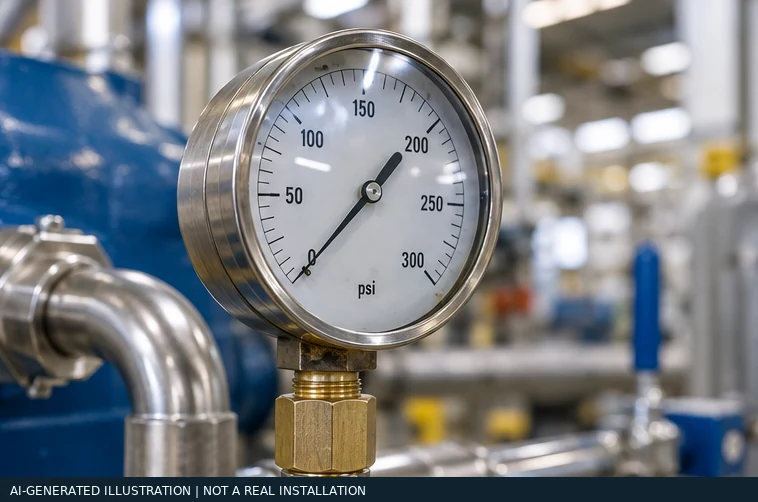
AI-generated illustrative scene, not an actual site, customer project, product interface or measured result. Equipment details and readings are illustrative only.
Turn images into contextual information
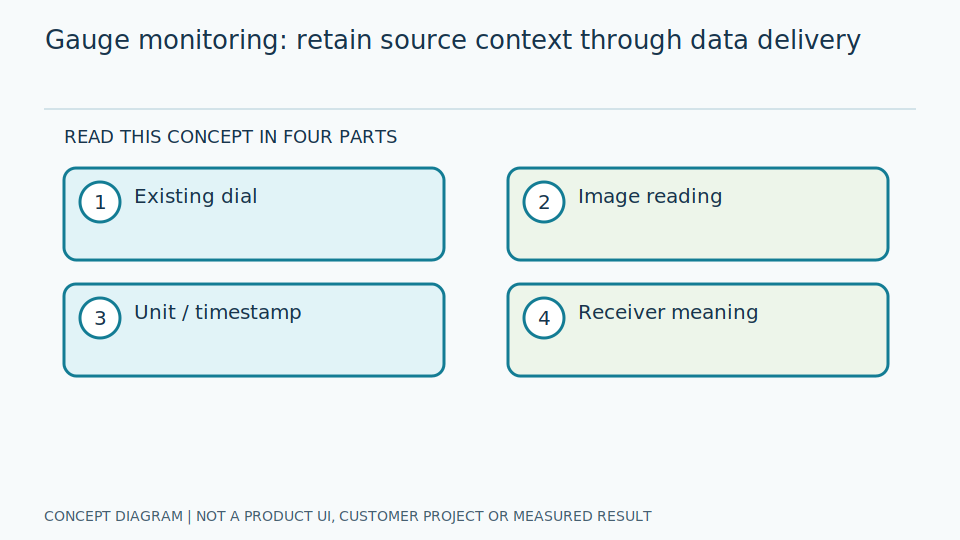
Image observation can bring existing gauges into digital analysis without replacing every instrument. A gauge photograph is not immediately trustworthy process data: units, scales, location, time and reading quality must be established together. Industry 4.0 involves the information lifecycle and its operational use, not merely installing cameras or AI.
Minimum reading-point information
- Identity: asset_id and reading_point_id remain stable through camera changes, with area and ownership.
- Meaning: verify values, units, ranges, instrument types and decimals during configuration.
- Time: distinguish capture, processing and receipt times with time zones and clock synchronization.
- Quality: represent valid, invalid and stale with reasons and configuration/model versions.
Begin with read-only integration
A pilot should send data to separate storage or dashboards without writing PLC commands. Define tags, units and quality before SCADA or historian integration. Shared protocols do not guarantee shared meanings. Test types, ordering, missing values and repeated delivery jointly with the receiver.
Distinguish reading error from availability
Report error among successful readings alongside unreadable rates. Excluding difficult images can create impressive scores but poor practical coverage. Evaluate by gauge, light, shift and range, stating sample counts, reference methods and agreed tolerances. Measure latency, missing data and review effort separately.
A reproducible trial plan
- Select valuable low-risk points and measure the existing method as a baseline.
- Create an instrument register and varied images, splitting development and test by day and equipment.
- Have knowledgeable reviewers verify reference values and their uncertainty.
- Agree on error, invalid rate, latency and human-confirmation criteria before testing.
- Run in shadow mode and test lost cameras, changed light and network outages.
- Handover settings, versions, ownership and retesting plans after camera or scale changes.
Limits that must remain visible
Image reading does not correct worn or uncalibrated instruments. AI must not be the sole source for emergency shutdown or safety responsibilities; keep monitoring separate from appropriately engineered SIS and interlocks. Personal or sensitive imagery needs suitable access and handling arrangements.
Keep instrument identity separate from camera identity
One camera may see several gauges, and an instrument may later use another camera. A reading-point identifier should describe the quantity being monitored, not just the camera IP. Record instrument type, unit, range and responsible verifier so equipment replacement does not break history or associate data with the wrong point.
For changing display modes, determine the meaning of the visible digits. Cumulative totals and instantaneous readings cannot occupy one undifferentiated field. Configuration matters as much as models: incorrect units or modes can create continuous numbers that are analytically meaningless.
Make missing data diagnosable
Missing values can originate in unreadable images, camera loss, network interruption or a slow receiver. Separate their states and times because remedies differ. Do not insert zero to complete a graph; zero may be a real process value and lead users to incorrect conclusions.
Recovered observations can be useful historian data, but preserve capture time and prevent duplicates. Current dashboards need agreed freshness rules. An old message arriving late should not silently reverse the displayed current state.
Expand while preserving evidence
Use consistent survey and acceptance methods when adding points, but do not assume one configuration fits every dial. Resolution, angle and light can differ. Establish references and tests for each condition, including unusable points, to describe actual coverage.
Compare benefits with existing work without double-counting. Reduced transcription does not remove sound or leak inspection. Visible trends do not establish predictive maintenance. Agree on the decision role of information, review ownership and maintenance burden. Industry 4.0 organizes useful data lifecycles; it is not a guarantee of financial returns or product certification.
Further reading
Gauge-reading process and trial criteria · Industrial protocols · OPC Foundation: OPC UA
Scroll the diagram horizontally to inspect all details.