YOLOv9 for Gauge Detection: Principles and Evaluation
Technical content and terminology still require expert review. Illustrations and references are not evidence of product deployment or certification.
Understand object detection, why locating a gauge does not read its value, and how to evaluate a model on representative site data. This is not a GaugeSnap product benchmark.

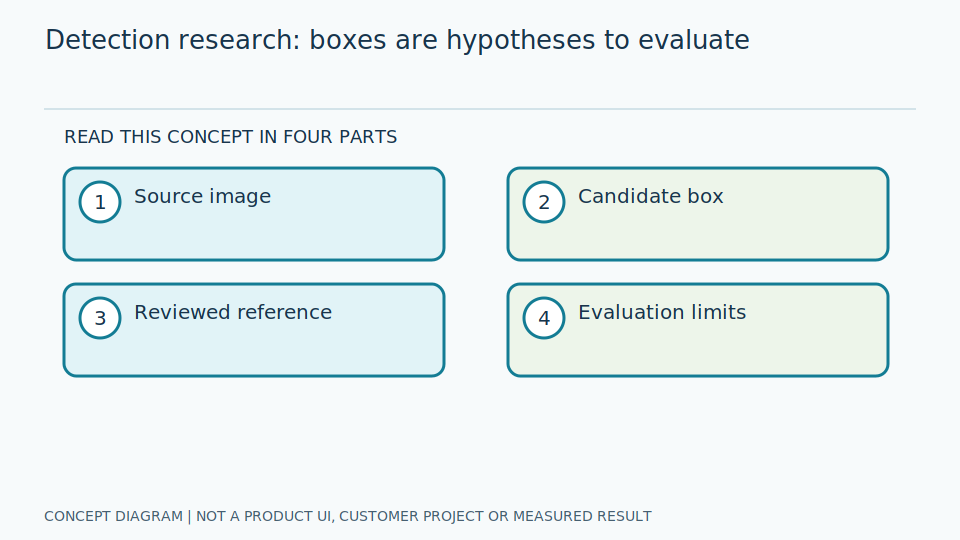
Illustrative image for context, not verification of a customer installation, product capability or measured result.
What YOLOv9 is and is not
YOLOv9 is object-detection research introducing Programmable Gradient Information and GELAN for learning and network architecture. Standard-dataset results support research comparison, not direct claims about gauge-reading accuracy or speed at a factory. This article explains principles and does not confirm that GaugeSnap deploys this version.
Detection still needs a reading pipeline
A bounding box locates a probable instrument; it does not provide pressure or temperature. Analog reading needs center, needle direction and scale mapping. Digital reading needs digits, signs, decimals and units. Evaluate detection separately from the final numerical interpretation.
Prepare representative site data
- Include daylight, night, reflections and unreadable observations, not only attractive images.
- Define consistent boxes and classes and review annotator disagreements.
- Split test data by camera, instrument and time to avoid adjacent-frame leakage.
- Include unfamiliar dials and needle appearances to examine rejection behavior.
Metrics to report
Precision describes correct detections among returned detections; recall describes coverage of actual objects. State IoU and datasets for mAP. These are not gauge-value error measures. Add absolute or full-scale numerical error against reference answers, invalid rate and capture-to-receiver latency on target hardware.
Confidence is not guaranteed correctness
Scores can rank results and set thresholds, but are not automatically calibrated correctness probabilities. Select thresholds on validation data, then fix them before held-out testing. Undisclosed tuning after seeing test results makes evaluation optimistic.
Deploy with a response to failure
- Version models, input size and preprocessing.
- Check model, code and dataset licenses before commercial use.
- Revalidate quantization and runtime conversions.
- Send invalid with a reason when evidence is insufficient, not zero or an old value.
- Retain necessary review evidence and separate monitoring from safety circuits.
Inspect stages to identify the real cause
If detection fails, inspect image detail and unfamiliar classes. If detection succeeds but reading fails, examine centers, needles, perspective and scale configuration. Attributing every failure to YOLO can target the wrong component because the detector does not perform the complete reading task.
With multiple gauges, associate detections with the correct equipment identity. An accurate box does not prove delivery to the intended point, especially with nearby instruments or camera movement. Verify final readings and identity rather than only attractive bounding-box overlays.
Prevent similarity from inflating evaluation
Adjacent video frames are often highly similar. Distributing them across training and test can examine memorization instead of new-condition generalization. Split by equipment, cameras or time to match the deployment question and disclose remaining coverage gaps.
Annotators need shared box and class definitions and review of ambiguous partial or obstructed instruments. Inconsistent reference answers make scores difficult to interpret. More images do not automatically repair this; clarify the task and labeling quality together.
Compare alternatives through actual operational outcomes
Newer models are not suitable for every device or constraint. Compare with existing methods or baseline models on the same examples, including whole-pipeline time, resources and unreadable rates. Higher resolution requires examination of both useful detail and computational cost, not research benchmark scores alone.
Fix validated versions and thresholds before release, with rollback when quality deteriorates. Runtime conversion or compression requires revalidation; shared original weights do not guarantee identical answers. This is experimental guidance, not confirmation of GaugeSnap using YOLOv9 or achieving published research performance.
References and further reading
YOLOv9: Learning What You Want to Learn Using Programmable Gradient Information · Research repository · Object Detection principles
Scroll the diagram horizontally to inspect all details.