
Principles, Scenarios and Suitability
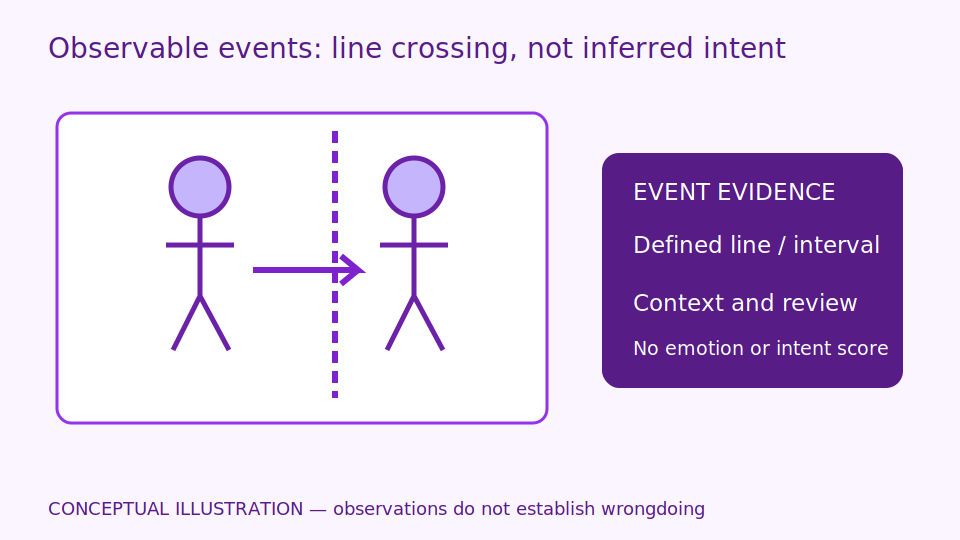
Treat this topic as screening observable events such as line crossings or objects left in place, not reading intent, dangerousness or mental state from posture. Do not infer emotion, sensitive traits or wrongdoing from a person appearing in an image.
Observable events need position or time descriptions, such as an object within a defined zone, not a suspicious-looking person. The same posture may be normal work or authorised activity. Results are questions for staff to review in context, not diagnoses of intent, violence or mental state. Neutral naming reduces consequences for affected people when images are incomplete.
Area rules require boundaries, start times and verifiable exceptions. Short dwell periods identify potential obstructions sooner but flag more temporary placements. Longer periods reduce workload but delay information. Area owners should choose based on actual use and retain primary measures, not use AI to predict wrongdoing. Limit images and histories to events; having cross-camera tools does not justify personal profiling.
Scroll the diagram horizontally to inspect all details.
Illustrative Design Scenario
Illustrative design scenario: flag an object in an exit zone for staff review. It may be authorised work equipment, so context must be checked and dismissal allowed. Do not automatically label the event a crime or the person a suspect.
Suppose a trolley remains in a zone, but staff find authorised work still maintaining the required passage. Dismiss with a verifiable reason, not a named offender record. For a real obstruction, follow site procedures rather than waiting for higher scores or accusing the person placing it of dangerous intent.
Options include aligning boundaries with the layout or managing placement procedures. The first reduces false events but does not correct real activity; the second requires discussion with users. Use authorised images and simulations that do not block emergency routes. Review confirmation and dismissal, with an appeal route. Never create real threatening incidents for testing.
Inputs and Prerequisites
Define observable events, area rules, periods and authorised exceptions. Provide notices, retention and access policies without unnecessary profiling or association of events with personal identities.
Retain layouts, rule revisions and authorised-activity information. Do not use unsupported intent labels. Test data should include normal activities resembling targets so reviewers clearly understand the limitations.
Results should show spatial events, times and limited images pending human confirmation. Exclude dangerous-person labels or emotion scores. Dismissal must correct what users see rather than preserve an automatic allegation.
Trial and Integration Workflow
- 1Replace intent-based descriptions with verifiable position or time events.
- 2Test rules against normal activities and explicitly authorised exceptions.
- 3Refer events to responsible staff and record confirmation or dismissal reasons.
Evaluation and Acceptance Criteria
Measure false alerts per actual operating period and recall only for defined events. Check reviewer workload and similar normal activities. Example video results must not be presented as an ability to predict crime or violence.
Count events, not frames, distinguishing occluded periods from cases outside the rule. Check that approved exceptions reduce false events without removing genuine events the defined scope should reveal. Report only tested areas and periods.
Reviewers should explain confirmation or dismissal from observable evidence. Trial appeals and image-access restrictions. Acceptance must consider personal effects and workload, not conclusions from selected video scores.
Scroll the diagram horizontally to inspect all details.
Failure Cases and Limitations
Similar postures can have very different meanings. Occlusion and camera angles alter results. The system neither diagnoses health nor proves intent. Detected events are not evidence of guilt, and people must review them before actions affecting individuals.
No event does not establish complete area safety. Finding an object identifies neither its owner nor its cause. Maintain appropriate area supervision and emergency plans rather than transferring responsibility to model scores.
Future rules must retain observable scope and personal rights, without emotion, health or wrongdoing inference. Risk-management standards guide study; they do not certify screening or establish legal conclusions.
Practical Checklist
- Are rules described through circumstances that can actually be observed?
- Are emotion and sensitive-trait inferences explicitly excluded?
- Can reviewers dismiss false positives and affected people challenge results?